By Olivia Cleaveland
The following piece is part of Progressive City’s “Keeping the ‘Public’ in Public Space” series, which asks authors to address the way public spaces are governed, restricted and/or policed, in addition to the role of planning in both enabling and contesting the enclosure of public space. Of special concern are policies, designs and practices that limit the use of public spaces, formally or informally, based on the race, gender, sexuality, disability and national origin of people. More information about this series can be found here.
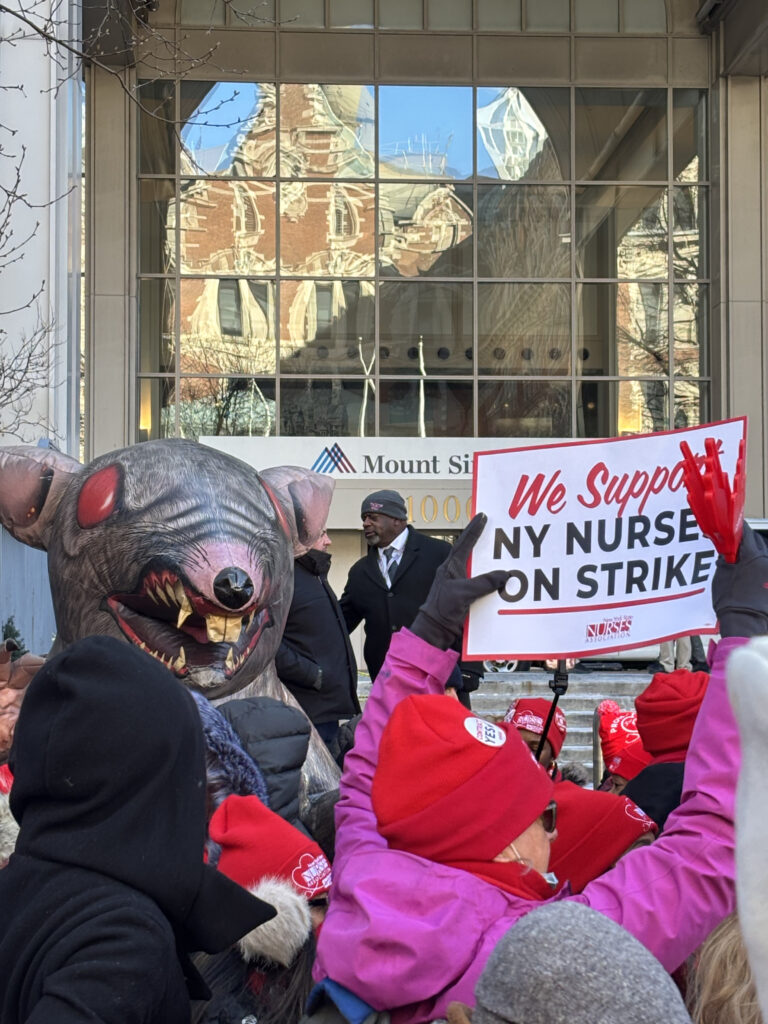
For 41 days during the January 2026 nurses strike, the sidewalks outside New York City’s (NYC) hospitals were not simply places to pass through. They became places where the future of care, and the meaning of public space in the city, was being negotiated. During the strike, nurses built a different kind of care infrastructure outside: folding tables with hot coffee, hand warmers passed between colleagues, mutual aid to support one another through freezing temperatures, music to sing and dance to, and lines of chanting people holding picket signs.
The nurses’ strike reveals something planners and policymakers often overlook: the infrastructure that sustains cities is not only physical but human. And when workers are pushed out of the institutions they sustain, they carry their struggle into public space.
As nurses gathered and remained there for weeks, sidewalks became the site where the infrastructure of care and protest was built, making the strike possible. Mass movements help reinforce public space as a site of collective action and public space is the very thing that makes those movements possible. Planning practice must recognize sidewalks not simply as passageways, but as sites where worker-led protest becomes visible and possible in real time. Sidewalks support mass movements by encircling major institutions, producing visibility, and allowing collective action to exert direct pressure on those in power.
In the fall of 2025, the New York State Nurses Association began negotiating a new contract with multiple hospitals that included safer staffing ratios and stronger protections against workplace violence. Chronic understaffing forces nurses to care for too many patients at once, putting both workers and patients at risk. The negotiations led to a strike authorization vote on December 22, 2025, followed by one of the largest labor strikes in NYC history.
Hospitals often present themselves as neutral spaces devoted to healing. Their daily functioning depends on the labor of nurses and other unionized hospital workers. Yet, hospitals are among the most dangerous workplaces in the country, exposing workers to significant risk. When conflicts over labor conditions intensify, they become hypervisible in public spaces, such as sidewalks.
History can help contextualize struggles over contested space: places where different groups compete to define how space should be used and who has the right to occupy it. In Benjamin Shepard’s writings on Zuccotti Park during the Occupy Wall Street movement, he describes how conflicts over land use and privately owned public spaces (POPS) revealed deeper struggles over control of the built environment. Shepard’s reflections are directly applicable to the nurses’ occupation of NYC hospital sidewalks.
Both the Occupy Wall Street movement and the nurses’ strike took place directly outside the institutions where decision-making power is concentrated, whether financial firms or hospitals. Through continued presence, often under harsh conditions, protesters were able to draw public attention to otherwise hidden labor conditions and exert ongoing pressure on those in power to make changes. Public space is not just a setting for protest, but a deliberate tool through which movements generate solidarity, attract attention, and influence policy change.
Who stood on those sidewalks matters just as much as why they were there. The workforce propping up New York’s hospitals reflects the demographics of much of the city itself. More than two-thirds of nurses in NYC are women of color, and more than a quarter of nurses in the state are proud immigrants from countries such as Haiti, Jamaica, and the Philippines. Their presence on the picket line made visible a workforce that is often essential but undervalued.
This demographic reality places the strike within a longer history of marginalized workers using public space to demand recognition and dignity. In 1909, thousands of immigrant garment workers, many of them young Jewish and Italian women, launched the Triangle Shirtwaist Factory Strike. Their protests spilled out of Manhattan’s garment factories onto the sidewalks, where they picketed outside the very buildings where they labored. Police frequently arrested strikers for obstructing sidewalks. But by occupying these public spaces, garment workers forced the dangerous work conditions inside factory walls into public view. More than a century later, striking nurses used hospital sidewalks in much the same way.
The nurses’ strike, overflowing into (often privately owned) public space, made health policies and spatial politics visible and tangible. Inside the hospital, non-union administrators and scab nurses continued the routines of care. At times, the replacement staff looked down from hospital windows at nurses gathered on the picket line below. Striking nurses described these moments with anger and betrayal, seeing them as a visual representation of the divide between those protected by the institution and those excluded from its protections. Outside, picket lines formed along the sidewalks under the watch of police and security guards. Union members knew they were safe from arrest while remaining on public sidewalks, yet they also understood that crossing onto private hospital property to block hospital entrances could lead to arrest.
To be sure, most nurses did not want to be outside in the first place. They entered the profession to care for patients at the bedside, not to stand on picket lines in the middle of winter. But many argued that chronic understaffing had already made it impossible to provide safe and dignified care inside the hospital. The strike was not a rejection of care; it was an attempt to defend it. Nurses did not casually abandon patients’ bedside. They were displaced from it by hospital administrators, but not without a fight. After monthslong negotiations, NYC nurses won a new three-year contract that included safer staffing standards, increased pay, and security for both nurses and patients.
For planners, supporting public space is not only about preserving access in the abstract, but about advocating for the everyday elements that allow people to stay: seating, shelter from the elements, access to power and connectivity, and other forms of care that make presence possible. These are the same features that support daily urban life, but in moments of collective action, they also enable people to gather, maintain visibility, and exert pressure. This reveals that struggles over care, labor, and space are inseparable, and that the ability to occupy public space over time depends on the material conditions that allow people to remain. Designing public spaces with these needs in mind means recognizing sidewalks not just as circulation space, but as places where care is practiced and collective action can take hold when it matters most.
__________________________________________________________________
Olivia Cleaveland is an Urban and Community Planning Masters’ student at Pratt Institute, whose work focuses on affordable housing, storytelling, and intergenerational community healing. Her research explores how urban spaces can be reclaimed for women, immigrants, and working-class communities. This article is shaped by both academic interests and personal experience, including witnessing a family member fight for her rights during the NYC nurses strike this year.