By Michael Willis and Lewis Anderson
The following piece is part of Progressive City’s “Keeping the ‘Public’ in Public Space” series, which asks authors to address the way public spaces are governed, restricted and/or policed, in addition to the role of planning in both enabling and contesting the enclosure of public space. Of special concern are policies, designs and practices that limit the use of public spaces, formally or informally, based on the race, gender, sexuality, disability and national origin of people. More information about this series can be found here.
On the morning of Monday, January 26, 2026, New Yorkers woke up to a city buried by its heaviest snowfall in half a decade. Many stayed home, but the ones who couldn’t were forced to clamber over sidewalks covered by a foot of snow. By the evening, the sidewalks looked strangely like a patchwork quilt, with some sections meticulously shoveled and salted, and others still covered in snow that had now been compacted into a slippery mess.
This piecemeal approach to sidewalk snow clearing, which New Yorkers stomach after every snowstorm, is due to a local law that is as old as the sidewalks themselves: under New York City Administrative Code § 7-210, it is the owner of the abutting property who is responsible for clearing snow from the sidewalk, not the municipal government. Importantly, the implications of this law, and similar sidewalk maintenance laws across the country, extend far deeper than poorly cleared snow. As you will soon learn, these laws frequently afford tremendous powers to private entities, allowing for the gatekeeping, dictation, and control of our public spaces.
In all but a few cities across America, sidewalk maintenance is the sole duty of the abutting property owner. In addition to snow shoveling, these responsibilities usually include everything from tree maintenance, to trash clearing, to repairing tripping hazards. Private entities have been responsible for sidewalk maintenance for as long as American cities have existed, largely because there was no formalized concept of a sidewalk in most cities prior to the early 19th century. In fact, before the Commissioner’s Plan of 1811 for New York City, which designated slivers of land for sidewalks within streets, it was common for the city’s property owners to construct their own sidewalks using wood, stone, or brick, in order to create clean passages for pedestrians on the otherwise muddy, unpaved streets. Throughout the following decades, sidewalks would become more formalized, but municipalities would continue to rely on property owners for sidewalk maintenance through the present day. Today, if a typical American municipality attempted to keep every inch of its sidewalks adequately maintained, it would be stretched impossibly thin, making this reliance on private entities a necessity.
A handful of municipalities across America have taken some sidewalk maintenance roles into their own hands, such as Burlington, VT, and Minneapolis, MN, where sidewalk snow is cleared by the municipality using specialized plows; and Charlotte, NC, where the local Department of Transportation repairs structural tripping hazards. However, even in these cities, substantial carve-outs are delegated to property owners, leaving them at least partially responsible for their sidewalks. For instance, Minneapolis will only clear sidewalk snow if a complaint is received about uncleared snow, and if the adjacent property owner pays for the work. And Charlotte will leave property owners liable for reporting tripping hazards to the City, even though the City will do the repair work.
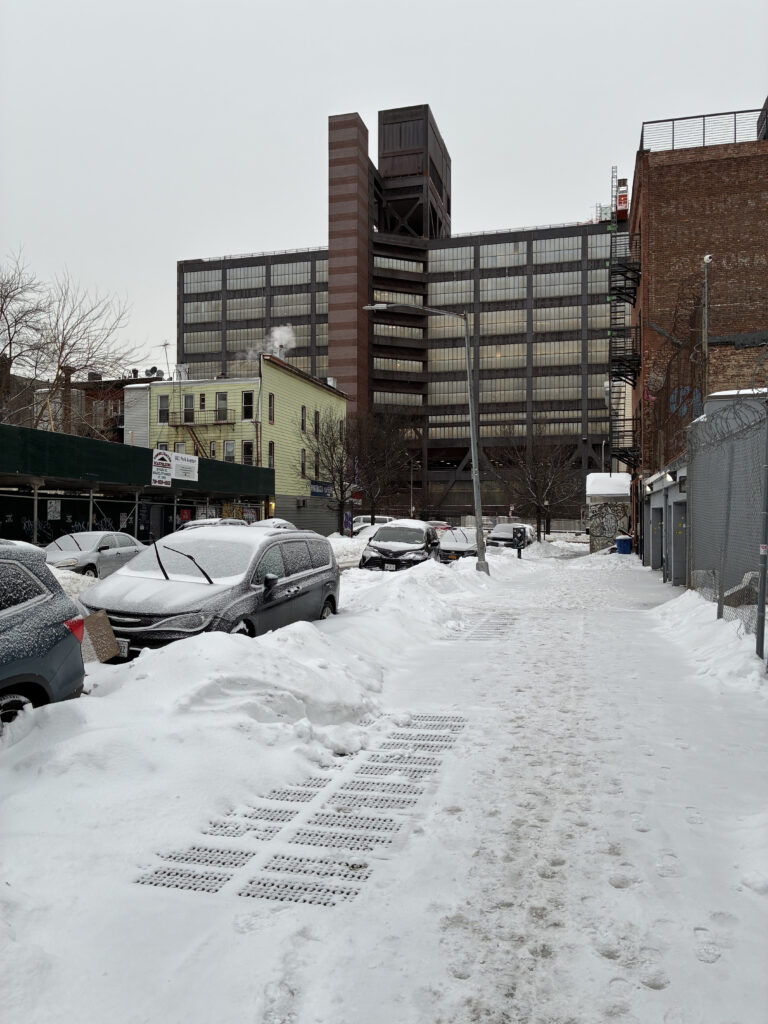
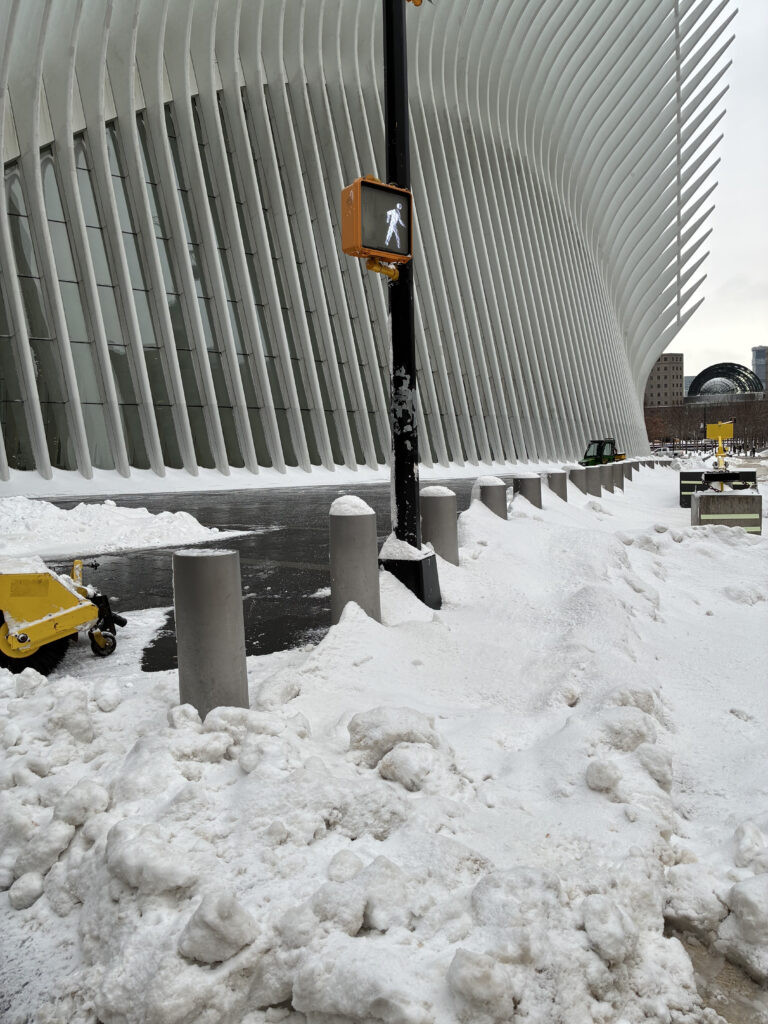
A snow-covered sidewalk in front of an empty lot in Bedford-Stuyvesant, Brooklyn, and an immaculately cleared plaza within an office complex in Manhattan. Both photos were taken on the morning of January 26, 2026, after the blizzard. Photographer: Lewis Anderson.
The responsibility of sidewalk maintenance comes with certain privileges that are usually insignificant and thus overlooked: By endowing a local resident or business with the task of keeping the public space in front of their building clean, safe, and attractive, the municipality also affords them excuses to decide for themselves what constitutes “maintenance.” And often, these private entities will extend said maintenance beyond what is necessary. While this is seldom a concern for a mom-and-pop-owned storefront, or a humble middle-class apartment building, it has become shockingly common for the most powerful property-owning corporations to take excessive control of their abutting public spaces using these excuses.
It may seem like a stretch to liken the management of a neighborhood sidewalk to that of a large urban plaza, yet it is the same laws and principles that dictate how both are managed, surveilled, and policed. Relying on property owners to clear snow—especially in the far-flung suburbs of a large metro area—may seem like a sensible delegation of civic duties across public and private sectors. But those duties quickly become privileges when they allow private players to make sidewalks and public spaces hostile to any aspect of public life they deem detrimental to the value of their properties.
The ramifications of these actions are extensive and deceptive. As private entities gain custodial authority over the streetscape adjacent to their property, they also gain legal precedent to control the uses of that section of the public realm. These legalities are hazy, and vary greatly from city to city, but they all-too-often allow private entities to skirt equal-access policies and prohibit certain actors from using the sidewalk. For instance, while protesting and panhandling are typically protected under government ordinances, private companies are able to evict those activities under the guise of keeping the sidewalk safe or maintaining clear pathways to and from the property.
In one example from 2023, a business improvement district (BID) in Midtown Manhattan hired private security guards who held special entitlements to issue City fines to street and sidewalk vendors. Under New York City Administrative Code § 7-210, the businesses within the BID are responsible for maintaining their abutting sidewalks, and the BID supports this work by providing supplementary sanitation, public safety, and business advocacy services. But in this extreme circumstance, the BID’s private security guards had also been deputized by the New York Police Department as “peace officers” to issue summonses. This was enabled by NYC Administrative Code § 14-106, an obscure local law that allows private entities to enforce laws within their realm of business, subject to the Police Commissioner’s appointment. At face value, these local laws are simply intended to streamline civic duties and municipal functions by delegating them across public and private entities. But instead, they culminate in a system that promotes the privatization of the public realm and enables private entities to welcome a desired subset of users while excluding others.
While these policies and consequences are anything but novel, they have taken new forms in recent years. Anti-homeless architecture, increased surveillance, and private security guards with special entitlements are some of the most flagrant methods used by private entities to regulate who has access to the adjacent streetscape. Businesses and property owners will argue that this is done for the sake of safety and economic benefit. While there is some merit to this argument, it ultimately leads to the perpetuation of a hierarchical class system among those who use public space. Those who can bring economic benefit to the businesses are invited and implored to use the sidewalk. Those who can’t, or those who are stereotyped as dangerous, are excluded and prohibited. The custodial responsibilities that were granted to businesses years ago to maintain their abutting sidewalk are being used today to sweep more than just leaves and snow.
New York City already has a collection of haphazard laws and policies that, to various extents, limit the private sector’s power over public space. For example, the NYC Department of Small Business Services—the department that administers NYC’s 78 BIDs—requires residents and elected officials to be represented on BID boards, alongside property owners. This important rule ensures that BIDs act in the interests of their communities at large, and not just of the property owners who fund them. Another example of a more recent policy change is Intro. 431, a City law that was enacted earlier this year that will incrementally lift the city’s tight restrictions on street vendors, a frequent target for commercial property owners. Unfortunately, however, each of these policies are hyperspecific, ad-hoc, and uncoordinated. Without a deep, systemic effort to de-privatize public space management, ideally at the federal level, there will be no substantial change to the status quo in NYC or any other American city.
Solving this issue is not simple nor straightforward. One may read this history and believe that the obvious remedy is to fully centralize maintenance responsibilities under the jurisdiction of the municipal government. However, this is most likely unrealistic, as the current system is necessary for consistent sidewalk cleanliness and maintenance. It would be impossible for New York City’s government to clear thousands of miles of sidewalks within 24 hours of a snowstorm. Yet, as New Yorkers know, reliance on private entities doesn’t fully work either, as many will decide not to shovel their sidewalk because they either deem it unnecessary or would simply rather pay a fine. The reality is that there is no obvious solution. The current system has merits in ways that serve its purpose, but is widely abused as a tool for private entities to regulate the public realm as they see fit.
The origins of privately maintained sidewalks in New York City are humble. They date back to a time when Fifth Avenue was lined with locally owned businesses that simply took matters into their own hands to clear an orderly pathway for pedestrians in front of their storefronts. But the relationship between private entities and public space has been strengthened to the point where, in many cases, property owners have become the de-facto owners of their abutting sidewalks. This reality has allowed private entities to warp their earnest responsibilities of clearing snow and preventing tripping hazards into full-fledged power, allowing them to maintain their adjacent public spaces at will and gatekeep who gets to access them.
We all want public spaces that are both well-maintained and inviting to all, and relying on private entities is, in some cases, the best option available to American cities in pursuit of that dream. But until we establish stronger protections for the democratic use of public space, relying on private maintenance will remain a slippery slope—not just after a snowstorm, but toward the complete privatization of the public realm.
Lewis Anderson is a Brooklyn-based public space and safe streets advocate with an MS in Urban Placemaking and Management from Pratt Institute and a background as a city planner in New Zealand. In his spare time, Lewis enjoys biking over the East River bridges and swimming at Jacob Riis Beach.
Michael Willis is a civil engineer based in Brooklyn with an MS in Urban and Community Planning from Pratt Institute. He is a staunch advocate of pedestrian safety and believes the streets and sidewalks should be prioritized for people rather than cars. He lives in Sunset Park with his cat, Franklin.