Diana Benitez, Senior Planner, Canal Alliance
Nicole Aguilera, Assistant Planner, Canal Alliance
Daisy Alvarez, Planning Fellow, Canal Alliance
The following piece is part of Progressive City’s “Keeping the ‘Public’ in Public Space” series, which asks authors to address the way public spaces are governed, restricted and/or policed, in addition to the role of planning in both enabling and contesting the enclosure of public space. Of special concern are policies, designs and practices that limit the use of public spaces, formally or informally, based on the race, gender, sexuality, disability and national origin of people. More information about this series can be found here.
Public space is often described as neutral and universal, but in practice, it is shaped by power, capacity, and safety: whose voices determine what happens there, who feels safe gathering, and who has the time to utilize it. For communities with limited “third places”—places beyond home and work where civic life can unfold—public space carries even greater weight. It should be a place where one can relax, form relationships, circulate information, and belong.
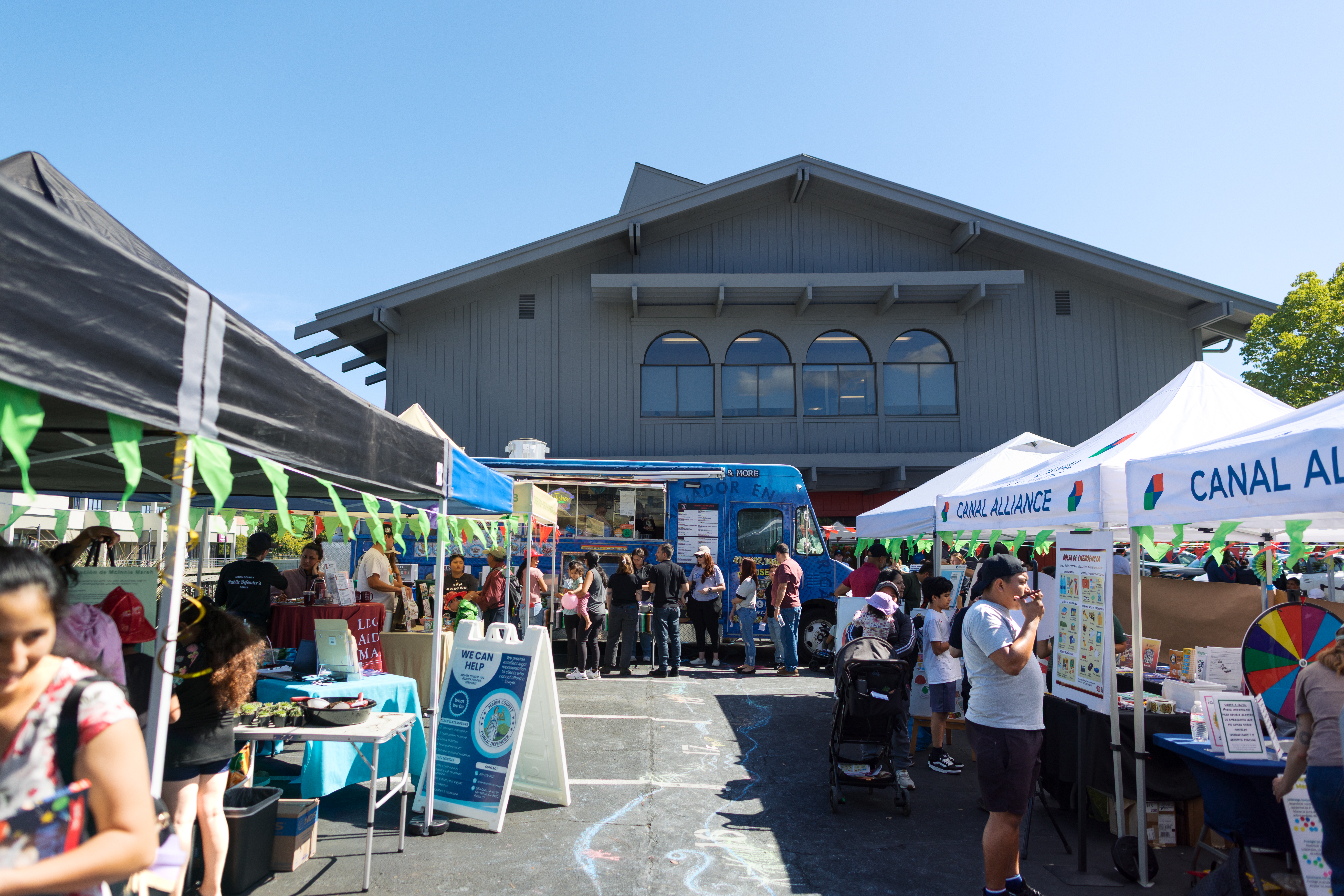
In the Canal neighborhood of San Rafael, California, a different understanding of public space is taking shape—one that recognizes trust as infrastructure and resident judgment as expertise. Canal Alliance’s parking lot regularly becomes a gathering space for the community, a place where children paint murals, families wait for flu shots, and neighbors gather to share food, information, and concerns. Through a series of three community fairs organized by Nuestro Canal, Nuestro Futuro (NCNF) (Our Canal, Our Future), a resident-led planning initiative, thousands of residents—mostly immigrant families and renters—came together. Held between October 2024 and October 2025, these fairs were not designed as traditional planning engagements so often are. Instead of evening meetings with sign-in sheets and presentations, resident leaders built joyful, family-centered events where residents discussed priorities for housing, climate resilience, transportation, and public safety while also celebrating culture and community.
But, at the start of 2026, with the success of these fairs still front of mind, the Consejo, NCNF’s resident governance body, made a different decision for engagement strategies in the year ahead. They decided not to hold the next outdoor fair as planned and, instead, chose to have smaller indoor workshops and other virtual engagement activities. As a result, NCNF team is exploring possibility of hosting an indoor community fair at the local community center or inside the Canal Alliance headquarters, ensuring the option to lock the doors to keep resident safety in mind while still bringing food and fun to the event. This choice to suspend successful outdoor programming did not stem from lack of enthusiasm, funding, or logistical capacity. It was born out of their lived experience of fear.
Fear as a Force that Shapes Public Space
At the time the Consejo made this call, the Canal community—home to approximately 13,000 immigrant and Latino residents—was reeling from heightened national immigration enforcement news coming from Minneapolis and San Francisco Airport and persistent rumors of ICE raids in the Bay Area. Even with support from the local Rapid Response Network, fear was palpable in the community, resurfacing memories of enforcement actions in the 2000s that separated families and caused lasting trauma. Attendance at the most recent fair had already signaled this shift with suppressed participation. For many residents, the visibility of gathering outdoors felt too dangerous.
The Consejo understood this. Fear can be exclusionary in public spaces. It can determine who feels safe being seen, heard, and counted. And in communities disproportionately targeted by immigration control, participating in third places is not a neutral act. Rather, it can be a choice that requires residents to set aside fear, to ignore the realities of recent news, and even pretend the possibility of ICE agents tearing their families apart isn’t real. The Consejo’s decision was a demonstration of understanding and community preservation, a move to protect, honor, and validate the realities of the moment and the experience of residents.
A Neighborhood Defined by Density, Resilience, and Memory
The stakes of this decision were shaped by the broader context of the Canal. The most densely populated neighborhood in Marin County, the Canal is home to the area’s largest Latino population, and adjacent to its largest industrial zone. While Marin is often associated with affluence and open space, Canal residents are predominantly low-income families living in crowded multifamily housing subject to significant flood risk due to sea level rise. Physical public space is limited with just one neighborhood park.
Yet the Canal is rich in community assets. Over the last year, as part of the NCNF initiative, residents have mapped hundreds of places—from small businesses to informal gathering sites—that reflect deep community creativity, mutual aid, and resilience. One of these community assets is Canal Alliance’s headquarters, a space intentionally designed as civic infrastructure. Classrooms, meeting rooms, and the parking area overlooking the Canal waterway function as a community hub for fairs, markets, mural projects, graduations, and community organizing. Since 1982, the organization has served as an anchor institution in the neighborhood, offering Marin’s immigrant and Latino community stabilizing direct services and programs, as well as community advocacy, leadership, and power-building. This approach has contributed to community wins like eviction protections and high COVID-19 vaccination rates.
Canal Alliance has been creating third places in the Canal for decades. The sidewalk and parking lot at Canal Alliance’s neighborhood location have long functioned as informal civic spaces, used for the food pantry which serves hundreds of families each week. Adjacent streets have been leveraged for community fairs, and outdoor patios converted into COVID-19 testing and vaccination sites during the pandemic. For years, these efforts required careful coordination around sidewalk access and street closures in a dense neighborhood. When Canal Alliance was able to purchase a larger headquarters nearby, with a large, private parking area, it marked a shift for the community. It allowed community gathering to happen more consistently and visibly, strengthening the role of the site as everyday civic infrastructure.
Ironically, that same consistency and visibility that strengthened community engagement is also what could harm it. Even in trusted community spaces, residents recognize that their vulnerability is heightened by congregating in highly-populated and publicized outdoor events. While large-scale immigration raids have yet to arrive to Marin County, the Consejo understood that fear of enforcement would shape behavior more strongly than assurances any institution could offer. In other words, the psychological landscape of public space is not just shaped by physical design and property ownership, but also by inherent risk for certain populations.
Community-Led Governance as Planning Practice
NCNF was developed to challenge the limits of traditional engagement structures. Many planning processes rely on outside consultants, pre-set timelines, and engagement strategies that assume residents can participate on command. NCNF instead makes residents the decision-makers, leaders who co-design engagement, project priorities, and determine how participation should occur. The Consejo, which is composed of 20 Canal residents—renters and Spanish speakers—appropriately reflects the neighborhood’s diversity. In honoring the Consejo’s call to pause the fair and shift to smaller indoor workshops and other virtual engagement methods, Canal Alliance adjusted timelines and venue options, continuing to gather input while reducing exposure for immigrant families. This is community governance in practice.
Reclaiming Public Space Through Trust and Listening
Public space must be shaped by those most vulnerable to its risks. When working with communities with a long history of being criminalized or surveilled, trust must be understood as infrastructure, built over time and sustained through accountability and negotiation across the scales of power. At Canal Alliance, we know firsthand that trust is what makes collective gathering possible. It is what determines who participates, who speaks openly, and who feels safe showing up.
We will continue to listen and adapt so families can remain connected and their lived experience can inform the neighborhood’s future, without requiring their exposure. Where traditional planning would see the fair’s postponement as a setback, we honor the Consejo’s choice and understand it to be rooted in care. Because protecting joy is planning work. Designing safety is civic work. Sustaining indoor, outdoor, and in-between third spaces where immigrant families can gather with dignity is how a truly inclusive city is built. In the Canal, resident leadership is strengthening public life through trust-building and shared governance.
Our parking lot will be here when the Canal community is ready.
Diana Benitez is a Senior Planner at Canal Alliance with over a decade of experience advancing community-based, equitable planning. She stewards Nuestro Canal, Nuestro Futuro, a resident-led vision plan in San Rafael’s Canal neighborhood serving a predominantly Latino immigrant community facing displacement and climate risks. Her work centers lived experience as planning expertise, translating resident priorities into policy, governance, and investment decisions. She holds a MURP from UCLA and a bachelor’s in Urban Studies and Planning from CSUN. Diana serves as Vice Chair of the MTC-ABAG Community Advisory Council and received the APA CA Northern Emerging Planner Award.
Nicole Aguilera is an incoming Master of Urban and Regional Planning student at UCLA Luskin School of Public Affairs and a 2024 UC Berkeley graduate. She currently facilitates the Consejo (resident governance body) of Nuestro Canal, Nuestro Futuro, a resident-led vision planning initiative in San Rafael’s Canal neighborhood working toward a more just and sustainable future for a predominantly Latino immigrant community. As a first generation daughter of Colombian immigrants, Nicole approaches planning with a focus on community-driven and equitable decision-making.
Daisy Alvarez is a Planning Fellow at Canal Alliance, where she supports Nuestro Canal, Nuestro Futuro (NCNF), a resident-led neighborhood planning initiative in San Rafael’s Canal neighborhood. Her work focuses on integrating the lived experiences of a predominantly low-income, immigrant Latino community into the planning process through inclusive community outreach and data analysis. Originally from a low-income community in Lancaster, California, Daisy is committed to advancing more equitable environments, particularly for communities historically underrepresented in decision-making. She holds a B.A. in Environmental Analysis and History from Scripps College.