By Kazembe Balagun
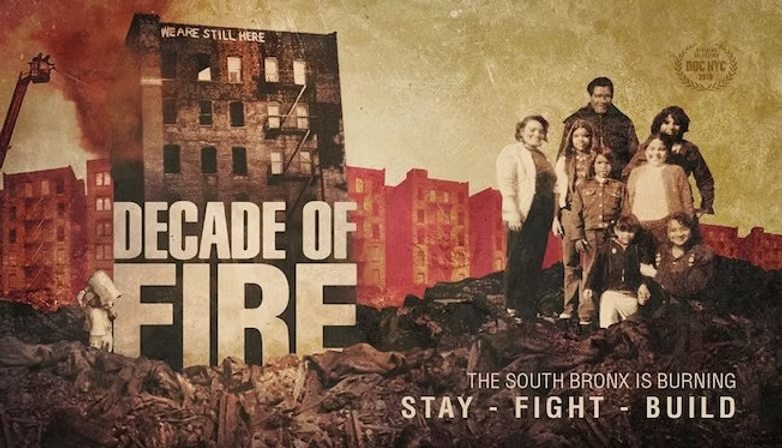
Film directors Vivian Vázquez Irizarry and Gretchen Hildebran have the good sense to know that movements move forward by looking backwards. That’s perhaps why their documentary Decade of Fire, which examines the Bronx arson crisis of the 1970s, feels more like an intervention in contemporary housing struggles than a simple walk down memory lane.
The Bronx today is a study in contrasts: It’s one of the poorest congressional districts in the US that promises to be the next big real estate “thing,” and a deeply traditional enclave which has produced two of the freshest voices in American culture, Cardi B and Alexandra Ocasio-Cortez. These competing strains, which encompass a broad multicultural community and a proud working class ethos, have popularized the Bronx across the globe.
But that wasn’t always the case. During the 1977 World Series, the nation watched in horror as blocks of buildings burned around Yankee Stadium, leading sports commentator Howard Cosell to yell, “Ladies and gentlemen, the Bronx is burning.” The Bronx became the poster child of inner city failure, synonymous with high crime, poverty, and abandonment.
As the only borough connected to the mainland, the story of The Bronx mirrors that of America. Throughout its history, it was home to Jewish, Italian, and Irish working class people, many of whom anchored affordable housing experiments like the Allerton Coops. Later, thousands of Puerto Ricans and Black southerners followed in their footsteps, making the Bronx a multicultural haven.
That all began to change in the 1960s. Urban planner Robert Moses instituted a program of urban renewal, which many grassroots activists called “urban removal.” These projects included the building of the Cross Bronx Expressway, which displaced thousands of residents in the South Bronx. Ironically, Moses built the road that led to the flight of South Bronx’s middle class Jewish community. With the rise of the civil rights and Black power movement along with POC-majority cities, the federal government began an overt policy of what Daniel Patrick Moynihan called “benign neglect.” This was a strategic divestment from urban communities, which resulted in cuts to health care funding, tuition at the City University, and the closure of firehouses across the city. The last point is key: Since banks refused loans for reinvestment in communities of color, landlords had an incentive to abandon their redlined property and commit arson to get a profit from insurance companies. The result was communities razed by fire.
Along with the cuts in vital services and abandonment by local authorities, the subsequent destruction of housing in the South Bronx created a vicious cycle, where communities were seen as pathological and not worthy of the help they needed to survive. This extended itself onto the big screen, where films like Fort Apache, The Bronx, The Bonfire of the Vanities, and even cinéma vérité classics like The Police Tapes painted the South Bronx as a no-go zone.
The beauty of Decade of Fire is that it allows the survivors of the fires to tell their own stories. This is important because there is no official narrative by the city on exactly what happened. Decade of Fire is a reconciliation: At a community screening with a Bronx housing group, some in the audience were in tears. It was first time that were able to look beyond the haze and see the truth.
Organizer and cultural historian Kazembe Balagun recently contributed an essay on “We Be Reading Marx Where We From: Socialism and the Black Freedom Struggle” to the book Imagine: Living in a Socialist USA (2014). He is now the Project Manager North America / United Nations for Rosa Luxemburg Stiftung New York City.
This piece was first published at metrograph.com and is reprinted with permission.