The following piece is part of Progressive City’s series The Future of Planning: Insights From Emerging Planners, in which current or recently graduated Planning students reflect on the state of the planning profession and how our activities as planners can be oriented towards justice as opposed to perpetuating ongoing racial, colonial, economic, environmental, and ability-related injustices. More information on this series can be found here.
By Jonathan Marty
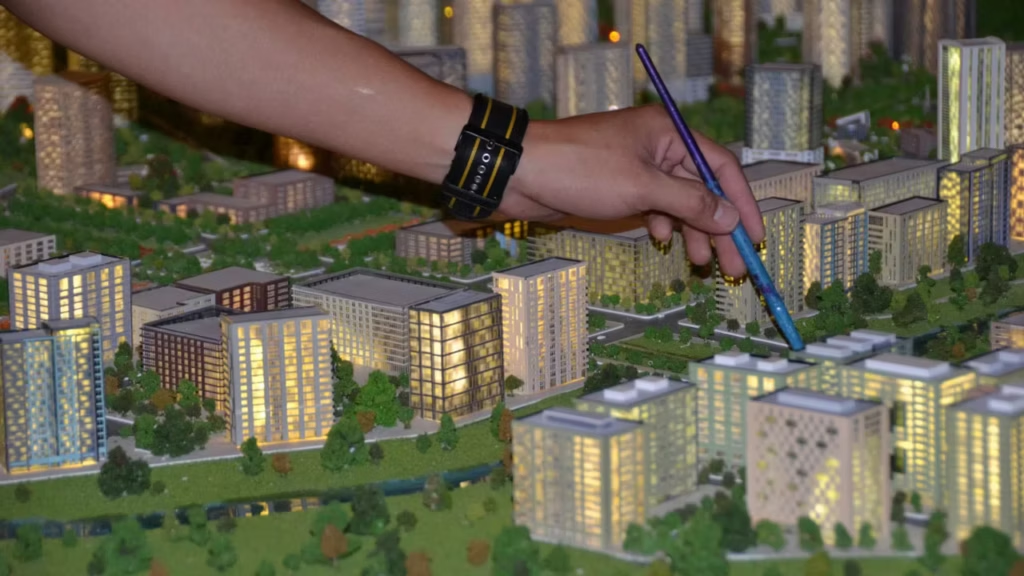
In December of 2020, after the strangest academic semester of my life, I experienced my first finals week in urban planning school. This bi-annual tradition sees planning students handing in bold research projects seeking to solve pressing urban problems, often through visually dazzling policy memos and pamphlets. If your program, like mine, is nestled within a design school, its Instagram will be blanketed with glossy renderings of student projects in architecture and urban form — many of which will veer into fantastical, idealist abstractions.
Since planning programs in urban universities tend to extoll the “city as classroom” outlook, the subject of students’ work will often be their respective neighborhoods and communities. Because my program is in upper Manhattan, many students focused on topics like the historically fraught relationship between Morningside Heights and Harlem, or environmental racism in the nearby South Bronx. What struck me most about this process was just how much of Uptown was under our microscopes, with new infrastructure, public spaces, and transportation schemes being proposed left and right. The massive scope of these projects, if actually implemented verbatim, stood to affect hundreds of thousands of people, dramatically altering some of the most intimate spheres of their lives from their neighborhoods, to their streets, to their doorsteps. Unfortunately due to COVID-19 precaution, many students had, through no fault of their own, not even been able to physically visit the neighborhoods they were reimagining. This all led me to wonder, what do these projects actually have to do with the people of Uptown?
To be clear, there is nothing inherently wrong with these exercises. One of the joys of our field is helping people craft and imagine better futures, and these thought experiments are excellent means of formulating and articulating such visions. Yet, as we are implored by our professors to find answers to urgent urban questions, we must constantly situate ourselves in the realities and struggles of the people and places we seek to help improve. This entails an acknowledgement that we are far from the first people to consider these issues, and a commitment to solving existing problems rather than inventing our own for the purpose of academic exercises. Most importantly, because we usually cannot fully comprehend the personal stakes of issues for city residents, we should look to tenant union meetings, labor strikes, and mutual aid campaigns (to name a few), as critical extensions of our research and participate in civic life more broadly. This ultimately entails a detachment from what I call “urbanist auteurism” — the vain and often subconscious desire to reshape the built environment in one’s own image.
It must be noted that, in this regard, urban planning has improved significantly over the years. Two summers ago, I spoke to a family friend about her experience at M.I.T.’s urban planning program in the 1960s. Embarrassed, she said that she was educated “before the enlightenment” of urban planning, and told me how the program tasked students with paternalistically “fixing” the “black ghetto” of Roxbury in Boston. If we compare this to contemporary pedagogy, where courses about racial equity, community engagement, and environmental sustainability can be found across the country’s planning programs, such progress is refreshingly evident. Despite these improvements, though, such paternalism lives on in planning education in a subtler, more insidious fashion. In 2017, Monxo López, a community organizer at South Bronx Unite, described the parasitic dynamic that planning programs have historically established with his community:
“There are 40 years of design plans, renderings, and sketches of urban design ideas for our neighborhood from elite schools — and very little has ever come of them. Our neighborhood is used by some educational institutions as what I call a ‘credit farm,’ when they need to look as if they’re doing socially responsible work. Over the decades, people in the neighborhood have gotten jaded from helping these institutions and not getting anything real back. Typically, students would come, talk with a few people for a couple of hours, and then disappear for the duration of their design process. They’d come back in a few months and present everything they’ve ‘done for the community…’ Other proposals have this science fiction quality because they’re all about letting the student’s creativity flourish.”¹
Here, López provides a crisp and scathing critique of the city and its vulnerable communities as “laboratories.” The problem with this approach is that no matter the purity of one’s intentions, the results will almost always be self-serving rather than mutually beneficial. While scientists who work in actual, enclosed laboratories must maintain a detached, analytical relationship with their test subjects, planners do not operate in such a vacuum. Because our “test subject” is the world and people around us, an approach of active and productive solidarity is therefore necessary. In short, we must, to the best of our abilities, work to understand and feel the conditions on the ground, rather than retreating further into our academic bubble.
The increased importance placed on informatics, data visualization, and GIS mapping in modern planning programs poses great risks in this regard. To be clear, I in no way wish to advocate for Luddism. These technologies are immensely powerful and can be used as potent tools for highlighting injustices and formulating possible remedies. Yet, as we sit in the Ivory Tower and use dot-density maps to visualize data as sensitive and complex as poverty and infant mortality rates, we run the risk of flattening the city, its problems, and most importantly its people, into abstractions. The great CUNY Geography Professor Neil Smith addressed this phenomenon in 1984, saying “I always advise students that you should only use statistical manipulations when they’re absolutely at a loss to know what’s going on in the world that you’re trying to investigate.”² Without deep engagement outside of the classroom, most of what “the city” is will be invisible to the planning student.
For planning education to progress, students (and our professors) must not view the city as some sort of docile laboratory to test our theories and ideas. Instead, we must treat the city like an ongoing political project and ourselves as one of countless actors within it. This vision of the city imagines urbanism as a constellation of individual struggles — those of tenants, workers, immigrants, the elderly, youth, families, those most vulnerable to public health crises, and those experiencing poverty and/or homelessness — that predate our planning interventions and will outlive them as well. In order to plan with integrity, we must involve ourselves in these struggles to the greatest possible extent, so as to feel a greater stake in their outcomes than in our own personal solutions.
Jonathan Marty is a graduate student in urban planning at Columbia University.
¹Bagchee, Nandini. “Design and Advocacy in the South Bronx.” Urban Omnibus. November 02, 2017. https://urbanomnibus.net/2017/05/hearts-studio/.
²Neil Reads USA Today: The Flip Side of the Weather Is the News. Performed by Neil Smith. Vimeo. 1984. https://vimeo.com/50446009.