By Lila Asher
The following piece is part of Progressive City’s series The Future of Planning: Insights From Emerging Planners, in which current or recently graduated Planning students reflect on the state of the planning profession and how our activities as planners can be oriented towards justice as opposed to perpetuating ongoing racial, colonial, economic, environmental, and ability-related injustices. More information on this series can be found here.
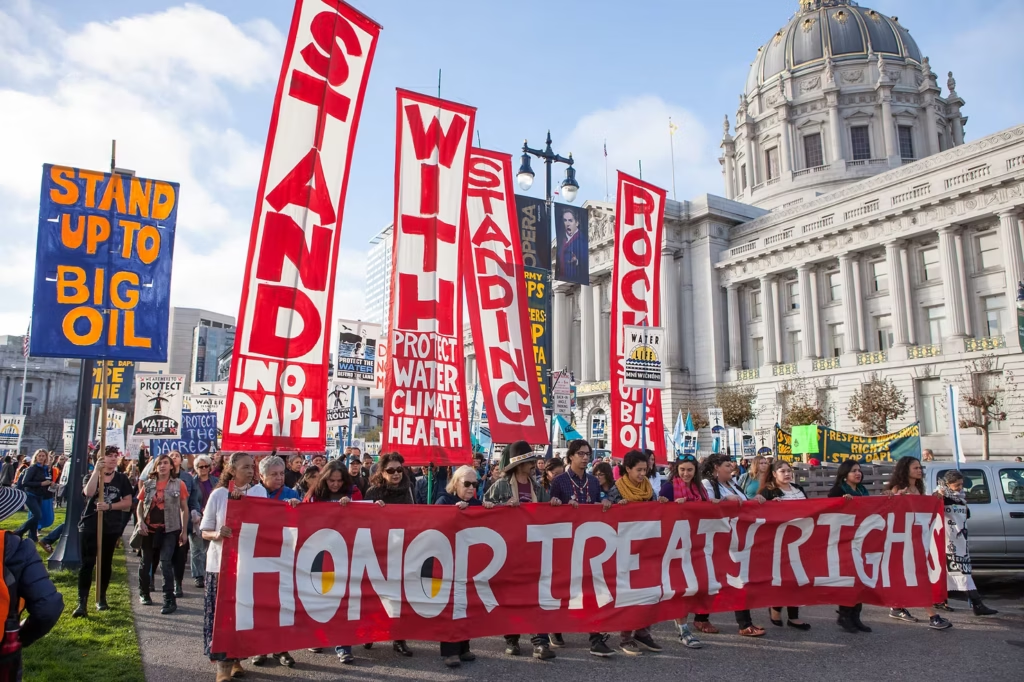
The dangers presented by climate change make it clear that planning has performed spectacularly poorly over the past few centuries. The planet is rapidly approaching tipping points that will make it uninhabitable: sea level rise threatens coastal cities, extreme weather endangers lives and taxes infrastructure, and shifting seasonal patterns complicate food supply. The unequal distribution of risks and resources along lines of race and class further amplifies the problems, as some will find themselves vulnerable to these changes sooner than others. Future (and present) planning practices must decarbonize society and ensure that it is drastically more equitable.
The broad conceptualization of planning required to make this shift is not the one that has been taught in traditional planning classes for my Master’s program thus far. The scope of the climate crisis requires planning by all levels of government across all sectors, alongside the planning done by community organizations and activists. Cities need major alterations, yes, but so too do the economy and immigration policy. Non-governmental actions, from mutual aid to advocacy, also play a vital role in determining what the future will look like. All of these are planning, and yet only a fraction of these processes are considered in the curricula I have encountered.
The reification of planning as the profession of city planning inhibits a full understanding of the interconnections between planning and climate change. It is straightforward to note how resource-intensive suburban development and car-centric transit harm the environment. Patterns of environmental racism, such as the siting of toxic waste facilities near communities of color and the disparate aid in cases of catastrophic weather,¹ also are clearly traceable to city planning. However, higher-level government policies such as decisions about fossil fuel subsidies,² for example, are also a form of planning. The decisions made by the US government and by corporations to push forward with the Dakota Access Pipeline, furthering settler colonial dispossession of the Standing Rock Sioux,³ were planning, too.
The power dynamics of racial capitalism that determine whose plans get implemented are obscured when we focus solely on municipal governance. The plans that will help communities survive the effects of climate change are already written; for example, they exist in the Green New Deal and in the Giniw Collective’s protests against Line 3 in Minnesota.⁴ When we envision future directions for planning, these are the types of plans we need to include. To actualize climate justice, these plans need to start winning. They need to win over oil companies’ plans to keep drilling and also over “climate-friendly” development that contributes to gentrification and displacement.⁵ In order for these plans to win, we need to strengthen relationships of solidarity between progressive legislators and government planners, Indigenous leaders, community organizers, and climate activists. The last two centuries of planning in the service of racial capitalism have gotten us into this mess and breaking the silos between different ways of planning is part of what will get us out.
Lila Asher is a first-year MCRP student at the Ohio State University. She has previously been published in Understorey Magazine and the ASU Envisioning the Future story contest. You can find her at lilaasher.bitbucket.io.
¹ Bullard, R. D., & Wright, B. (2012). The Wrong Complexion for Protection: How the Government Response to Disaster Endangers African American Communities. New York University Press.
² Nuccitelli, D. (2018, July 30). America spends over $20bn per year on fossil fuel subsidies. Abolish them. The Guardian. http://www.theguardian.com/environment/climate-consensus-97-per-cent/2018/jul/30/america-spends-over-20bn-per-year-on-fossil-fuel-subsidies-abolish-them
³ Estes, N. (2019). Siege. In Our History is the Future: Standing Rock versus the Dakota Access Pipeline, and the Long Tradition of Indigenous Resistance (pp. 25–66). Verso Books.
⁴ Tigue, K. (2021, February 16). Urging Biden to Stop Line 3, Indigenous-Led Resistance Camps Ramp Up Efforts to Slow Construction. Inside Climate News. https://insideclimatenews.org/news/16022021/biden-line-3-minnesota-enbridge-pipeline-indigenous-resistance/
⁵Anguelovski, I., Connolly, J. J. T., Pearsall, H., Shokry, G., Checker, M., Maantay, J., Gould, K., Lewis, T., Maroko, A., & Roberts, J. T. (2019). Opinion: Why green “climate gentrification” threatens poor and vulnerable populations. Proceedings of the National Academy of Sciences, 116(52), 26139–26143. https://doi.org/10.1073/pnas.1920490117