By Corrie Parrish
The following piece is part of Progressive City’s series The Future of Planning: Insights From Emerging Planners, in which current or recently graduated Planning students reflect on the state of the planning profession and how our activities as planners can be oriented towards justice as opposed to perpetuating ongoing racial, colonial, economic, environmental, and ability-related injustices. More information on this series can be found here.
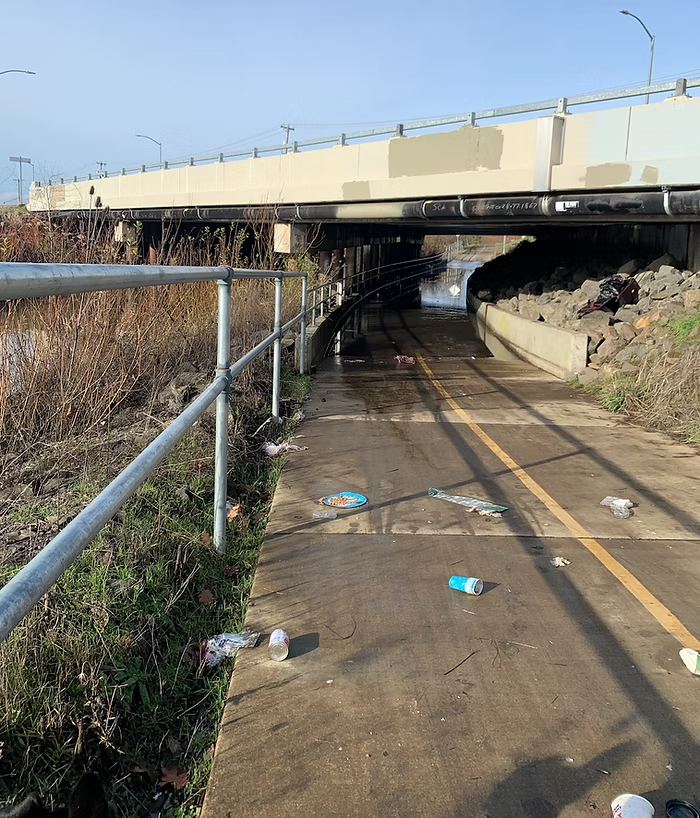
Photo by Author
The COVID-19 Pandemic has highlighted and exacerbated a number of shortcomings of public infrastructure in the United States. US public transit agencies saw ridership fall between 45-95% in the wake of COVID-19, and many still offer reduced services today. Despite major disruptions to public transit, walking and biking remain as viable options for transportation, especially for those who rely on public transit for essential services Just as we’ve seen the importance of active transportation access throughout the pandemic, parks have also been recognized as an essential service. Trail use skyrocketed by 193% at the onset of the pandemic. Multimodal access to parks supports community resiliency during crises in which public transportation services are disrupted, as we’ve seen not only throughout the pandemic, but also for other events, such as the occasional snowstorm. Yet 100 million Americans, including 28 million children, do not live within a 10-minute walk (~1/4 mile) of a park today.
The lack of both multimodal transportation and park access stems from the historic, forced displacement of communities of color. One of the best examples of this displacement and its relation to park access can be found in Eugene, Oregon (ancestral homelands of the Kalapuyans). The Ferry Street Village, Eugene’s first Black community, was forcibly removed and resettled on the western outskirts of town in 1949 when the City built a bridge to expand city limits to the other side of the Willamette River. The land on which this community once resided on is now one of Eugene’s most popular parks.
Planners continue to fail communities of color because they plan without these communities in mind, beyond looking at some census data, if they even do that. Despite the well-documented relationship of multimodal transportation access to socioeconomics, a national survey of pedestrian plans found that only 30% of those plans noted any socioeconomic characteristics. What is more startling from this study is that not one of the planners surveyed listed socioeconomic characteristics as an “important” consideration for pedestrian planning. Similar research can also be found on bicycling access. Furthermore, access is not just about whether a person can physically get to a park. Several studies found that parks in communities of color also lack access to basic facilities like benches, playgrounds, and lighting. One of the newest parks in west Eugene—named after a Ferry Street Village community member—is an open field that floods throughout the winter, just how the Ferry Street Village flooded seasonally. The shared multi-use path leading to this park also floods and becomes dangerously inaccessible.
Restorative justice in planning means authentically engaging diverse communities, and allowing those communities to lead in local planning practices. Planning is much more than land-use designations but more often than not, planning only looks at land, which leaves many communities out. Planners must evaluate not just access to space, but access to amenities in that space, which can look different based on diverse socioeconomic factors. We must evolve our planning practices to truly include those displaced on the basis of race if we are to engage in a just planning practice moving forward.
Corrie Parrish (she/they) graduated in June 2020 with a Master’s in Community & Regional Planning and a graduate certificate in nonprofit management from the University of Oregon. Corrie currently works for Vicus Planning focusing on transit-oriented community development, first/last mile connectivity, equity-focused program evaluation, and diverse community engagement. You can connect with them on Twitter or on LinkedIn.