By Roz Palmer
The following piece is part of Progressive City’s “Keeping the ‘Public’ in Public Space” series, which asks authors to address the way public spaces are governed, restricted and/or policed, in addition to the role of planning in both enabling and contesting the enclosure of public space. Of special concern are policies, designs and practices that limit the use of public spaces, formally or informally, based on the race, gender, sexuality, disability and national origin of people. More information about this series can be found here.
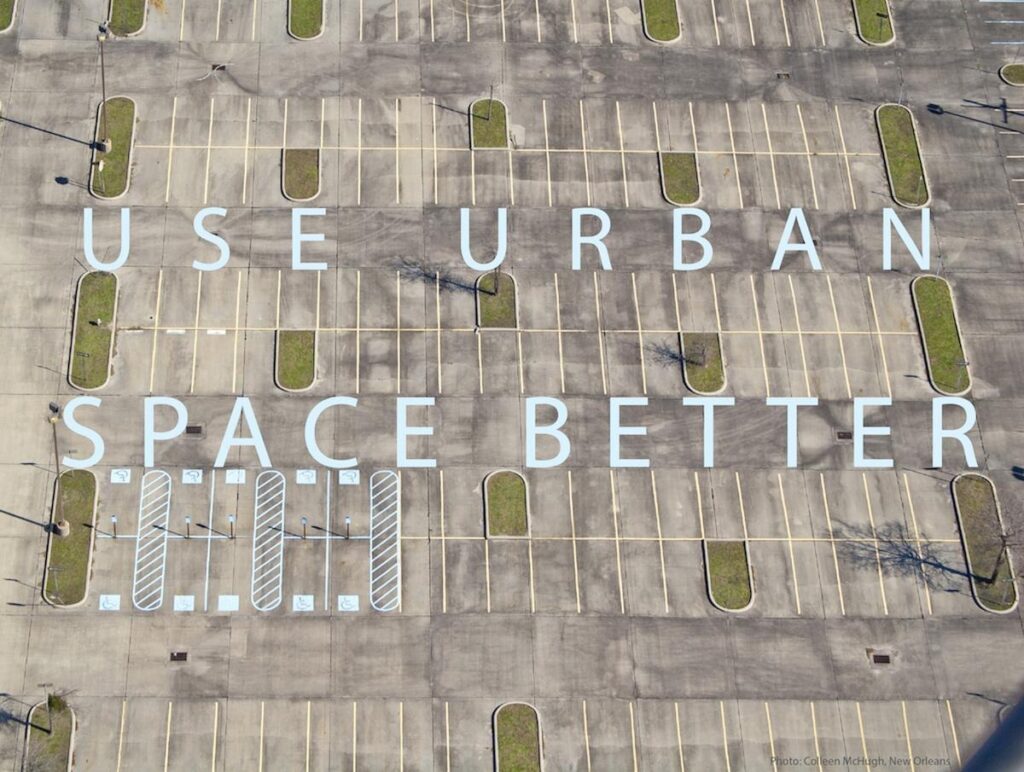
Streets make up one third of total urban area and eighty percent of our public space. In dense urban areas like New York City where space is precious, we need to respect our streets as public space and use them for multiple public purposes. There is outcry when parks, plazas, or conservation areas are threatened with privatization, yet we are comfortable using streets for the singular purpose of moving and storing private vehicles when we’d never tolerate using other public spaces, such as parks, to store individuals’ property. Let’s be ambitious about how we preserve public space by doing the obvious: take back streets and take down highways in the interest of public purpose, public funds and public play.
Can I please use my street?
Public space is where we associate and build relationships with people who are not our immediate kin; it is where humanity comes together to play. It is also where we eat, drink, talk, read, argue, kiss, hug, cry, recuperate, garden, grow, breathe, get exercise, cool down, warm up, hang with friends and generally meet our particularly human animal needs. As our third spaces become too expensive to operate or visit and billionaires profit from funneling our attention into lonely disembodiment, public space is vital to our humanity because social animals need a venue for observing and demonstrating what we value doing with our lives.
Instead, the default use of streets—a full third of the land in our cities—is for the sole purpose of speedy movement and storage of vehicles. If we’d like to use them for any of the myriad ways we spend our days, we need to request permission. Open Streets and other advocates are trying to make it easier to request an open street, but let’s reorient: why should we need to ask permission to act human together? The movement is strong to make city streets healthy, complete, shared spaces. What will require more long-term work is combating the auto industry’s private interests, and undoing ‘forced car ownership’ resulting from low-density planning and public transport deserts.
205 avoidable deaths
We didn’t always have to ask for permission to use our streets, and we didn’t always need cars (or military Humvees for that matter). The history of how private interests fueled our thirst for cars in America and for major thruways in our cities is well-summarized by an episode of Climate Town: from the 1920-1960s, car manufacturers wanted us to buy more cars, so they lobbied to build cities in a way that prioritized their movement and sabotaged public transport. Now those private interests want us to buy more, larger vehicles because they turn a higher profit, even though they make traffic worse and have a higher chance of killing someone.
Although down 31% since NYC’s Vision Zero launched in 2014, there were still 205 traffic deaths in 2025, the highest cause of death aside from heart disease and cancer. These are 205 neighbors who we were content to sacrifice for our devotion to speed and convenience.
The simple act of lowering speeds on streets not only saves lives but also saves money. Australia and New Zealand’s apex transport guidance body, Austroads, just put a price tag on slower streets, finding that reducing speeds to 40 km/h (~25mph) returns $5.09-$68.26 for every $1 “lost” in traditional travel time savings. These impressively high figures are based on avoided crash costs but also a true reflection of the value of ‘place,’ or being able to use our streets for activities that we value over speed.
Gloriously expensive traffic jams
Innercity laneways, streets, avenues and boulevards are a first-pick for reclaiming our public space for public purpose, but what about exclusionary public space on steroids: highways? We know that highways sever cities and disproportionately diminish quality of life for marginalized communities. Robert Moses famously sliced Sunset Park and Williamsburg in half with the Brooklyn Queens Expressway (BQE), while Jane Jacobs famously stopped him from doing so in the West Village, and the well-connected wealthy of Brooklyn Heights got him to skirt their neighborhood by installing an expensive, special Triple Cantilever design.
Like many urban highway corridors, the space that is now occupied by the BQE used to be filled with housing, businesses, streets where children played, sidewalks, plazas and parks. Then the manufactured “need” for high speed movement of cars through the city trumped all of those other uses. Now average speeds on the BQE “are typically lower than the posted limit” of 45 miles per hour, so the highway is not even accomplishing its one purpose. Many BQE proponents argue that its ability to move freight is in the public interest, but freight accounts for only 10% of vehicles on the BQE.
The public funding that goes into building and maintaining these vast infrastructures are magnitudes beyond most public space spending (estimated upcoming costs for the entire NYC Department of Parks & Recreation is $854 million, compared to $7.4 billion for streets and highways alone). Off-Ramp NYC is in the process of modelling the cost of removing instead of rebuilding an 11.7 mile segment of the crumbling BQE, which at current estimates would save $21 billion (according to the live model as of April 29, 2026). They also estimate that a single household could save $10,000-$38,000 per year by being able to live without a car. This estimate does not account for the ‘place’ value of a highway-less corridor, which could include boosts to local business sales, public health savings from cleaner air and more pleasant active transport opportunities, or the proven social return on investment of adding parkland.
Nothing is free in NYC (except parking)
The Mamdani administration is renewing an ongoing effort to end the free storage of private vehicles on public land. New York City is one of the only major U.S. cities where private cars are allowed to park on residential streets for free and only meters 3% of available space, which is well below other major urban areas. Metering parking in commercial areas and requiring residents to have a permit (even if free) would free up space for multiple public purposes instead. The space could be used to improve how we move around the city, with alternatives like share-vehicle bays, more share-bike docks, and temporary standing zones for deliveries, which by itself would cut down on the double-parking that often delays buses and causes traffic.
The return of roadway space to public use could also mean more parklets and infrastructure for mico-mobility (walking and riding). Safe micro-mobility infrastructure allows more people to comfortably choose walking and riding over driving, and supports a mode shift for last-mile deliveries (i.e., using cargo bikes instead of trucks for package deliveries from the nearest warehouse). In New York City, “when protected bike lanes are installed, injury crashes for all road users (drivers, pedestrians, cyclists), typically drop by 40 percent.” Streets can still be for moving people, but in more efficient, accessible, lost-cost, and fun ways that accommodate other human activities, much like you see on play streets and open streets.
See you in the streets
With mounting support of streets as multi-purpose public space, we are driving out the deep but new assumption that streets are for cars. Streets and highways are where so many movements converge, spanning social, environmental and economic justice: for freedom of speech in public protest, for freedom to play and stay healthy, for freedom from pollution, for access to services not severance, for freedom from the costs of car ownership. Yet amidst this powerful convergence, we are complacent about the car industry’s ubiquitous use of our public space. With more people living in cities than ever before, streets are the increasingly precious, prime space for demonstrating that we are no longer satisfied to request permission to use public space for public good.
Roz Palmer is a community-led urban planner with experience working in high-pressure flood recovery efforts globally, including in New South Wales in Australia, New York City and the US Virgin Islands. Roz works on both planning the public infrastructures that build our collective resilience as well as how we rebuild or refurbish them in a way that adapts us to a climate-changed future. She manages complex stakeholder dynamics to shape inclusive, sustainable and delightful urban places.