
By Ishita Chatterjee and Minati Dash
The following piece is part of Progressive City’s “Contesting the University as Planner, Occupier, and Developer” series, which asks authors to examine the role of academic institutions in (re)shaping cities and how planning practitioners, activists, educators, students, or other actors can contest their harmful impacts both from within and outside these institutions. More information about this series can be found here.
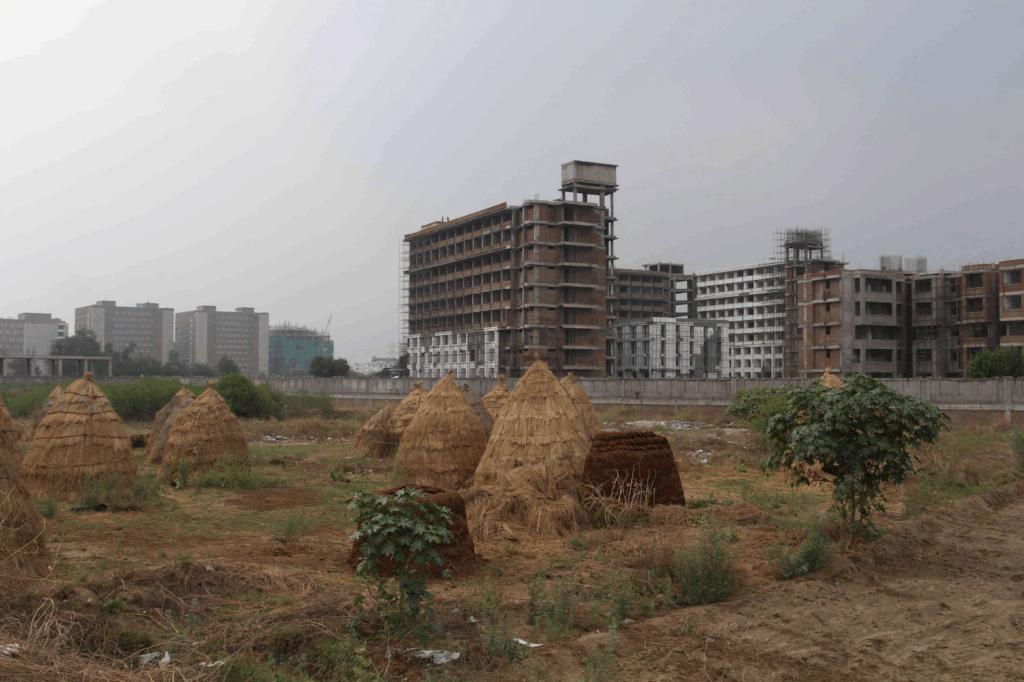
In Sonipat, a city approximately 50km from the centre of Delhi in the National Capital Region, private universities have emerged as powerful urban actors, significantly reshaping the socio-economic, political and environmental landscapes. Here, expensive education is intertwined with extensive land acquisition, peri-urbanisation, and real estate development, leading to significant shifts in land use, labour dynamics, land markets and deepening social inequalities.
Sonipat’s growth as an education city has to be understood within the major shift that has been taking place in the higher education sector in India since the early 2000s. There has been a rise of private universities as sprawling university campuses are established in peri-urban regions of cities such as Bangalore, Delhi, Mumbai, Chennai, Bhopal, Ahmedabad and Pune. Universities are no longer seen as centres of learning but as prime drivers for urbanising a region and catalysts for real estate speculation. This phenomenon contributes to the rise of “UniverCities,” where higher education institutions exert growing control over economic development and political governance, akin to “company towns.” Universities are emerging as an important avenue of corporatisation, blurring the lines between education, real estate and monetising university assets. We engage with the concept of ‘UniverCities’ to understand how universities exercise control over the local landscape in their capacity as economic entities.
Sonipat is historically an agrarian region on Delhi’s northern border. With its fertile lands, Sonipat became an important site of the green revolution in the 1960s, leading to an increase in crop productivity and economic growth. In the 1980s, farmers’ upward economic mobility also benefited from landmark government programs such as Operation Flood that led to dramatic increase in milk production due to introduction of exotic milch cow varieties and linking milk producers with urban consumers. This agricultural-led growth plateaued in the 2000s due to the decline in the vitality of soils due to overuse of chemicals. Across India, this period coincides with India’s capital markets exploring new avenues of profit. It was during this period that Sonipat was envisioned as a multi-functional urban complex as part of the wider Delhi National Capital Region (NCR) expansion in 2006. As a result, education, land acquisition, and urbanisation have become deeply interlinked.
The transformation of Sonipat’s landscape began with large-scale land acquisition starting in the mid-2000s. State agencies, such as the Haryana Urban Development Authority (HUDA) and the Haryana State Industrial and Infrastructure Development Corporation (HSIIDC), acted as “land brokers,” acquiring vast tracts of fertile agricultural land for projects like the Rajiv Gandhi Education City (RGEC) and industrial development. This acquisition was often justified under the “public purpose” clause of the Land Acquisition Act of 1894, a clause frequently criticised for being misused to forcefully acquire private land and convert it into residential and commercial zones. For instance, 2,006.5 acres across nine villages were acquired for RGEC Phase-I, with only 535 acres designated for ‘education plots’ and the remainder for commercial, residential, and various infrastructural purposes. Beyond the RGEC, other private universities have also acquired land through market-led processes by obtaining land directly from farmers in phases, offering significantly more compensation than government agencies. Farmers resisting RGEC frequently cited this disparity as evidence of unjust compensation. Urban proximity and private negotiations played a large role in determining land value. Additionally, the Haryana Private Universities Act (2006) further tied higher education to land ownership, requiring 10–20 acres per institution, binding private education with real estate speculation.
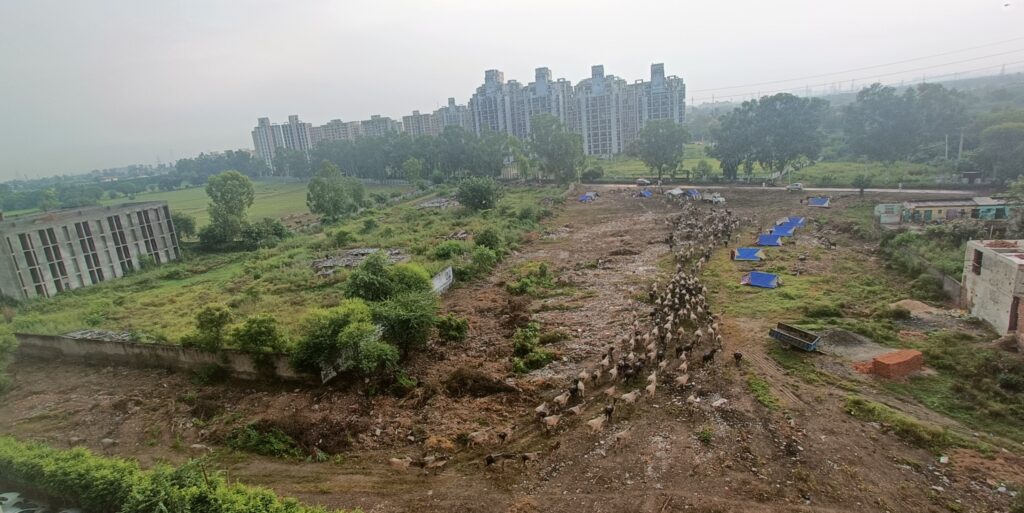
The region’s proximity to Delhi and the development of major expressway corridors like the Kundli-Manesar-Palwal (KMP),Kundli-Ghaziabad-Palwal (KGP), Eastern Peripheral Expressway (EPE) and improved connectivity through Delhi Metro and National Highway 44 significantly increased land values and attracted real estate speculation. According to Colliers International, a global commercial investment management company, land price is likely to appreciate threefold in the next five years in Sonipat. The speculative investment in the region has led to a fundamental shift in land use patterns from agricultural to urban, including the construction of large, gated university campuses, associated housing, commercial complexes and other retail infrastructure to cater to the influx of the urban elite. Real estate developers and the state government actively marketed the Sonipat-Kundli region, drawing comparisons to Gurgaon, highlighting “world-class” education facilities as a key driver of development. This reconfiguration of the urban landscape creates distinct “live, work, play” bubbles around university campuses with little productive interface with local communities.
Socio-Economic Realities and Disparities
The emergence of elite private universities in Sonipat has created a series of stark social and cultural contrasts between the various social groups in the area.
At a broader level, local communities are disconnected from university communities that are largely drawn from affluent urban backgrounds. The high fee structures of these private institutions make “world-class education” inaccessible to most local students, entrenching a stark disparity in education quality.
Additionally, within these universities, employment opportunities for locals are primarily limited to unskilled roles in maintenance, housekeeping, and security or non-teaching clerical positions. The rise of these universities has also coincided with the rise of informal labour, comprising a mix of villagers and migrants, who serve the new peri-urban population as street vendors, cab drivers, house helps, cleaners, etc. This has resulted in the growth of bastis, informal labour colonies in neighbouring areas. These communities often lack access to basic infrastructure and services, such as waste disposal, water supply, electricity and decent roads, in stark contrast to the world-class infrastructure of neighbouring universities.
Rapid urbanisation has also led to increased housing costs and the displacement of long-term residents, who are pushed to the periphery or into informal settlements. Within the villages themselves, there is diversity in economic and social realities. While the privileged agrarian landed class, like the Jat community in Haryana, often holds significant power in urban transformation, approaches to land acquisition vary. Some landowners engage in speculative land pricing in anticipation of rising prices, while others actively resist it due to inadequate compensation and the threat of loss of fertile agricultural land. This highlights the complex and often unequal socio-economic shifts occurring within these communities.
Commodification of the University
The process of education-led urbanism in Sonipat is interlinked with the commodification of higher education. Private universities in India, despite their claims of diversity and public service, often shy away from addressing deeply entrenched issues like caste and class discrimination. There is a significant underrepresentation of marginalised and low-income communities in these spaces. As a result, they deepen educational inequality, maintaining the dominance of upper-caste and upper-class groups.
The profit-driven approach of private universities contributes to the commodification of education and its infrastructure. University infrastructural resources are monetised and conceived of as property, acting as assets for loans and raising funds by engaging directly in capital markets. As capital markets look to expand into alternative ‘asset classes,’ education presents the property sector with a golden opportunity for partnerships. While this is an established feature of Western universities, it is an emerging trend in the Indian context. Within the context of the rise in private university-led peri-urbanisation, universities are increasingly becoming neoliberal corporate entities and large-scale private developers, emerging as major players in the peri-urban region.
Overall, the transformation of higher education from a public good to a market commodity impacts the peri-urban social and economic landscape, rapidly transforming its built environment. These profit-driven models hamper long-term community building, marginalise local communities and demonstrate the deepening marketisation of higher education.
Ishita Chatterjee teaches at the Jindal School of Art and Architecture, O. P. Jindal Global University. Her work focuses on informal urbanism, housing inequality, spatial justice, ecological debt, epistemic justice and politics of knowledge.
Minati Dash teaches at the Jindal School of Art and Architecture. O. P. Jindal Global University. Her work focuses on anthropology of extraction, environmental justice, politics of development and climate justice.