By Peter Marcuse
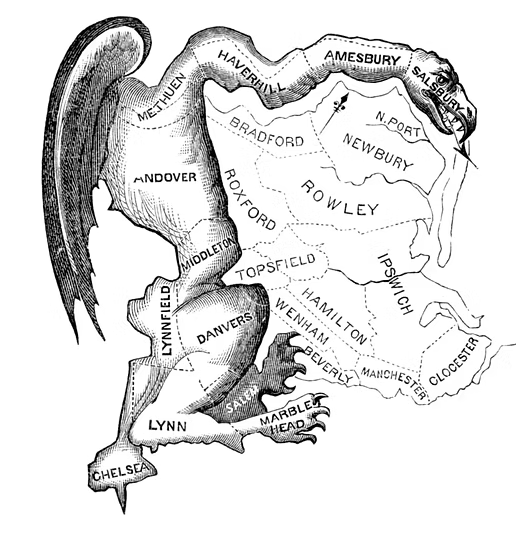
Following each decennial U.S. census, electoral district lines are redrawn to reflect changing demographics, from the Congressional districts within the 50 States, down to the state, county and city legislative levels. Gerrymandering, the drawing of those lines to advantage one political party over another, is almost as old as U.S. democracy itself—the name dates from 1812, when Massachusetts Governor Elbridge Gerry, soon to be elected Vice President with James Madison, used the technique to benefit his Democratic-Republican Party.
Over the centuries since then various attempts have been made to prevent the worst abuses, but each political party, seeking its own advantage when in power, has found ways of circumventing those solutions. In the most recent iteration, for example, the G.O.P.-controlled Pennsylvania state legislature is attempting to use gerrymandering to stack the State Supreme Court with judges drawn from “rural, predominantly conservative areas,” who they hope will rule favorably in challenges against unfavorable election results.
In recent years one of the most common tools used to curb gerrymandering is the appointment of non- or bi-partisan commissions to redraw district lines. Such commissions are currently in use in about 20 U.S. states and a number of other countries. Rarely do the appointees on such commissions have any qualification beyond their partisanship (or lack thereof). I propose that readily available professional city planning and zoning commissions should be utilized in the redistricting process. Such commissions would not only mitigate the problem of gerrymandering, but could also contribute in a positive way to the democratic process.
One Solution, in Short: Substitute “Social Mandering” for Gerrymandering
A social co-mandering process might begin with a public proposal for an expansion of the powers of a community’s existing planning and land use processes, or with the creation of a special comprehensive zoning and land use commission that would undertake a process of social mandering. My chapter in the book Site Matters, “From Gerrymandering to Co-Mandering: Redrawing the Lines,” provides further background on this discussion. A special, newly created or empowered body might be constituted at the local level with democratic control over land uses, as is consistent with the constitution. Existing documents can form the basis for implementing social mandering, and there are no doubt governmental bodies in many other communities across the country that can serve as models, and whose charters could easily be amended to relate a Congressional redistricting role with other existing land use governance bodies.
It would be beneficial to draw lines that avoid the ills of gerrymandering, but by positive, rather than negative action. The kind of partisan demographic political analysis of voting patterns that curbing gerrymandering entails should be set aside until the processes of planning are well advanced, and then applied only as a control to make sure they do not accidentally result in racially or other biased delineation of districts. Political analysis would be undertaken only to assure fair access to all voters to participate in elections, debates, and organizing.
Such “social mandering” would instead engage professional planning and design firms to explore possibilities of line drawing, which would look at the possibilities for redrawing lines that would delineate public open spaces, both as parks and as assembly and meeting locations for community discussions, including electoral debates, and be laid out to maximize areas and facilities for constructive public democratic activities – the opposite of what occurred in Washington D.C. on January 6, 2021 (or at the Democratic National Convention in Chicago in August 1968), which resulted in bodily harm as well as physical destruction. Instead, spaces would be laid out explicitly for appropriate peaceful public access and use.
Further possibilities for social mandering with professional input could include:
• Laying out zones for housing, designed to meet goals of affordability, demographically diverse use, consistent with environmental protection and aesthetic pleasure, while respecting existing community organizations, school districts, recreational needs, and taxation districts tied to housing goals such as affordability, quality of life, and solidarity.
• Using real estate valuations affirmatively to help support the implementation of social goals in the tax process, instead of only balancing budgets.
• Considering democratic institutional formations such as community land trusts to take over ownership and control of particularly prized locations for purposes favored by residents of a community.
• Laying out access routes and planning for transportation patterns that will facilitate democratically determined, desired uses.
Many districts already have such a professional zoning body. Alternatively, a special popularly elected and controlled body can be created at the local level with control of land uses, as is constitutionally supported since the Supreme Court’s 1926 decision in favor of a Cleveland suburb’s attempt to use zoning ordinances to limit a developer’s plan to expand industrial infrastructure into its jurisdiction. Its charter is carefully drawn and might easily be rewritten to merge the redistricting role with the roles of other land use governance bodies.
Land use planning of necessity is always faced with choices among conflicting alternatives, no one of which is perfect, and some disparities in costs and benefits or alternate plans will inevitably arise. The courts have recognized these difficulties and allowed for some range of deviation from perfection. The one consideration that courts have virtually unanimously disallowed in proposed plans has been a finding of illegal discriminatory motivation as a violation of the 14th or 15th Amendments. If the process has resulted in a plan being challenged, any court should have concrete, transparent standards by which to judge Constitutional deviations from perfection that vitiate any attack on the grounds of motivation. This would make judicial review of social-mandered plans a positive process.
Using, building on, augmenting, and partnering with all available local, community, regional, state and federal resources in the redistricting process ought to be a cardinal part of every redistricting effort. Both grassroots groups and constitutionally concerned planners ought to be pleased at the results of cooperative efforts at long-range, comprehensive, and democratic planning that turn redistricting into a positive, anti-gerrymandering process.
Peter Marcuse is Professor Emeritus of Urban Planning at Columbia University’s Graduate School of Architecture, Planning and Preservation. He has served on the planning commissions of several cities, has been a member of the editorial boards of multiple journals, and has written extensively in English and German on topics such as racial discrimination, housing policy, comparative planning, and globalization. He has been a members of Planners Network since its founding in 1975.