By Tom Angotti
Over the next several days Progressive City will be posting a series of tributes to Peter Marcuse (1928-2022), influential planning scholar, practitioner, and activist. Peter was a long-time Planners Network member and founding editor of Progressive City: Radical Alternatives online magazine and Progressive Planning magazine (our print predecessor).
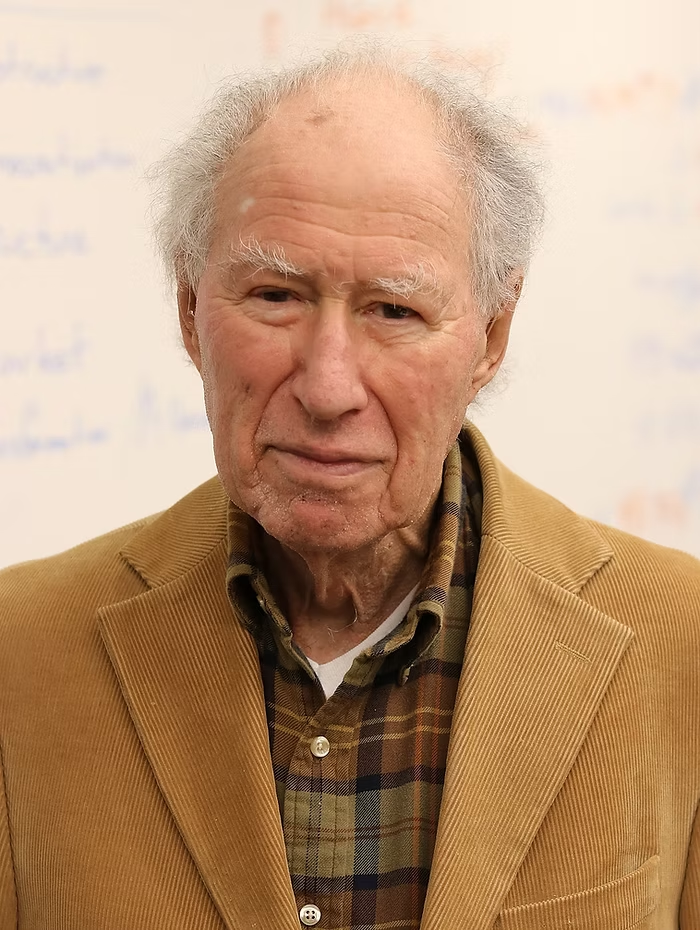
Throughout the world, Peter Marcuse was known as one of the leading scholars in the fields of housing, urbanism and planning. His list of publications and awards is impressive. However, somewhat less appreciated is his lifelong commitment to progressive and radical urban theory and practice. Indeed, Peter was solidly on the side of the activists and organizers who moved beyond the academy, bridging the gap between theory and practice and staking out more forward-looking and radical approaches to urbanism. During the Civil Rights era he was part of Planners for Equal Opportunity and supported Planners Network since it started in 1975. Peter was a regular participant in local and national Planners Network meetings and conferences and a featured speaker at many of them. He keynoted the PN conference held in Ciudad Juárez, México. Peter was a regular contributor to PN publications including the newsletter, Progressive Planning Magazine and progressivecity.net.
I had the enormous privilege of knowing and working with Peter for almost five decades. When he chaired the urban planning program at Columbia University he recruited me to join the faculty. I was inspired working alongside Jackie Leavitt and others that he recruited. Around this time Peter organized a conference that gave voice to radical approaches to democratic reforms to the New York City Charter that called for community control and challenged the mainstream proposals which were stifling the voices arising from the grassroots and civil rights movements. He also got involved in and chaired a local community board.
In the decades I knew him I experienced many times a quality that Peter exercised consistently: solidarity with urban social movements, in particular those calling for radical changes in policy and practices. In New York City Peter was a valuable resource for local activists and actively engaged in numerous campaigns. We were both part of the Right to the City Coalition and supported initiatives led by Picture the Homeless and other campaigns for housing justice. Peter was a prominent advocate for tenant rights and rent regulations and a central figure in the rise of a citywide movement promoting community land trusts. He was often the most prominent among the small group of academics engaged with community-based movements calling for radical social change and progressive politics. He was also a frequent panelist at the Left Forum and The NY Marxist School, where he and I jointly taught a course on housing. He was an outspoken critic of the policies guiding the rebuilding of Manhattan after 9/11.
In his many publications over his lifetime, Peter demonstrated his characteristic wisdom and generosity of spirit. In addition to his own extensive publications, he supported and participated in numerous book projects that boosted the work and profile of young and emerging scholars. In the panels he participated in he often demonstrated an uncanny ability to distill complex issues that were on the table into a maximum of three or four points, frequently in the form of proposals around which we could move forward. This would demonstrate how his experience as a practicing lawyer overlapped with his lifelong commitment to transformative planning.
I will never forget my visit with Peter in Berlin. It was 1990, around the time the Berlin Wall came down. I blithely suggested to him that this could be an opportunity to get rid of the worst on both sides of the wall and build on the best. Peter quickly crushed my naïve hopes. He spoke fluent German and had spent enough time on the Eastern side of the Wall to see that the system was already in the process of collapsing. Peter was born in Germany and had fled the Nazi regime with his family (his father was the distinguished social scientist Herbert Marcuse). Thus Peter characteristically understood the power of politics and place.
Presente compañero Peter!
Tom Angotti, New York
April, 2022
Tom Angotti is an editor of Progressive City and Professor Emeritus, Hunter College and The Graduate Center, City University of New York. [email protected].