Peter Marcuse was not just a radical urban scholar but also a public scholar who believed in free and accessible exchange of planning knowledge and practices. It is for this reason that he strongly committed to publishing in popular as well as academic outlets and why he was part of the founding of this magazine. Here we share some excerpts from his past work as well as a list of over 25 articles that he has published in Progressive City magazine and its predecessor, Progressive Planning, in addition to a number of articles that engage with his work.
Peter Marcuse’s articles:
Inclusionary Zoning Moves Downtown (1987) (page 3)
Lessons From Housing in Eastern Europe (1991) (pages 3-4)
Report from South Africa (1995) (pages 4-5)
An Isolated US Opposes Housing as a Human Right (with Tom Angotti) (1996) (pages 12-13)
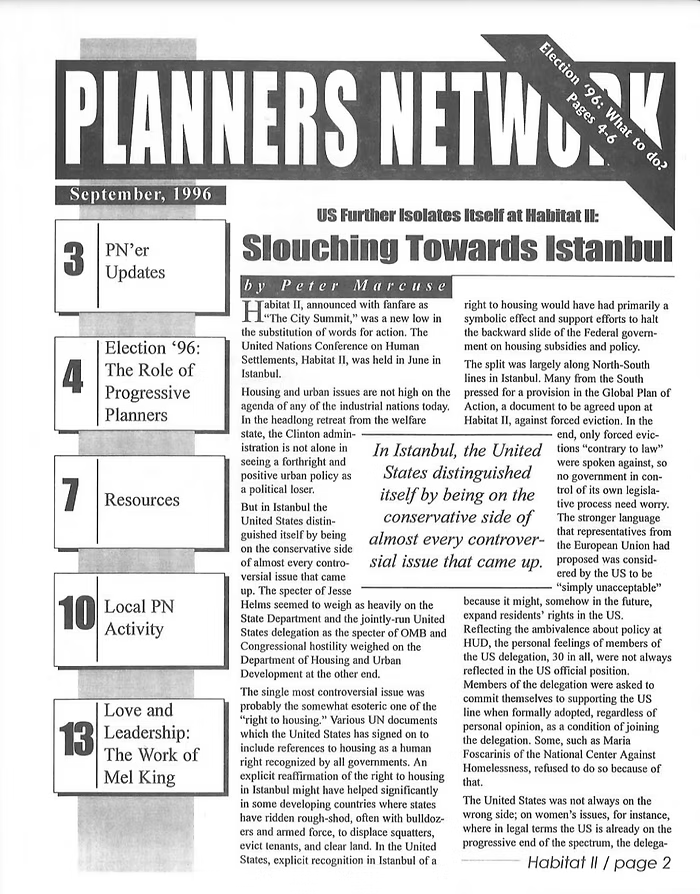
US Further Isolates Itself at Habitat II: Slouching Towards Istanbul (1996) (pages 1-2)
Sustainability: Who benefits? (1998)
Peter Marcuse On Sustainability, May 1998:
“Sustainability as a goal for planning just doesn’t work. In the first place, sustainability is not a goal; it is a constraint on the achievement of other goals. No one who is interested in change wants to sustain things as they are now. Taken as a goal by itself, ‘sustainability’ only benefits those who already have everything they want. It preserves the status quo, making only those changes required to maintain that status.”
“You could argue that the status quo is not sustainable socially, because an unjust society will not long endure. That is more a hope than a demonstrated fact. You could also argue, and with more evidence, that the status quo is not environmentally sustainable; indeed, that is the origin of the ‘sustainability’ slogan. But changes can be made within the present system to cope with problems such as environmental degradation and global warming. Nor is it inevitable that such changes will be socially just.”
Urban Life Will Change: Proposals for Rebuilding (2001)
Planning after September 11: The Issues in New York (2001)
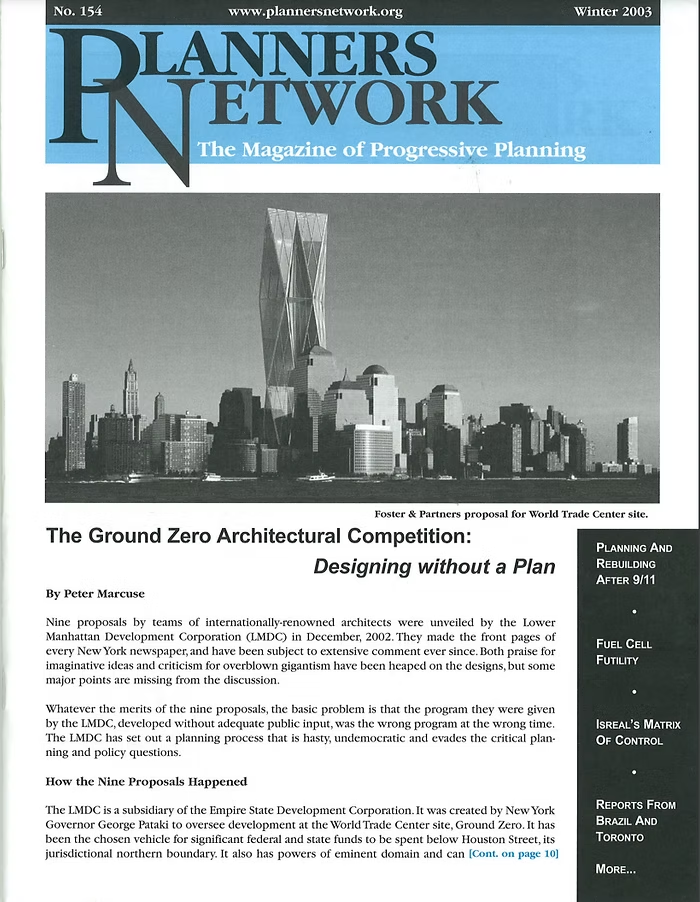
The Ground Zero Architectural Competition: Designing without a Plan (2003)
Lower Manhattan after 9/11: Where’s the Planning, Where’s the Money? (2004) (pages 13-14).
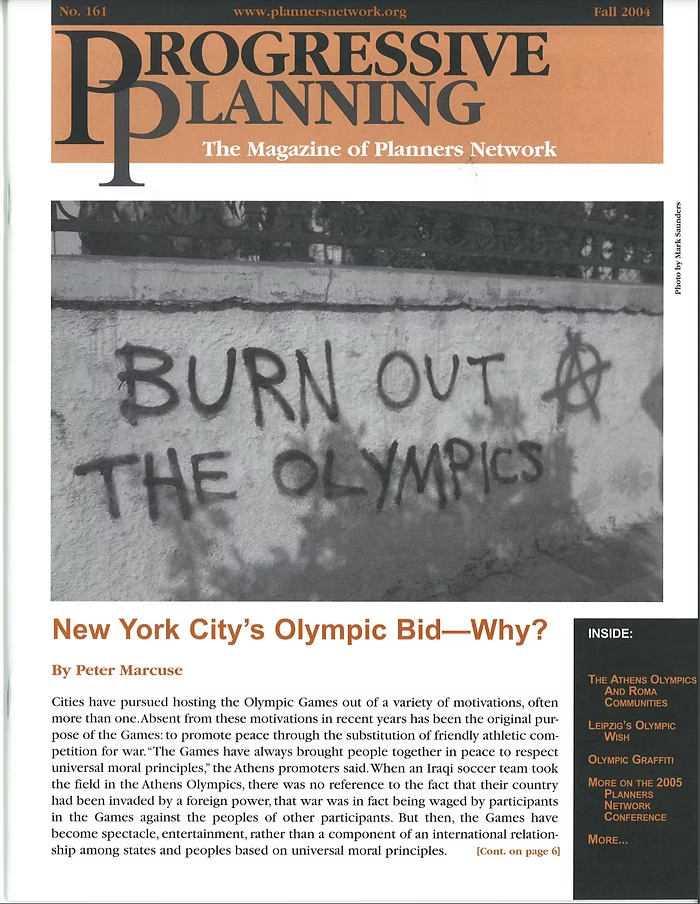
New York’s Olympic Bid: Why? (2004)
Back to Basics for Progressive Planners (2005) (pages 4-5).
Social Justice in New Orleans – Planning after Katrina (2007)
The U.S. Social Forum: Major Success for Networking (2007)
Changing Times, Changing Planning: Critical Planning Today (2010) (pages 13-16)
Two World Urban Forums, Two Worlds Apart (2010)
The Heresies in HUD’s Public Housing Policy (2011)
The Austerity Scam (2011)
Peter Marcuse on Austerity, Summer 2011:
“Very simply, the United States is a rich country….Austerity is not a characteristic of our private sector; our level of consumption, both gross and per capita, is higher than that of any other country. It is only in the public sector that there is talk of austerity, and even here not in every sector: our military expenditures are the highest in the world, and are effectively insulated by our political leaders from the budget cuts that they claim are needed elsewhere.”
Keeping Space in its Place, in the Occupy Movements (2012)
Un-Natural Disasters, Recursive Resilience, Unjust Compensation, Visionless Planning (2013)
A Just Code of Ethics for Planners: A Priority for Planners Network (2014)
Peter Marcuse on the proposed revision of the Code of Ethics for planners by the American Institute of Certified Planners (AICP), Winter 2014:
“The profession’s Code of Ethics is, or ought to be, a clear site for the formulation of planning policy on racial and ethnic justice. But the recent revision of the AICP Code studiously avoided this….In addition to being vague, the Code had no enforcement mechanisms. That problem led the AICP to undertake a thorough-going revision of the Code….The lawyer charged with the drafting proposed that the new code should separate out the “public interest” provisions to make them an “aspiration” and not binding, while the other “rules of conduct” should be binding on members.
Progressive Planning at the Border (2014)
Peter Marcuse on Progressive Planning at the Border, Summer 2014, from closing plenary at the PN conference in Ciudad Juárez, Mexico
“The basic problems we have seen here include low wages, poverty, poor housing, insecurity, inadequate infrastructure, inequality and corruption. What are the causes? They heavily involve the economy’s dependence on maquiladoras, and the domination of foreign capital, which relies on a differential wage structure.”
Fair Housing and Beyond: Some Elusive Principles for Social Change (2015) (pages 41-43)
Peter Marcuse on Fair Housing, Fall 2015
“Ultimately you cannot have fair housing in an unfair society.
· Color blindness is a serious threat to decades of civil rights activity
· Gentrification is a game changer
· Integration needs more careful consideration
· Solutions to the problem of discrimination inevitably involve conflict
· If conflict is inevitable, the distribution of power must be confronted
· Transformative policies are necessary if long-term goals and short-term possibilities are not to get in the way of each other”
Jackie Leavitt: A People’s Planner (2016) (pages 24-26)
What’s the Matter with “Good” Planning? (2016)
From Bob Fitch to Donald Trump: “Unfriendly Fire” (2017)
From Gerrymandering to “Social Mandering” (2021)
Articles About Peter
‘Adding Marcuse’ to Equitable Development Approaches: Combatting Indirect Displacement by Julie Mah & Emma Clayton Jones (2020)
Good Planning, Progressive Planning and Urban Transformation: Reflecting on Peter Marcuse by Aseem Inam (2016)
Good Planning” is Bad Planning, and “Progressive” is not Enough: a Response to Peter Marcuse by Samuel B. Stein (2016)