Universities play a critical and often contradictory role in planning. They not only bestow accreditation and confer degrees, but also shape the discourses and practices that define the field. These in turn influence the design, use, and accessibility of our cities. Although university planning programs make claims of educating practitioners who will work towards more equity, participation, and justice, recent events remind us that despite these overtures, the university remains a key institution in reproducing a racial-capitalist, patriarchal, and colonial status quo in our cities.
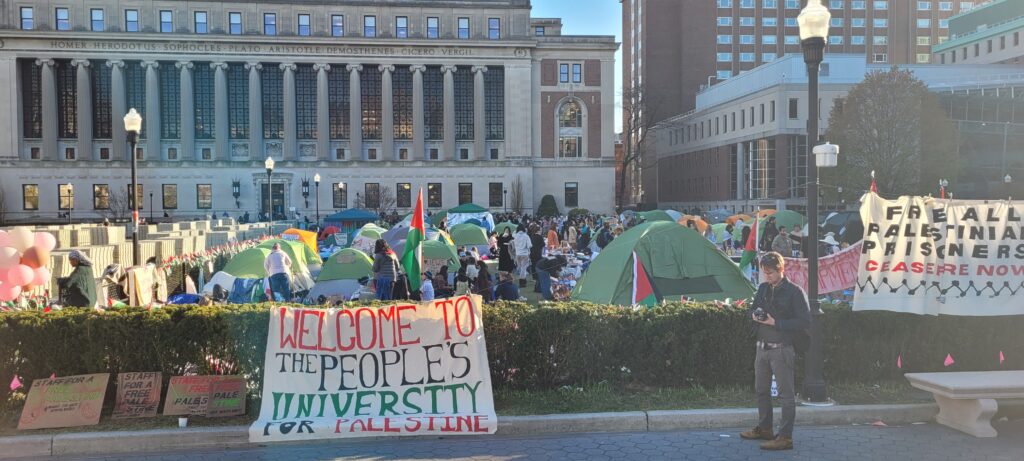
The increased securitization, surveillance, and policing of space over the past year has brought into focus the university as both a planner and an occupier, as well as an extension and geographic locus of state power. Perhaps the most immediate reminder of this has been the harsh crackdown on pro-Palestine encampments on university campuses across the world. Wielding their institutional, economic, and legal power, universities act as arbiters of space in our cities: what constitutes public space, who can use these spaces, and what forms of speech are permissible within them. Many are familiar with the case of Columbia University, which was complicit in ICE’s warrantless abduction of Mahmoud Khalil, who participated in peaceful protests that challenged the university’s spatial control.
Along with universities’ exclusionary violence towards students, employees, and visitors to university spaces, universities also stand among the largest real estate developers, speculators, and land holders in many cities. In this capacity, their influence extends from shaping the built environment to driving processes of gentrification, displacement, and social exclusion.
These factors, coupled with longstanding scholarly and activist criticisms of universities—and their planning programs—as exclusionary, elitist, or narrow-sighted, underscore the importance of maintaining a critical eye when engaging with higher education institutions. For planners, students of planning, or for those building a more just city in any capacity, these cases raise pressing questions: ‘who’ is the university when students reclaim or resist certain uses of university space; what does it mean to plan from, with, or against the university?
It is with this in mind that we are seeking short submissions (roughly 1000 words) for our online magazine Progressive City: Radical Alternatives on the theme of “Contesting the University as Planner, Occupier and Developer.” Contributions can approach this theme from a variety of perspectives, but should address the role of academic institutions in (re)shaping cities and how planning practitioners, activists, educators, students, or other actors can contest their harmful impacts both from within and outside these institutions.
Submissions should be written in an accessible (jargon-free) manner. A few suggested readings may be mentioned in the text (hyper-links to references are encouraged), but please do not submit footnotes. We encourage the submission of a photograph or illustration (with appropriate permissions). In addition to short essays, we welcome the submission of photo essays, videos, or other primarily visual forms. Please note that while we work with authors to help them fit the Progressive City style, format, and themes, we cannot accept all articles that have been submitted.
Please send submissions to [email protected] by September 15th (with some flexibility; email us if interested).