
By Ljubica Slavković
The following piece is part of Progressive City’s “Keeping the ‘Public’ in Public Space” series, which asks authors to address the way public spaces are governed, restricted and/or policed, in addition to the role of planning in both enabling and contesting the enclosure of public space. Of special concern are policies, designs and practices that limit the use of public spaces, formally or informally, based on the race, gender, sexuality, disability and national origin of people. More information about this series can be found here.
In Serbia, the erosion of public space rarely begins with a bulldozer. It is encoded much earlier, in a legal-administrative act that redefines where and how decisions are made, and whose interests no longer matter. The instrumentalization of planning in Belgrade is now at an advanced stage, and the furthest-reaching mechanism is the Spatial Plan for a Special-Purpose Area (SPSPA). It is a planning instrument that takes over hundreds upon hundreds of hectares, but its reach has also sparked something else: a growing civic mobilization in defense of public space against the very institutions meant to protect it. This article examines the SPSPA and highlights the case of resident mobilization to counter its use and defend public space.
Under Serbia’s planning legislation, an SPSPA may be prepared for projects designated as being of significance for the Republic of Serbia, a category the law leaves substantively undefined. The plan is adopted by the Government rather than the local assembly, and lower-order local plans must conform to it. Formally, the procedure includes public insights. In practice, these steps are performed after the designation has already fixed the outcome, so the declaration of national significance functions as a discretionary political trigger rather than a planning criterion. In Belgrade, two such projects now claim roughly 11.4 square kilometers between them, an area larger than the city’s entire historic core: the Belgrade Waterfront on the Sava River, and the National Football Stadium and EXPO complex in Surčin, which reached the river in its fourth phase (with the total number of phases still open). Both grew through successive government decrees, each displacing rules already in force, followed by many legal exceptions.
In this process of centralization of power, a privileged deregulation is produced. Regulation is not eliminated; it is selectively reconfigured. Rules continue to exist, but they are rearranged to facilitate particular interests, compress procedural resistance, and reduce the effective power of local institutions and communities. The formal language of planning remains intact, yet the underlying political logic shifts from coordination to authorization.
Moreover, this planning instrument is often accompanied by lex specialis, the exceptional legislation adopted specifically for a particular project. Such project-specific laws introduce additional procedural exceptions, altering existing regulatory frameworks and enabling the implementation of projects under rules tailored exclusively for them. These laws effectively establish a parallel legal regime that bypasses or modifies ordinary planning, property, and construction procedures, producing the system in which exceptions become the rule. This was the case with the Belgrade Waterfront redevelopment, implemented in partnership with investors from the United Arab Emirates, as well as with the preparations for EXPO 2027, a major drain on public funds.
However, there is one more side of this story. The more exceptional procedures are used to reorder urban space top-down, the more citizens are learning to organize from below in defense of public goods, collective use, and the right to their cities. In Serbia, citizens have become far more organized, informed, and persistent in defending public spaces—most often, from the institutions that enable the particular interests to override the public ones. Over the past decade, a more mature civic capacity to read planning documents, monitor procedures, build coalitions, engage experts, use media strategically, and insist that spatial decisions are political decisions has emerged, and it increasingly appears to be here to stay.
This is particularly visible in Savski blokovi, the Sava River blocks of New Belgrade, where residents have repeatedly mobilized in defense of open green areas, shared courtyards, riverfront access, and the spatial logic of the modernist blocks themselves. Built on marshland after the Second World War in the spirit of Le Corbusier’s functional city, New Belgrade is home to some 200,000 people, most of them living in high-rises surrounded by vast green spaces. Upstream and on the opposite bank of the Sava from Belgrade Waterfront, whose own riverfront was for decades occupied by railway tracks and infrastructure, this district was shaped by modernist planning, with particular attention paid to a publicly accessible, green riverfront. Half a century later, these spaces are not empty residual land awaiting “activation”, as official development discourse often implies. They are integral parts of everyday urban life and their value lies precisely in the fact that they are public in use, the kind of space that is systematically under attack all over the city.
Built on the left bank of the Sava River in the mid-1970s, New Belgrade’s Sava River blocks house tens of thousands of residents in one of the most socially mixed districts in Belgrade. Their entire southern side is lined by the Savski kej (Sava Quay), a two-kilometer promenade laid over an engineered embankment that shields the low-lying Sava blocks from flooding. The embankment is public infrastructure in the fullest sense: a shared surface for walking, cycling, and recreation, and a flood defense for the many thousands of residents who live behind it, and one whose integrity is written into law.
It is citizens who have recognized the importance of preserving and improving this public infrastructure, and the neighborhood initiatives have carried its defense. The Za naš kej (For Our Quay) initiative grew in 2019 out of resistance to the so-called reconstruction of the quay itself, demanding that the entire quay be governed by a single plan of detailed regulation, in place of the present patchwork of block-by-block parcels. The initiative’s members say they were brought together by the deputy of the Belgrade Mayor at the time, who showcased how public money was being spent while announcing that the Sava River quay would be remodeled to follow the example of the newly built Belgrade Waterfront—where over 80% of the riverfront is under concrete, the public promenade has been downsized to less than 20 meters in width, trees are planted in concrete planters, and private security displaces “undesirable persons” from what is declared to be public space.
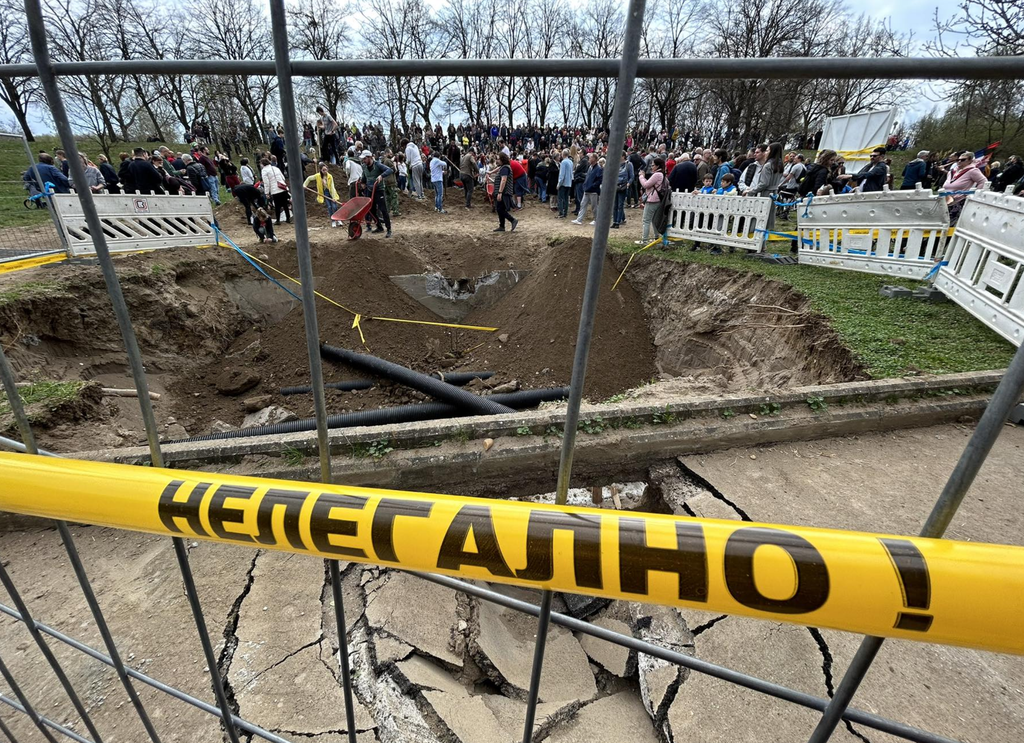
By contrast, the Sava River quay of New Belgrade spans over two kilometers with almost 150 meters in width, covered in greenery and trees, and with a public space designed over 50 years ago with the public in mind, which is now more than ever a valuable oasis within the city and makes any proposal for change all the more contentious. The works on the embankment were officially presented as reconstruction, but residents read them as preparation to cut through the dike and run utility lines out to the barges moored along the bank. When the works began, residents stood watch on the quay, mobilized within minutes through neighborhood alerts, and physically blocked excavators and concrete trucks, while filing objections and taking the public institutions responsible for works to court at the same time. Their claim joins the physical with the procedural: the dike is a shared public surface and a flood defense whose breach they will not accept, and decisions about it, they insist, cannot be made elsewhere and imposed. It is the residents who kept a 24-hour guard to protect the quay, the public space, and the future of New Belgrade—from the institutions tasked with safeguarding such uses.

The initiative Zajednička akcija Blok 70/70a (Joint Action Block 70/70a) was formed during the pandemic when residents collected more than 10,000 signatures to contest an ad hoc and flawed plan to build a “pedestrian and cycling” bridge (in which a six meter lane was placed in the middle), which they read as a disguised car entrance and a costly and damaging intervention pushed through an instrumentalized planning procedure. The citizens’ initiative kept a standing presence on the ground through all sorts of actions, such as neighborhood clean-ups and tree planting, and put forward a counterproposal, grounded in the strategic planning of New Belgrade: a network of green corridors reconnecting the quay with the wider riverfront. Its record sets a pattern combining mass mobilization on the site, legal arguments and institutional pressure, and a positive plan for the future of the space—demanding strategic planning from the institutions that fail to provide it.
The residents of these blocks have shown that the defense of public space is inseparable from the defense of planning as a democratic process. In this sense, a paradox emerges: in the context of captured institutions, it is citizens who assume the role of defending the city from the very bodies mandated to protect it. They increasingly operate within and against the institutional terrain of planning. They submit objections, analyze plan proposals, expose procedural inconsistencies, organize assemblies, and produce counter-publics around spatial issues that official institutions attempt to depoliticize. They are not outside the planning process; they are forcing open the democratic dimension that exceptional procedures seek to contain.
The Belgrade case thus reveals a sharp contradiction. On one hand, the state increasingly relies on exceptional mechanisms to accelerate implementation and insulate key projects from local resistance. On the other hand, this very process has contributed to the political mobilization, the strengthening of grassroots urban movements, and a more explicit defense of public space as a democratic rather than merely physical category, and citizens are there to stand up for it and to illustrate the means for (re)claiming the institution of planning from the bottom-up.
Ljubica Slavković is an urban researcher based in Belgrade and the founder and director of Nova planska praksa (New Planning Practice), an independent organization for urban research and public advocacy. Her work examines how political power shapes urban space in post-socialist Serbia, with a focus on informal and illegal construction in Belgrade and its legalization. Her doctoral research looks at the capture of Serbia’s planning system by particular interests. She is the editor and author of award-winning publications, such as In Search of Public Interest: the Realms of Urban Planning and Urbanism and Corruption.