By Azadeh Sobout
The following piece is part of Progressive City’s “Keeping the ‘Public’ in Public Space” series, which asks authors to address the way public spaces are governed, restricted and/or policed, in addition to the role of planning in both enabling and contesting the enclosure of public space. Of special concern are policies, designs and practices that limit the use of public spaces, formally or informally, based on the race, gender, sexuality, disability and national origin of people. More information about this series can be found here.
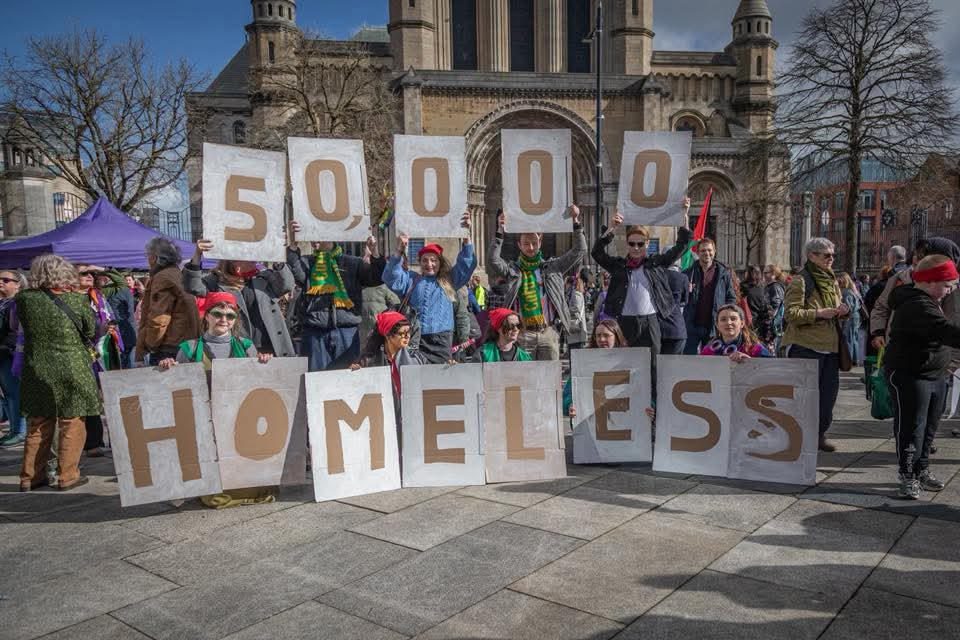
Belfast’s urban geography cannot be separated from the colonial history of Northern Ireland, where British imperial industrialisation and settler governance shaped housing, land allocation, and municipal planning as mechanisms for maintaining Protestant political dominance and Catholic marginalisation. The partition of Ireland and subsequent militarised planning during the “Troubles” further entrenched these divisions through segregated housing estates, checkpoints, surveillance infrastructures, and peace walls that fragmented neighbourhoods and restricted movement. Although the 1998 Good Friday Agreement reduced large-scale violence, many of these spatial arrangements persist, producing enduring inequalities in access to housing, land, and public space.
Public space in Belfast is not a neutral civic category, but a terrain shaped by colonial governance, territorial control, and uneven access to land. Under Unionist rule, housing allocation functioned as a mechanism of political control and demographic management that shaped citizenship, electoral representation, and belonging. From this perspective, housing has never been simply a welfare issue. Against this backdrop, I examine how initiatives associated with Take Back the City Campaign and Participation and the Practice of Rights (PPR) enact forms of decolonial urbanism. Specifically drawing on the traditions of Meitheal, an Irish philosophy of communal labour and collective stewardship through which communities organised work, care, and responsibility, it argues that urban commons in Belfast emerge through collective practices of care, stewardship, and insurgent spatial production that challenge dominant understandings of land, planning, and public space.
Public Space, Coloniality, and the Limits of Liberal Urbanism
Much liberal urban theory treats public space as evidence of democratic openness: parks, streets, plazas, and civic institutions ostensibly accessible to all. Decolonial scholars, however, have shown that public space is never neutral, but historically produced through colonial governance, securitisation, policing, and unequal access to land.
In Belfast, public space has long functioned less as a shared commons than as a managed spatial order shaped by territorial governance and military urbanism. Decolonial scholarship produced in and about Ireland increasingly challenges interpretations of Belfast that reduce the city primarily to an ethno-national or post-conflict framework. Instead, scholars situate segregation, spatial fragmentation, and uneven development within longer histories of colonial planning and settler governance, as explored in Obert’s analysis of architectures of subjection and subversion in Belfast, Donnelly’s work on planning and architectural governance in Northern Ireland, and Cunningham’s analysis of military urbanism and the architecture of segregation in Belfast.
The formation of Northern Ireland in 1921 consolidated these colonial structures through housing allocation, policing, gerrymandering, and uneven development designed to maintain territorial dominance and a permanent Protestant Unionist majority. During the “Troubles,” these dynamics intensified through peace walls, checkpoints, interface zones, surveillance infrastructures, and defensive urban design that regulated movement and fragmented neighbourhoods.
Public land in Belfast therefore frequently remains governed through bureaucratic and speculative planning regimes rather than collective stewardship, demonstrating that state ownership alone does not guarantee democratic access or collective use. The contradiction at the centre of Belfast’s housing crisis is not simply the coexistence of homelessness and vacant land, but the persistence of “public” land that remains inaccessible to the communities most in need of it.
At the same time, communities across Belfast continue to challenge these arrangements through grassroots organising, ecological restoration, and planning from below. These struggles demonstrate that public space is not simply delivered through policy or design, but actively produced through political struggle, collective labour, and social relations.
Housing Crisis and the Struggle Over Urban Land
The contradictions surrounding public land are particularly visible in Belfast’s housing crisis. While official planning frameworks such as the Belfast Agenda, the Local Development Plan, and the Resilience Strategy present the city through the language of growth, resilience, and inclusion, PPR has consistently challenged the ways these visions reduce the city to targets, investment metrics, and development indicators. The issue is not simply how many homes are built, but where, for whom, and under whose control. Growth-led planning treats land as an economic asset, while communities experiencing homelessness, housing stress, and displacement understand land as the basis of belonging, social reproduction, and everyday survival. This tension exposes a wider contradiction within post-conflict regeneration in Belfast: official planning imagines the city as competitive and investment-ready, while grassroots movements continue to confront the realities of territorial division, uneven access to land, and enduring forms of social exclusion.
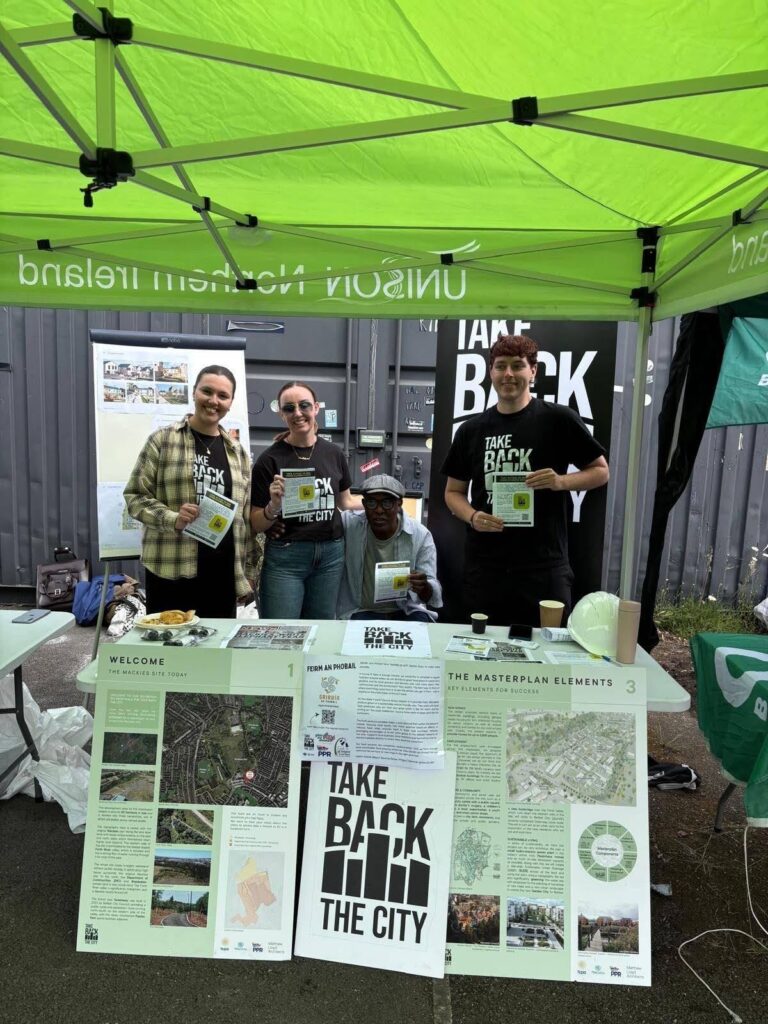
Participation and the Practice of Rights (PPR), founded by Inez McCormack in 2006, has played a central role in challenging these contradictions. Working alongside homeless families, migrants, asylum seekers, housing activists, researchers, and community organisers, PPR developed a rights-based and movement-oriented approach to housing justice grounded in collective participation rather than charity. Out of this organising work, Take Back the City emerged as a grassroots housing campaign responding to the visible contradiction between escalating homelessness and the existence of large areas of unused public land across Belfast.
Bringing together precariously housed residents, architects, planners, trade unionists, refugee solidarity activists, Irish-language organisers, gardeners, artists, educators, and local community groups, Take Back the City evolved from rights-monitoring and evidence gathering into a broader insurgent planning movement focused on land justice and community-led urban futures. Within this wider movement ecology, CATU (Community Action Tenants Union) emerged as a key organising infrastructure, connecting local housing struggles to broader campaigns around tenant power, anti-landlordism, housing rights, and democratic control over land and housing.
Importantly, the campaign moved beyond protest politics into forms of militant and decolonial knowledge production. Through Freedom of Information requests, occupations, mapping projects, architectural competitions, and pre-planning proposals, campaigners challenged the assumption that planning expertise belongs exclusively to state institutions or professional planners. Through Freedom of Information requests and community-led research, housing activists mapped extensive areas of vacant publicly owned land across Belfast, identifying the Mackie’s site – a 13-hectare former industrial site in West Belfast- as one of the largest publicly owned vacant sites in the city and a potential location for urgently needed social housing.
The Mackie’s site sits within an area experiencing some of the highest levels of poverty, unemployment, and housing stress in the city. Yet despite urgent need, the land remained largely unused for decades. For campaigners, this represented more than a technical planning failure. It revealed how public land could remain inaccessible even amid severe social need.
Rather than waiting for formal redevelopment processes, campaigners developed their own vision for the site. An international architectural competition invited planners and architects to produce proposals for affordable housing, ecological restoration, and shared community infrastructure. The competition attracted submissions from practices across the world and centred the voices of residents and families directly affected by housing insecurity.
The resulting proposal developed in collaboration with StreetSpace Studio and Change Stories Project imagined Mackie’s not simply as a housing development, but as a sustainable and community-led neighbourhood rooted in ecological care, collective infrastructure, and social inclusion. Shared green spaces, food-growing initiatives, community facilities, and public gathering spaces formed part of the wider vision for the site.
The campaign also used creative and unconventional tactics to draw attention to housing injustice. Collaborations with artists, architects, and community organisations transformed housing activism into a broader public conversation about land, inequality, and urban futures. Exhibitions, public workshops, storytelling, performance, and community mapping became tools for political mobilisation as well as forms of knowledge production.
Meitheal and the Making of Urban Commons
Beyond policy debates and masterplans, the work of campaigners is also visible in everyday practices that transform land into shared commons. The collaborative ethos shaping these initiatives resonates strongly with the Irish tradition of Meitheal, cooperative labour organised through reciprocity, collective responsibility, and mutual aid.
At Mackie’s and associated community spaces, collective gardening, ecological restoration, storytelling, food growing, and children’s activities create forms of commons-making grounded in care rather than profit. Planting indigenous species, teaching children Irish-language names for plants, and reclaiming derelict land through shared labour all contribute to rebuilding relationships between land, memory, ecology, and community.
In a city marked by intergenerational trauma and inherited spatial division, children’s participation in land stewardship carries particular significance. These activities become practices through which relationships to land, language, and community are reconstituted across generations, interrupting cycles of alienation and territorial fragmentation.
These practices are significant because they produce forms of belonging that exceed the boundaries of state-led urban governance. Refugees, asylum seekers, Irish-language activists, housing campaigners, gardeners, artists and local residents participate together in shaping shared space in ways that refuse the false narrative of competition between migrant communities and working-class residents.
Beyond Housing: Gairdín an Phobail and the Ecology of Urban Transformation
Projects such as Gairdín an Phobail demonstrate how Take Back the City’s vision extends beyond housing provision to encompass wider questions of land justice, food sovereignty, ecological stewardship, and collective care. Rather than an isolated community garden, Gairdín an Phobail forms part of the broader Take Back the City movement ecology, bringing together many of the same actors, organisations, and values that animate the campaign. Developed through collaboration between Springhill Community House, Anaka Women’s Collective, Glór na Móna, sheltered housing residents, GROW, supportive Belfast City Council staff, and PPR campaigners, the project reflects the coalition-building practices that have characterised Take Back the City from its inception.
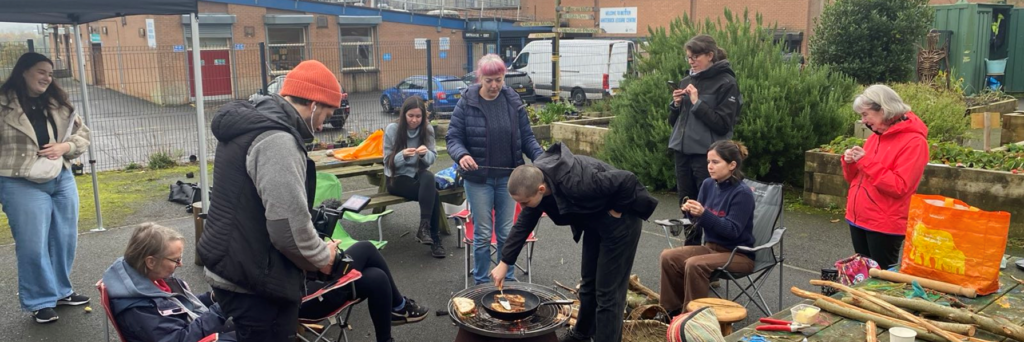
Through food growing, community gardening, environmental education, seed sharing, and rewilding initiatives, Gairdín an Phobail embodies many of the principles that underpin the campaign’s vision for Belfast’s urban future. If Take Back the City seeks to reclaim land for social housing and community-led development, Gairdín an Phobail demonstrates how communities can already begin collectively stewarding land in the present. The garden functions as a living commons where relationships of care, reciprocity, and shared responsibility are cultivated alongside food production.
Viewed through the lens of movement ecology, Gairdín an Phobail represents a prefigurative dimension of Take Back the City. It shows how housing justice, ecological restoration, cultural revitalisation, migrant solidarity, and community wellbeing are not separate struggles but interconnected aspects of a broader project of democratic urban transformation. In this sense, the garden is not merely a support activity for the campaign; it is one of the ways the movement actively produces the alternative urban futures it seeks to realise.
Conclusion
The struggle over housing and land in Belfast reveals the limits of liberal understandings of public space. Land designated as “public” may still remain inaccessible, securitised, or disconnected from collective need. The campaigns explored here therefore challenge more than housing policy alone. They challenge who has the authority to shape urban futures.
Take Back the City and related grassroots initiatives demonstrate that commons are not simply spaces owned collectively, but relationships continuously produced through care, cooperation, ecological stewardship, and political struggle. Through practices rooted in Meitheal, community organising, and insurgent planning, campaigners transform vacant land into spaces of learning, cultivation, and collective autonomy.
In this sense, taking back the city does not simply mean reclaiming public land from neglect. It means reimagining urban space itself not as a managed asset governed from above, but as a shared and living commons produced from below.
Azadeh Sobout is an interdisciplinary urbanist, researcher, and campaigner whose work explores the relationship between land, memory, displacement, and spatial justice in conflict-affected cities. Her research and practice focus on decolonial and experimental urbanism, grassroots planning, and community-led struggles over housing, public space, and urban commons. She is currently a Postdoctoral Research Fellow in the School of Natural and Built Environment at Queen’s University Belfast, working on the Change Stories project, an international research partnership based at the University of Washington and operating across Bogotá, Belo Horizonte, and Belfast. In Belfast, the project is led by Prof Geraint Ellis and Dr Agustina Martire and foregrounds the work of Participation and the Practice of Rights (PPR) and the Take Back the City campaign.