By Farida Rady and Jacob Roberts
The following piece is part of Progressive City’s “Keeping the ‘Public’ in Public Space” series, which asks authors to address the way public spaces are governed, restricted and/or policed, in addition to the role of planning in both enabling and contesting the enclosure of public space. Of special concern are policies, designs and practices that limit the use of public spaces, formally or informally, based on the race, gender, sexuality, disability and national origin of people. More information about this series can be found here.
Toronto is one of sixteen cities hosting FIFA World Cup football matches in the summer of 2026. From June 11 to July 19, 2026, Toronto Stadium at Exhibition Place will host six matches, and Toronto’s Bentway will be re-purposed into the FIFA Fan Festival™. To commemorate the one-hundred day countdown to this mega-event, Mayor Olivia Chow announced: “Toronto is ready to welcome the world. The whole world will experience Toronto as the safe, affordable and caring city that it is. As millions tune in and visitors arrive from across the globe, this tournament is our opportunity to showcase the strength of our communities and the spirit that brings people together.” This municipal declaration is in line with Toronto’s host city official slogan, “The World in a City.” These diversity discourses become especially contentious when we consider the sites the World Cup will unfold within and transform.
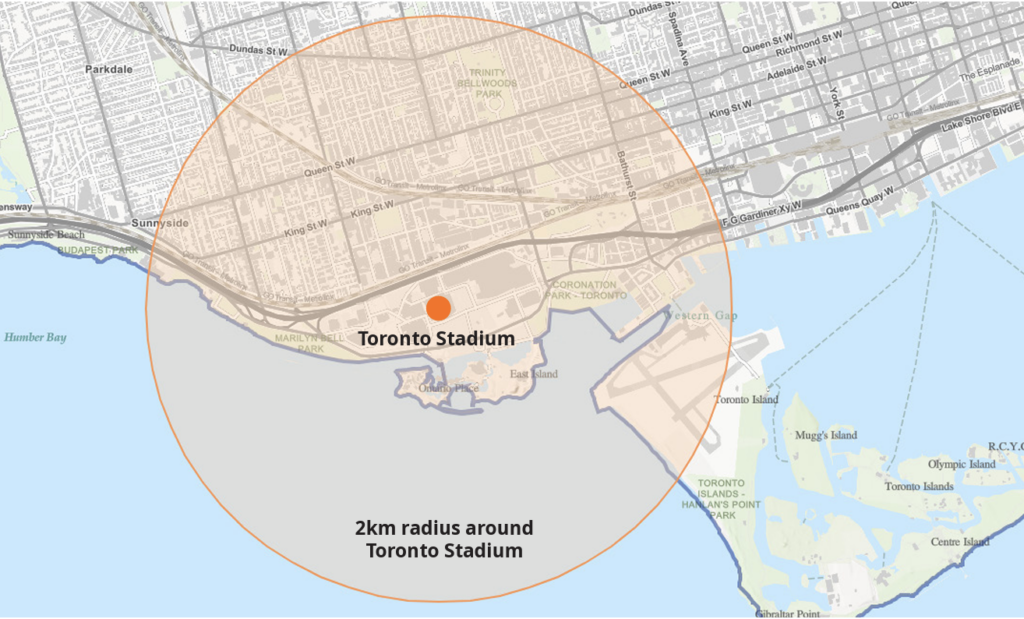
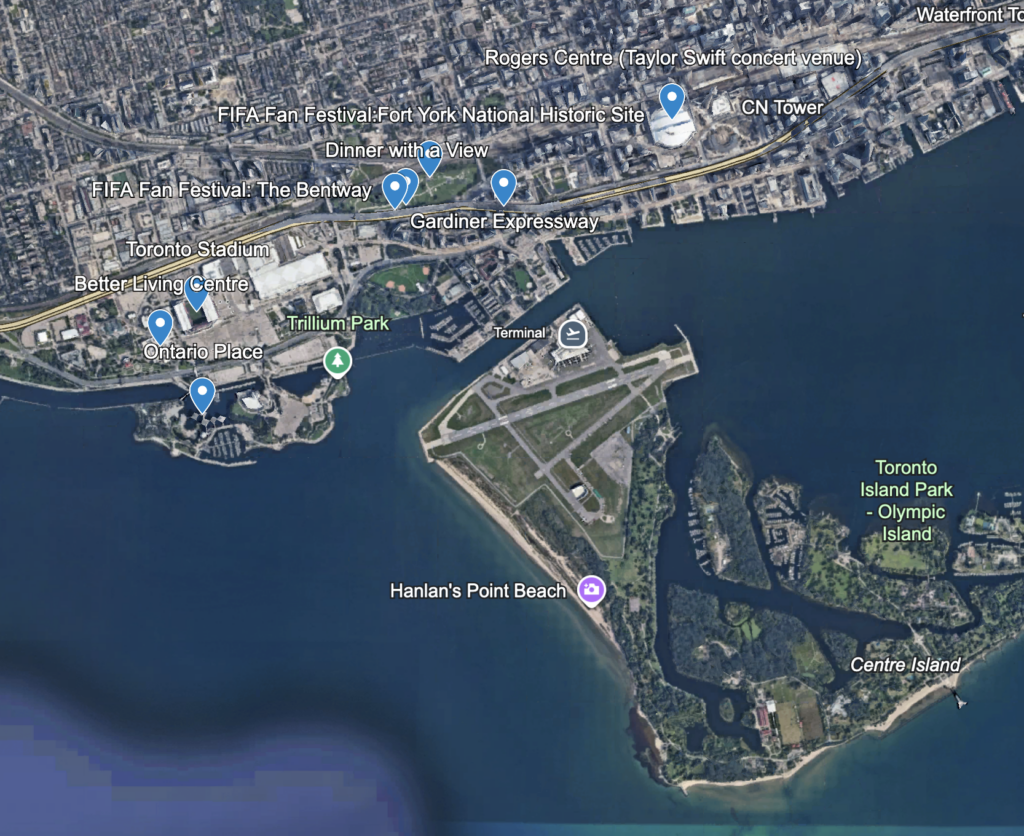
As can be seen in the maps above, the immediate vicinity of Toronto Stadium (and mostly within the 2 kilometre radius of the FIFA “Controlled Area”) contains multiple markers of displacement of unhoused people and the concomitant enclosure of public space. For example, in 2019, shortly after unhoused people were evicted from beneath the Gardiner Expressway, a pop-up restaurant emerged in the Bentway. Wealthier city residents could pay hundreds of dollars to dine in a heated dome under the Gardiner, for a “unique” dining experience called “Dinner with a View.” This is the same place where the FIFA Fan Festival™ will be hosted this summer. Nearby, Ontario Place, a former public space, was recently sold to Austrian developer Therme, which will build a spa and waterpark on the large waterfront site. In direct connection to the World Cup, the Better Living Respite Centre (BLC) closed on March 15th for the season—a month earlier than usual—leaving the 300 people who stay there every night scrambling for shelter. The early closure is due to the City of Toronto’s agreement that the BLC be available for FIFA-related uses as of April 1st. Other mega-entertainment events, like the Taylor Swift Eras Tour, where the Rogers Centre hosted around 500,000 visitors in November 2023, also resulted in direct instances of displacement of unhoused people who were living by the concert venue.
Amidst these diversity discourses and city branding tactics, concerns surrounding displacement and neoliberal governance are obscured in the name of curating a version of the city that is attractive to certain mobile citizens who traverse the city (and national borders) with ease, who spend in abundance, and who celebrate a superficial diversity while neglecting to contend with complex difference. Our contribution to Progressive City: Radical Alternatives diverges from the more spectacular moments of politics during the FIFA Games, as we survey the less examined preparation stage of a sports-mega event, when multi-year policy, planning, and the city is ‘sold’ to the world. We explore the discourses and tactics that are constituted as common sense in Toronto during the mega-event preparations, through an examination of The Bentway area.
As has been well-established, ideas around diversity, inclusion, and participation are central to the City of Toronto’s brand. Claims of diversity are fundamental to the city’s Official Plan, which states that “our future must … be diverse, inclusive, and equitable.” This branding is prevalent in how the municipal administration has approached the World Cup, from the slogan, “The World in a City” to the guidelines within the municipal Community Activation Toolkit released in February 2026 which affirm that “our Host City brand is rooted in inclusivity, vibrancy, and unity…Toronto is one of the most diverse cities in the world – we don’t just embrace our diversity, we celebrate it.” The city’s inclusion branding is also visible in its legacy initiatives, including funding new soccer mini-pitches in lower-income neighbourhood parks across Toronto. The emphasis on diversity discourses as part of Toronto’s World Cup brand becomes the marketable imagery of the city for the world. This promotes and distinguishes Toronto as a distinct competitive, global city. However, as illustrated in the corridor of Toronto’s tourist spaces, displacement of unhoused Torontonians and the privatization of public space contradicts the city’s passionate declaration of “inclusivity, vibrancy, and unity.”
The selling of a fabricated, idealized image of the city, as mobilized through empty discourses of diversity, facilitates an undemocratic politics of urban space. Toronto’s social welfare programmes are sidelined under FIFA preparations, as the city pushes a fictional cultural narrative that ignores the actually-existing conditions of urban space, fixing an advertised utopian vision of the city. The entrepreneurial character of the city in these ‘quieter’ moments of FIFA preparations reflects Toronto’s incessant and existential hunger to attract capital in the competitive inter-urban marketplace.
Farcically, declarations celebrating diversity and inclusivity while public space becomes enclosed fits directly into the sports mega-event (SME) literature. Sports scholar Helen Lenskyz notes criminalizing homelessness and poverty are necessary to upkeep a sanitized global media image of the mega-event city, province, and country. Notably, while exceptional legal tools such as temporary bylaws and special zones are mobilized by municipal administrations to manage the FIFA Fan Festival and surrounding areas, City Council refused to suspend the enforcement of camping bylaws for unhoused residents in encampments, even at the height of the pandemic crisis. More recently, the early closure of the BLC facilitates this sanitization of tourist spaces, as unhoused Torontonians will interfere with the branded-image of the city as “the tournament will bring unprecedented global attention and economic benefits to Toronto, including an influx of international visitors, major global media exposure, and opportunities for local engagement.” Contesting the repurposing of public space (such as the BLC) for FIFA’s needs is challenging, as geographer John Lauermann notes SMEs induce undemocratic politics through a moment of “institutional displacement.” The suspension of a vital social welfarist city programme using FIFA ‘licensing’ as an excuse facilitates a city politics of neoliberalization, where free-market oriented governance is the norm. Toronto’s FIFA moment has already arrived, and we question whether Toronto needs the World Cup at all.
We are intervening in a context where sport mega-events appeal to people across the political spectrum through universalizing narratives of global citizenship, interconnection, civic pride, competition, and youth engagement. The spectacle of these mega-events works to obscure the complex urban politics they activate or augment. Through our brief intervention into Toronto’s FIFA preparations, some of our research on the 2010 Vancouver Olympics bid and planning also comes to mind. Interviews of politicians, volunteers, protestors, and senior Olympic officials, revealed that the Vancouver Games were common-sensically articulated through a discursive politics of inevitability and necessity. The political challenge for Toronto’s World Cup is to interrupt the ‘natural’ destiny of a sports-mega event, as it encloses and sanitizes public space. The undemocratic neoliberalizing of Toronto’s city politics as constituted through SMEs institutes a state of emergency, effectively shutting down any dialogue to question the political relevancy of mega sporting events. Hollow statements of diversity and inclusion risk fabricating an identity of the city and shifting the way urban citizens experience their own city: “from passionate soccer fans representing nations across the globe to the rich mosaic of neighbourhoods and communities that make up our city, Toronto is truly ready to welcome the world.”
The task of planners and geographers is to trouble these generalizing narratives and instead to demystify the event—identifying the enclosures of public space, advocating against the instances of displacement, and anticipating the particular ways neoliberalization flows through the urban to realize these mega-events.
Based between Cairo, Toronto, and Abu Dhabi, Farida Rady is an artist, writer, and researcher currently pursuing a PhD in urban geography at York University. Farida explores questions of urban governance, housing justice, migrations, memory, and the poetics of place.
Jacob Roberts recently defended his masters in critical human geography at York University. His research explores the politics of the 2010 Vancouver Olympics and neoliberalization of urban space.