By Swati Batra
The following piece is part of Progressive City’s “Keeping the ‘Public’ in Public Space” series, which asks authors to address the way public spaces are governed, restricted and/or policed, in addition to the role of planning in both enabling and contesting the enclosure of public space. Of special concern are policies, designs and practices that limit the use of public spaces, formally or informally, based on the race, gender, sexuality, disability and national origin of people. More information about this series can be found here.
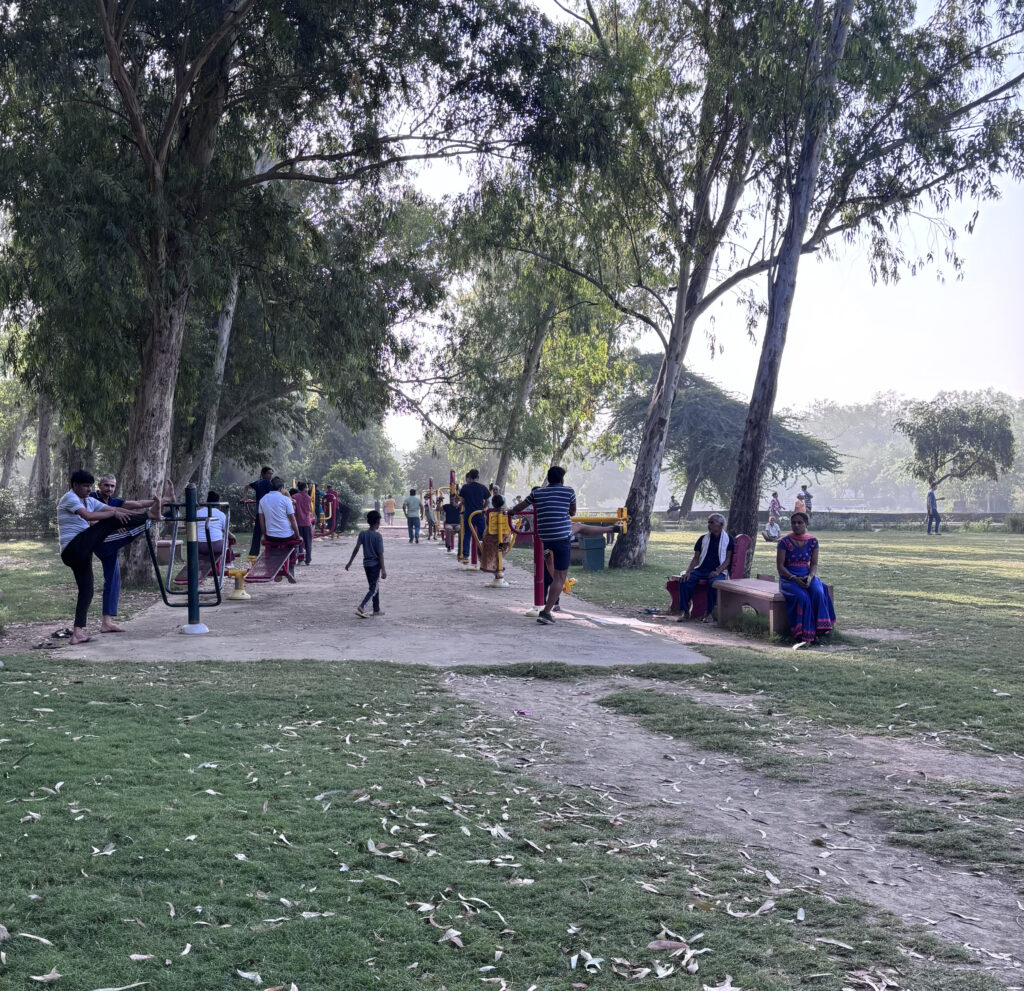
Reclaiming public spaces through civic participation does more than reshape the physical city; it also strengthens how people experience citizenship in everyday life. Streets, parks, squares, markets, open grounds, pavements, neighbourhood corners, bus stops, waterfronts, and community courtyards are not merely elements of urban design; they are everyday stages on which social life plays out, reflecting the culture and character of a society.
Yet across Indian cities today, many of these shared spaces are shrinking or being redesigned in ways that quietly shape how they can be used. What may appear as a park rule, design choice, or planning intervention often determines something deeper: who feels comfortable occupying these spaces and who must negotiate their presence.
Public space and the right to occupy
While the uses of public space are many, at critical moments they become arenas where citizens gather, speak, and assert their rights. When people assemble in streets, parks, or squares to raise their voices, they are not stepping outside the purpose of public space; they are inhabiting it fully.
Yet today, there has been a decline in institutional tolerance for dissent in India’s public spaces. This becomes most visible when authorities regulate where and how people can gather and express disagreement through barricades, restricted access, surveillance, and designated protest zones. Such measures do more than manage crowds; they shape where dissent can be visible in the city and where it is pushed to the margins.
The farmers’ movement revealed how citizens respond when access to space is restricted. During the 2020–2021 protests against three agricultural laws passed by the Indian Parliament, thousands of farmers travelled toward Delhi, opposing what they saw as a top-down legislative process and fearing the changes could lead to greater corporate control and potential loss of livelihoods. As large groups moved towards the capital, access to highways were blocked with barricades, concrete barriers, trenches, and even roads studded with nails. Yet instead of dispersing, they turned the border highways themselves into sites of collective life. What began as blocked roads slowly transformed into vibrant public spaces where people cooked, slept, organised discussions, held reading circles, and raised slogans on the very roads meant only for vehicular traffic. For months, these highways functioned as spaces where political debate and everyday life unfolded side by side.
A similar transformation took place during the protests against the Citizenship (Amendment) Act (CAA) and the proposed National Register of Citizens (NRC) at Shaheen Bagh in late 2019 and early 2020. The demonstrations, led largely by local women, emerged in response to concerns about citizenship and exclusion. An otherwise ordinary neighbourhood road became a powerful site of resistance. What had once been a transit route evolved into a space of dialogue, art, speeches, and collective reflection on citizenship and belonging.
These moments point to a broader pattern. When established protest sites are restricted or tightly controlled, citizens often reclaim other parts of the city roads, intersections, and neighbourhood streets turning them into spaces of assembly and debate. In doing so, they challenge the idea that public space must remain orderly and controlled, reaffirming it as a space for gathering and dissent. At the same time, such instances reveal a deeper tension in how cities are planned and governed, where efforts to make them more “livable,” “safe,” or “accessible” often rely on regulation and design that quietly shape who can occupy public space and whether it remains truly public.
Public Space and the Right to Belong
The contest over public space unfolds not only during moments of protest but also in the quiet routines of everyday life. If protests show how people come together to claim space, daily life reveals who can move through that space with ease. For many women, being in public space still involves a small but constant negotiation. Time outside is often expected to have a purpose, such as commuting to work, running errands, or accompanying family. Simply sitting in a park, lingering on a street, or walking without urgency can sometimes invite unwanted attention.
Responses to concerns about safety have often focused on separating women-only metro compartments, pink buses, special queues, or designated “safe” zones. While these measures are intended to protect, they do little to transform the conditions that shape how public spaces are experienced. Safer cities are not created through segregation, but through streets that are well lit, active, walkable, and open to diverse users at different times of day.
The deeper issue is not only safety but the freedom to simply be there. What many women seek is the ability to move through the city’s public spaces to walk, sit, pause, or spend time without explanation. Yet even today, many step outside, carrying a quiet calculation of risk that should not be necessary in spaces meant for everyone. When planning focuses only on protection rather than presence, it risks reinforcing the idea that women must adapt to public space, rather than ensuring that public space fully belongs to them.
Public Space and the Right to Move
Public space is shaped not only by who can enter it, but also by how easily people can move through it. The question of belonging often appears in everyday acts- walking along a street, pausing briefly, or finding a place to sit.
Footpaths are among the most basic forms of public space, yet in many cities they remain fragmented or obstructed. Parked vehicles, construction debris, and temporary barriers often push pedestrians onto busy roads. For older people, persons with disabilities, vendors, or workers carrying goods, the street becomes even harder to navigate. These conditions reflect planning priorities that have long centred vehicles over people. Treating footpaths as essential public infrastructure rather than leftover road space is a necessary step toward making public space more accessible.
Public Space and the Right to Keep it Public
Public spaces are not amenities added after the city is built; they are the civic ground on which urban life unfolds. When access to these spaces is restricted through barriers, scrutiny, or the quiet erosion of walkable streets, it becomes clear that the struggle over public space is also a struggle over who these spaces are meant for.
Issues related to accessing public space rarely unfold in simple or predictable ways. They sit at the intersection of dissent, gender, mobility, livelihoods, and safety. Perhaps the task before planners and city governments is not always to design more, but sometimes to step back and leave room for the unplanned rhythms of public life. This can also mean recognising when not to redesign public spaces, but to improve them in ways that support existing use. Large-scale revamps and highly-designed environments can overlook everyday life and local character. Instead, planners can focus on making spaces more usable and inclusive, improving hygiene, providing restrooms for all genders, ensuring accessibility, widening footpaths, removing blockages, and adding seating and shade. Allowing street vending and small-scale livelihoods, while addressing unsafe or exclusionary conditions, can help strengthen public spaces making them active and welcoming.
Across cities, there are already efforts moving in this direction. The Sustainable Mobility Network, working across Indian cities to advance more accessible, and people-centred planning, brings together a range of initiatives and organisations. These include supporting efforts such as Raahgiri Day, which temporarily transform streets into spaces for community activity, urban groups in Bengaluru, which work with communities to improve walkability and everyday access to public space, alongside fellowships that help build youth leadership. Together with many other civic collectives, these efforts continue to advocate for more inclusive and people-centred planning.
When public spaces remain open to commuters, vendors, protesters, workers, and those who simply linger, they keep the city alive as a shared place. Efforts by citizens, planners, and civic networks alike remind us that keeping the public in public space is not simply a planning challenge, it is an ongoing democratic practice.
Swati Batra works in research, impact, and learning with Purpose, a social impact agency. Her work focuses on generating insights, drawing out learnings, and documenting stories of change. She is part of initiatives in India, including the Sustainable Mobility Network and People First Cities, working across themes such as gender, mobility, climate, waste, and urban planning. She focuses on understanding lived experiences and translating insights into approaches that strengthen equitable access, belonging, and more people-centred urban futures.