By Jenn Hendricks
The following piece is part of Progressive City’s “Keeping the ‘Public’ in Public Space” series, which asks authors to address the way public spaces are governed, restricted and/or policed, in addition to the role of planning in both enabling and contesting the enclosure of public space. Of special concern are policies, designs and practices that limit the use of public spaces, formally or informally, based on the race, gender, sexuality, disability and national origin of people. More information about this series can be found here.
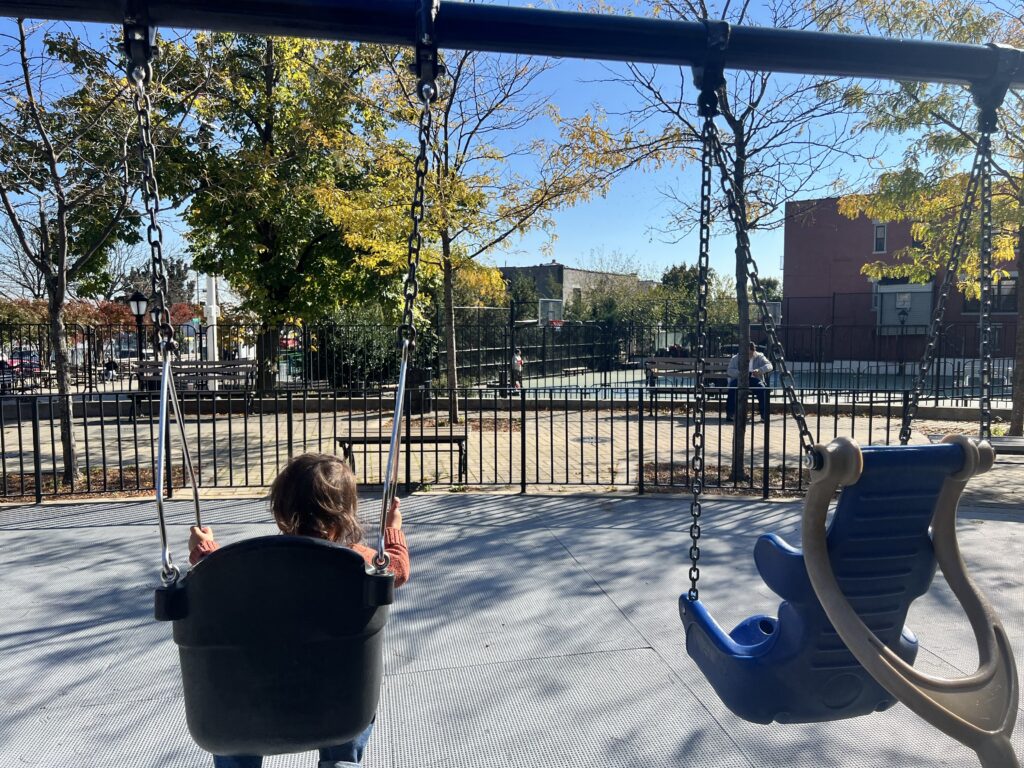
Public space is often imagined as a shared civic amenity—parks to relax in, libraries to visit, recreation centers to enjoy. In neighborhoods facing deep childcare shortages and economic precarity, public space serves a far more basic function. In Brownsville, Brooklyn and Hunts Point, Bronx, families rely on libraries, parks, recreation centers, and community-based organizations as part of their everyday childcare system.
These spaces provide supervised environments after school, safe places to spend time, and predictable routines when formal childcare is unavailable or unaffordable. For caregivers navigating work schedules, school dismissals, and limited household resources, access to functional public space is not optional. It is a condition of daily survival.
Brownsville and Hunts Point both rank among the highest-need districts in New York City according to the Citizens’ Committee for Children Community Risk Index. Brownsville’s child poverty rate exceeds 55 percent, while Hunts Point’s approaches 38 percent. Families in both neighborhoods face high rent burden, housing instability, and serious health risks, including elevated asthma hospitalization rates. In these conditions, families depend heavily on free or low-cost environments to support caregiving.
Despite these shared challenges, public space functions very differently in each neighborhood, driven not by need, but by uneven investment, design quality, environmental conditions, and fragmented governance.
Public Space as Childcare
In Brownsville and Hunts Point, families assemble care through a network of locations rather than a single provider. After school, children move through libraries, parks, community centers, and neighborhood organizations before returning home. These “care chains” allow caregivers to manage work, commuting, and household responsibilities while children remain in supervised, accessible environments.
Brownsville offers families more flexibility within this system. The neighborhood has 87 open and recreational spaces compared to 48 in Hunts Point. Brownsville also has more voucher-based childcare providers, 281 compared to 213, and nearly twice as many DOE Pre-K sites, with 25 in Brownsville versus 13 in Hunts Point. While both neighborhoods have similar numbers of contracted EarlyLearn childcare sites, Brownsville’s broader mix of assets gives families more options when stitching together care.
Hunts Point families navigate a more constrained landscape. With fewer total community spaces and higher environmental burdens, caregivers rely heavily on a small number of indoor anchor institutions, particularly the Hunts Point Library and THE POINT Community Development Corporation. These spaces play an outsized role in daily childcare, but limited capacity means they fill quickly and cannot absorb all demand.
When Public Space Is Technically Open but Practically Unusable
The quality of public space matters as much as its existence. In Hunts Point, many parks lack basic features that allow caregivers and children to stay for meaningful periods of time. Shade, seating, bathrooms, lighting, and safe access routes are often missing or inconsistent. Without these elements, parks function as pass-through spaces rather than reliable places for care.
The contrast with Brownsville is stark. Betsy Head Park, which has received significant capital investment, includes shade, seating, bathrooms, water access, and multiple play areas. These features allow families to remain for extended periods and integrate the park into daily routines. In Hunts Point, by contrast, Riverside Park lacks shade, bathrooms, seating, and safe circulation, making long stays difficult for caregivers with young children.
These conditions create a form of exclusion without explicit rules. Parks remain legally public, but missing amenities communicate that extended use is not supported. For caregivers, especially women managing children and strollers, this transforms “open” space into space that is functionally inaccessible.
Indoor spaces offer more reliability. Libraries and community-based organizations in both neighborhoods provide consistent hours, adult supervision, and predictable access. Brownsville Library, Hunts Point Library, and THE POINT CDC all function as stable environments where children can safely spend time after school. Recreation centers also play an important role, though inconsistent hours, aging facilities, and renovations limit their reliability.
Fragmented Governance Shrinks the Public Realm
A major barrier to making public space usable for families is fragmented governance. Parks, libraries, recreation centers, schools, and youth programs are managed by separate agencies with different hours, maintenance systems, and funding streams. Families encounter this fragmentation directly: bathrooms closed during peak park hours, recreation centers with limited schedules, and spaces that shut down just as others open.
This lack of coordination undermines the publicness of public space. Even where assets exist, caregivers cannot rely on them consistently. Parents must constantly adjust routines based on unpredictable access, increasing stress and reducing the usefulness of public environments for care.
Planning systems often separate childcare policy from public space policy. In practice, families experience them as one system.
What Planning for the Public Would Look Like
The findings point toward straightforward, achievable changes. Coordinating hours and maintenance across agencies would immediately increase usability. Ensuring bathrooms, lighting, and shade are available during peak after-school hours would make parks function as real childcare supports rather than symbolic amenities.
Small, targeted investments could have outsized impact. Modest funding for shade structures, seating, hydration stations, and safe access routes would address the most significant barriers in Hunts Point parks. Similarly, improving information access, so families can see which spaces are open, staffed, and accessible in real time, would reduce uncertainty and caregiver burden.
Finally, evaluating public space based on how it works for children and caregivers, rather than abstract design standards, would help planners prioritize equity in investment and maintenance.
Keeping the “Public” in Public Space
In Brownsville and Hunts Point, public space already functions as childcare infrastructure. Whether it truly remains public depends on design, maintenance, and governance choices. When public spaces are predictable, comfortable, and coordinated, they support daily caregiving and neighborhood stability. When they are neglected or fragmented, public space contracts, becoming inaccessible in practice despite being open in name.
Keeping the “public” in public space means planning for how families actually live. In high-need neighborhoods, public space is not an amenity. It is everyday infrastructure.
Jenn Hendricks is an urban researcher residing in Queens. This article draws from her capstone research in the Urban Policy and Planning master’s program at Hunter College (CUNY), which examines how public spaces function as informal childcare infrastructure in high-need New York City neighborhoods.