By Tom Angotti
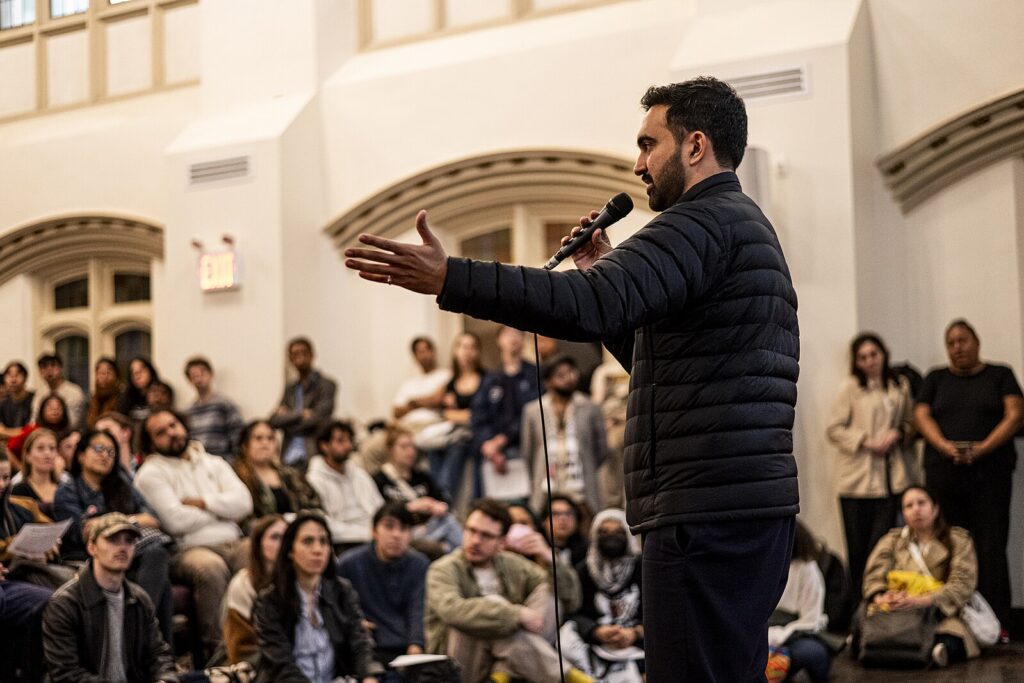
Progressives in New York City are celebrating the huge, decisive and unprecedented victory of Democratic Socialist Zohran Mamdani to be the next mayor, following a huge grassroots campaign that went up against big money, a withering Democratic Party apparatus and an intense, well-funded media blitz that accused the candidate of being too inexperienced, a Communist, Muslim terrorist and anti-Semitic. President Donald Trump wound up supporting Mamdani’s opponent, disgraced former New York State Governor Andrew Cuomo, who had been forced to resign amid multiple accusations of sexual abuse of his staff. Mamdani’s overwhelming victory may well help deter Trump and the Republican Party from attempting to use the violent, ruthless tactics that were used in Chicago, Los Angeles and other cities to taunt and arrest immigrants.
Among Mamdani’s most heartening comebacks in response to Cuomo’s red-baiting was his embrace of historic socialist leaders including Eugene Debs. While Cuomo accused Mamdani of being a socialist and/or communist (would he know the difference?), Mamdani did not shrink from his socialist identity and in his acceptance speech acknowledged the legacy of the great labor leader Eugene Debs, who a century ago ran for office in New York City on the Socialist Party line.
Mamdani’s win garnered huge support from tenants and small homeowners across the city who face rapidly rising rents, property taxes, and predatory real estate practices. The executive branch under mayors of both major parties has consistently backed big real estate deals and weak rent regulations while reinforcing its control over land use and zoning. Over time they have weakened the powers of community boards and progressive grassroots organizations while steam-rolling zoning giveaways in favor of developers and diminishing the voices of tenants, small homeowners and City Council representatives. New York City’s imperial executive branch overshadows neighborhood-based organizing and ability to control development.
Over the last century, New York City politics has maneuvered around and largely supported narrow ethnic politics, which have always been subject to high-level negotiations between those in power and community-based kingpins who are merely brokers and not leaders. Zohran Mamdani may have signaled the beginning of the end for such retail politics and sparked the rebirth of politics that transcend racial and class divisions and cut across neighborhood boundaries. He has a chance to help re-ignite one of the most important elements in the history of New York City politics: an alliance between anti-racist, anti-imperialist and pro-labor movements that transcend the barriers of neighborhood, ethnic and language isolation.
One of the most amazing aspects of Mamdani’s campaign was the extensive support he received from young voters, communities of color and immigrants. Critical in the campaign were the organizing skills of the Democratic Socialists of America (DSA) and the Working Families Party. Especially notable was the powerful grassroots organizing by the Working Families Party and progressive Jewish organizations, especially Jewish Voice for Peace (JVP), which firmly opposed Israel’s genocidal war on Gaza. Mamdani’s campaign went forward even when the traditional power brokers stood firm in favor of the usual transactional politics that left only crumbs for working people.
I grew up in an Italian/Jewish neighborhood in Brooklyn and over recent decades sadly watched as both communities moved out to the whiter,wealthier and more conservative suburbs. However, after the Isreali/US-backed genocide in Gaza, I supported JVP because it was a major force that openly and boldly challenged the hegemony of conservative groups such as the powerful American Israel Public Affairs Committee (AIPAC) and the Anti-Defamation League.
The recent elections in New York may well have signaled the waning of the old ethnic politics and the birth of a new progressive, working class coalition that can challenge the hegemony of big real estate and build new coalitions supporting working class politics and contesting imperial projects. We will hopefully join Seattle, Minneapolis and other cities that have challenged the dysfunctional, wasteful and often reactionary two-party monopoly that is financed and controlled by big donors. The big question is now whether we are able to consolidate this electoral win, stop the fascist wave and unite to build new political relations within and between our diverse neighborhoods.
Mamdani’s detractors are already circling the wagons to protect themselves, block major reforms and launch a comeback. The most critical question, however, is whether Mayor Mamdani will back down when confronting the powerful real estate lobby and Wall Street, still major power brokers in city politics. Will Mamdani continue to champion those without jobs and adequate housing who are left in the wake of a vengeful Donald Trump? Trump is hardly a popular figure in his home town but it is not hard to imagine the city’s wealthy class and mostly conservative press rallying to prevent Mamdani from enacting any serious reforms. Mamdani already came out in favor of (outgoing) Mayor Adams’ proposed revisions to the City Charter that would ease restrictions on real estate development in lower-density working class neighborhoods and restrain grassroots advocates. When he comes under more intense pressure, will Mamdani end up appeasing landlords and developers and throw his most active supporters under the bus? Will he back the pro-developer YIMBYs (Yes In My Back Yard), stop the movement towards the privatization of public housing, and go beyond the popular but still vague promise of “social housing?” Will he follow the previous mayor’s deregulation of land use controls? Last but not least, we have yet to see Mamdani endorse a serious plan to end homelessness. Now is the time for him to take the initiative!
Trump’s empire started in New York City and, hopefully, will end here; his properties are as big as his ego and we need the space. Fortunately for us, our city has become more like the city that former Mayor David Dinkins, the first African American to be elected to that office, called a “gorgeous mosaic.” Though he rarely dwelled on it, Dinkins was the first mayor who belonged to DSA! That is a precautionary tale: when he ran for a second term, Dinkins faced an ugly racist campaign waged by Trump’s buddy Rudolph Giuliani, and Giuliani won the race. Will Mamdani be able to fortify his base in the neighborhoods, within unions and among the multinational working class who make up his natural base? That will be the key to fulfilling his promises and implementing an ambitious agenda.
I am hopeful. The first time I ran into Mamdani was at a rally outside City Hall on a cold winter day where immigrant taxi drivers were on hunger strike. Mamdani was the only elected official in sight. I hope we will see him there in the future. That kind of firm action may be the only thing that can sustain his legitimacy. DSA’s progress in the electoral arena has yet to be matched by its progress in the wider arena of grassroots activism, but Mamdani can help move the ball forward. He will have his hands full if he is going to serve those who elected him to bring out fundamental change.
Tom Angotti is Professor Emeritus of City University of New York and a founding member of Planners Network.