
By Chris Giamarino
The following piece is part of Progressive City’s “Contesting the University as Planner, Occupier, and Developer” series, which asks authors to examine the role of academic institutions in (re)shaping cities and how planning practitioners, activists, educators, students, or other actors can contest their harmful impacts both from within and outside these institutions. More information about this series can be found here.
At UCLA, the number one public university in the nation, public spaces are managed in exclusive ways that limit their accessibility and impact students’ social inclusion. During my tenure at UCLA as a PhD student and lecturer (2019-2025), the university implemented a suite of hostile designs—policing, surveillance, and hostile architecture —to produce an exclusionary campus environment. This also included racial profiling, mass arrests, physical violence, and planned exclusion during the 2019 Cost of Living Adjustment movement, the 2020 Black Lives Matter uprisings, the 2022 UC Academic Worker Strike, and the 2024 pro-Palestinian campus occupation. Beyond quantitative metrics like graduation rates, student-faculty ratios, and faculty citation impact scores, publicness can be measured by how ownership structures and management strategies impact accessibility to and inclusiveness of public spaces.. However, the exclusionary strategies employed by UCLA call into question its publicness – just because a university is ‘public’ does not mean it is planning just public spaces. The purpose of this contribution is to highlight two examples of spatial storytelling that catalog hostile campus designs and reimagine them to enhance publicness. While planning is a contentious political and social process that guides economic development of cities, it is also a persuasive storytelling practice that articulates a compelling vision for a more just future.
To paraphrase Ed Soja’s concept of “spatial justice,” just public spaces are fair and equitably distributed places that provide people opportunities to access them and use them for their own desires. For example, UCLA’s public spaces, while owned and managed through restrictive regulations and police presence, should allow students to access them, feel included in their use, and partake in protest and play. Students should feel included in the public spaces where they attend college and have accessible places to engage in peaceful protests and physical activity without fear of arrest, ticketing, or violence. Three decades ago, Mike Davis expressed that urban planning has become a comprehensive security effort in Los Angeles, with “physical security systems” to control users through the “architectural policing of social boundaries.” At the university scale, UCLA similarly produces spatial injustice through hostile design controls that limit access to its public spaces. As an urban planning scholar, public space advocate, and skateboarder, I use storytelling to humanize the experiences of unhoused communities and youth skateboarders as they navigate hostile designs to plan public spaces that are more accessible and inclusive. I present a story map of UCLA’s historical investment in racist, spatial policing strategies and a photographic catalogue of hostile architecture throughout its public spaces. Both works editorialize the need to plan a future where public campus spaces are free of hostile designs and instead foster a sense of accessibility and inclusion (i.e., publicness).
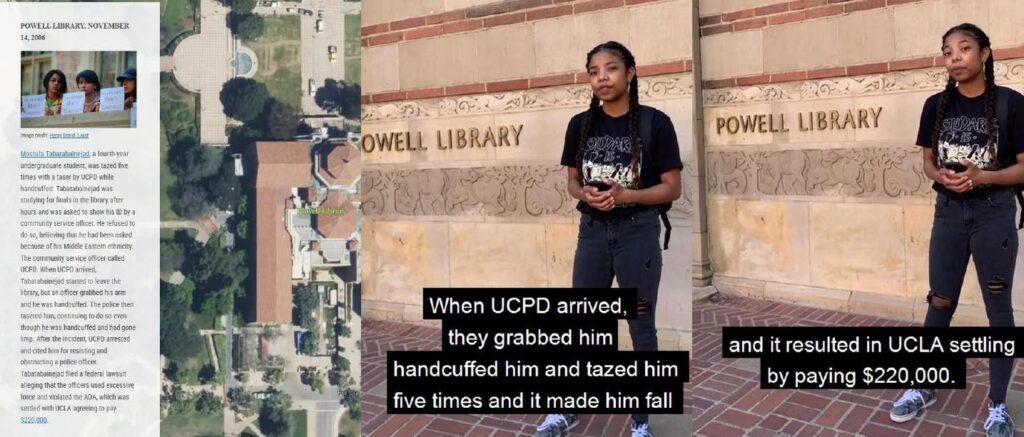
During the COVID-19 pandemic, a faculty and undergraduate working group reached out to me to help them build an interactive story map for the UCLA Cops off Campus initiative. The design was inspired by a life history of Octavia E. Butler in greater Los Angeles. The story map presented a “spatial and temporal journey towards a campus and a world without cops.” The storytelling goal was twofold. First, the spatial story functioned as a catalogue that mapped sites of carceral violence in public spaces on and near campus. Second, it demonstrated how the university has been historically complicit in investing in racist research programs, spatial policing strategies, and physical violence on campus. From the 1993 protests against budget cuts to the Chicano Studies Program and subsequent arrests, which led to its departmentalization, to the arrests of protesters and use of Jackie Robinson Stadium as a jail during the 2020 Black Lives Matter demonstrations, the map helps tell a story of injustice and advocates for imagining a future where UCLA invests in livable wages, racial equity, social services, and publicness through its spatial contribution to the UCLA Luskin Institute on Inequality and Democracy’s Abolition Repository. The map has been used for teach-ins and walking tours to build the case for a future without cops and hostile designs on a public campus. As evidenced by UCLA calling the police to demolish pro-Palestinian encampments, which resulted in over 200 arrests, 150 students being assaulted, and 25 hospitalizations, there is an ongoing need to “pressure our campus to end its legacy of policing students and community.”
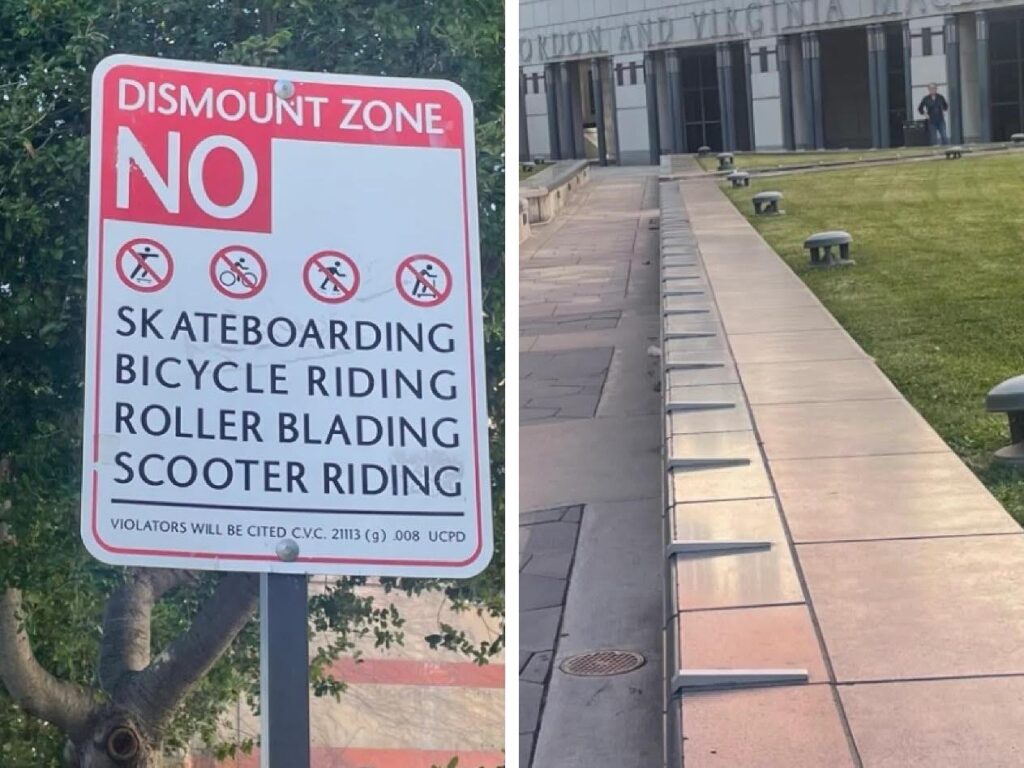
In a collaborative autoethnography, my friends and I publicized our personal experiences navigating public university spaces as skateboarders in Australia, the United Kingdom, and the U.S. Our goal was to visually document how our universities use public funds to invest in hostile architecture. Through photographic journaling, we detailed how regulatory signage and police enforcement criminalize active transportation options. In one instance, I was carrying my skateboard after dismounting outside of the building where I taught Geographic Information Systems for two years. I was stopped by a cop, asked what I was doing on campus, and forced to show my UCLA Faculty ID to enter the building. We collaged thousands of brackets called “skatestoppers” which architecturally communicate that certain modes of transportation and students are unwelcome. We calculated an investment of tens of thousands of dollars in skatestoppers. These designed exclusions produce negative social and physiological outcomes but present us with opportunities to contest them. By performing tricks on public-facing architecture before police arrived, we were able to recreate temporarily. Reflecting on our findings, we offered two planning recommendations. First, universities should increase outreach to students to include them in decision-making processes that may lead to their exclusion through hostile designs. Second, universities can decriminalize activities, address injury liability, and reduce property damage by installing materials like angle iron and providing sanctioned spaces to promote physical activity. The UCLA Skate Club’s collaboration with UCLA to program campus spaces for recreation offers a partnership model to expand publicness.
While a growing number of students are living in their vehicles, UCLA’s walkways display banners that market the public campus as the top public university based on teaching, research, and funding metrics. These two storytelling examples illustrate how the management of public spaces impacts publicness for students, faculty, and staff. The use of public funds to communicate through regulatory signage, spatially harass through policing and arrests, and physically exclude through hostile architecture demonstrates that campus spaces are neither public nor just. Therefore, public universities should also be measured by their degree of publicness in spatial accessibility and inclusiveness. If planning is persuasive storytelling about a desired future, then there is an ongoing need to document hostile designs spatially, photographically, and journalistically through story maps, blog posts, and other public forums. Through protest and play, we must ensure that university spaces are planned to be spatially just.
Chris Giamarino is an Assistant Professor in the Urban and Regional Planning Department at Cal Poly Pomona’s College of Environmental Design.