
By Stefan Chavez-Norgaard
The following piece is part of Progressive City’s “Contesting the University as Planner, Occupier, and Developer” series, which asks authors to examine the role of academic institutions in (re)shaping cities and how planning practitioners, activists, educators, students, or other actors can contest their harmful impacts both from within and outside these institutions. More information about this series can be found here.
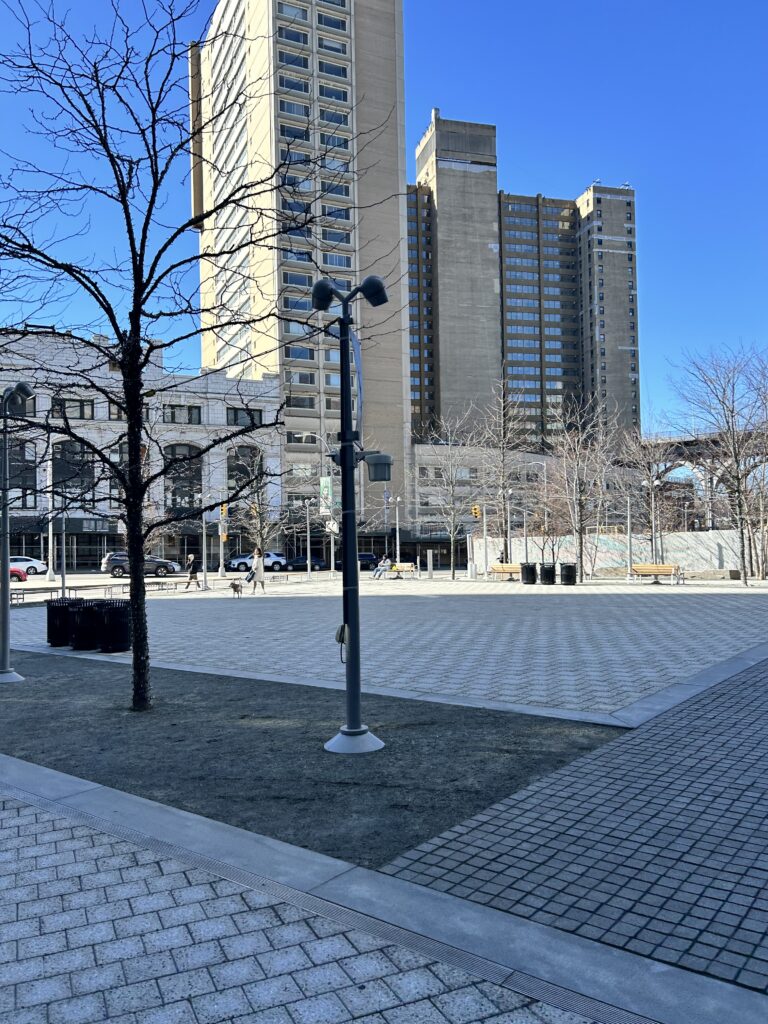
Columbia University’s Manhattanville Campus Expansion Project, first proposed in 2003, envisioned a massive 17-acre campus in West Harlem from 125th Street to 133rd Street, and from either side of Broadway to 12th Avenue. Implementing this project required that the university work with the New York City Department of City Planning (DCP) to re-zone key areas of the working-class, predominantly Black area West Harlem neighborhood and declare numerous parcels ‘blighted’ to invoke the heavy hand of eminent domain. The project, which was approved and is now under active implementation, led to evictions and dispossessions and altered community character: the very name ‘Manhattanville,’ only recently constructed by the university as a development promotion tool, suggests an erasure of the West Harlem neighborhood demolished to make way for the new campus. Throughout the past decade, Columbia University used tools of land-use, zoning, and urban redevelopment to transform a low-lying, environmentally vulnerable neighborhood of West Harlem into a gleaming new campus for its business school. Yet Columbia students, faculty, staff, community members, and other advocates contested these efforts over time, including at one point through a 10-day hunger strike in 2007, and ultimately negotiated a field-defining Community Benefits Agreement (CBA) for over $150 million dollars.
Columbia’s Manhattanville Campus Expansion indeed reveals the university to be a powerful planner, occupier, and developer. But it also reveals the importance of contestation and the ultimate negotiating power of communities as they engage university institutions. Another instructive lesson from the Manhattanville Project is that of mnemonic resistance: it is essential to remember the history of these 17 acres, in full critical form, to organize in the face of future university-driven projects of dispossession and to lift up vestigial remains of what was once a vibrant, if underappreciated, Manhattan neighborhood.
The case of Manhattanville reveals contradictions inherent to universities’ roles in urban planning. University expansion is often justified as an educational and public good. However, university-driven dispossession reveals the callousness of these institutions toward low-income people of color – neighbors – who find themselves “in the way” of campus expansion. Although universities are nominally beacons of progressive humanism, and in the contemporary moment purport to be pillars of principled, values-based resistance, cases of university-driven dispossession should give us pause.
Columbia’s Urban Planning program, in particular, lies at the heart of this contradiction. The program, known internationally for its emphasis on social justice in urban planning and its focus on participatory planning and procedural justice, included a Planning Law course focused in detail on the juridical and socio-legal processes by which land use, zoning, and urban-development changes might occur. Given my critical Planning Law expertise, I found that the very university in which I was sitting, Columbia, was a “worst offender.”
Working with np: press, a nonprofit publication project seeking to disrupt university publishing in favor of more representative and creative approaches, I recently published a book offering an extended case study of Columbia University’s Manhattanville Campus Expansion. In this book, I explore the project’s motivations, various actors’ resistance to it, and the university’s eventual implementation of the project, all from my own very partial perch within the university’s urban planning program.
Part of my goal in crafting this book was pedagogical. Indeed, as a Teaching-line faculty member at the University of Denver, I found that Manhattanville provides instructors with an evocative teaching case and students with a close-by experiential learning opportunity. Indeed, when discussing Manhattanville’s campus expansion, course discussions often raise issues not solely confined to university-driven dispossession, but of various forms of exclusion and dispossession globally, particularly of the poor and of people of color. How might examples like the Manhattanville project galvanize students and instructors to respond to the complicity of their very own institution, and not merely to injustices of settler-colonial landed-property arrangements more abstractly? Alternatively, what is missed by an overly insular focus on campus-connected injustices while numerous seizures of “real property” continue across American cities, often complete with fewer ancillary community benefits? These questions connect challenges at Columbia University with those at the University of Chicago, University of Pennsylvania, and other institutions, and likewise connect issues of campus expansion with hubristic urban-planning projects around the world, from Robert Moses’ Cross Bronx Expressway to widespread eviction in cities like Luanda, Angola. Indeed, there is a growing corpus of critical scholarly work on university exclusion in planning in particular, including works by Davarian Baldwin, Laura Wolf-Powers, and others.
Beyond insights for teaching and learning, the case of Columbia’s Manhattanville campus expansion offers insights behind the working of Columbia University, and of other American higher-education institutions. Like many universities, including its New York City neighbor New York University, Columbia functions simultaneously as a university and as a large real-estate corporation. Indeed, the university benefits from tax breaks as a 501(c)(3) nonprofit even as it is New York City’s largest private landowner. With over 320 properties, at a combined land-value of over $4 billion, the university’s tax-exempt status means it does not need to pay property taxes. According to a New York Times analysis, over $182 million annually is not going to New York City’s public coffers because of the university’s tax-exempt status. Yet while many of Columbia University’s real-estate activities are indeed associated with higher education and student learning, many others are not. The university is a large residential and commercial landlord, charging rent for both students and faculty and non-affiliate community members, small businesses, and large national franchises.
Yet counterintuitively, projects like Manhattanville offer a setting in which students, faculty, activists, and community members can learn to contest power. Power-building can take the form of solidaristic relationships across lines of race and class that lead to durable political coalitions for other social issues. At Columbia, a coalition of activists and movement members protested the Manhattanville plan, including the United Front Against Displacement (UFAD), campus organizations such as Student Worker Solidarity and Columbia Housing Equity Project, and students and outside activists. And although advocates did not halt the Manhattanville plan, their contestation and the media attention it created helped launch the university into negotiations for a Community Benefits Agreement (CBA). In essence, the West Harlem Community Benefits Agreement (CBA) entailed the creation of a legal contract signed in 2009 between Columbia University and a wide-ranging coalition of community leaders, elected officials, and civic organizations, collectively governed as the West Harlem Local Development Corporation (WHLDC). The CBA specifies key guardrails for the Manhattanville development and promises some $150 million in community benefits. However, scholars like Nicholas Robinson have questioned Columbia’s good-faith implementation of its CBA commitments, for example by placing implementation responsibilities with WHLDC despite that organization’s known capacity concerns.
Projects like Manhattanville also raise the importance of mnemonic resistance. Mnemonic resistance foregrounds the power of memory to introduce new, creative, and emancipatory forms of resistance beyond the more traditional repertoires of community contestation that include protests, demonstrations, or negotiated Community Benefits Agreements (CBAs). Mnemonic practices involve remembering what was previously there in Manhattanville, and remembering who lived there and how. These practices also uplift those who were not displaced, but who witnessed their neighborhood transform. Mnemonic resistance can connect memories of those displaced and those still present to the larger social implications of urban planning and university-driven dispossession. I believe that such memories can be the fuel to structure contestation and protest against future unjust planning efforts, and can even serve as the foundation for a future, mnemonically informed reparative planning regime guided by values of community care, participation, and popular democracy.
Stefan Chavez-Norgaard is Teaching Assistant Professor of Public Policy at the Douglas and Mary Scrivner Institute of Public Policy at the University of Denver’s Josef Korbel School of Global and Public Affairs, where he teaches courses in urban planning and public policy. He received his PhD in Urban Planning from Columbia University in 2024. His research interests include planning history and theory, planning law, and mixed-methods research focused on planning practice and urban governance in the related but distinct late-liberal contexts of South Africa and the United States. Stefan is passionate about participatory democracy and how cities’ public/private arrangements affect equitable and sustainable urban development. His forthcoming research explores possibilities for equitable, democratic urban development in Denver.