The following piece is part of Progressive City’s “Contesting the University as Planner, Occupier, and Developer” series, which asks authors to examine the role of academic institutions in (re)shaping cities and how planning practitioners, activists, educators, students, or other actors can contest their harmful impacts both from within and outside these institutions. More information about this series can be found here.
Authored by Solidarity Group, a collective of teachers and researchers employed at Chalmers University of Technology, including Emilio Brandao, Naima Callenberg, Sofia Cvetkovic Destouni, Greta Faxberg, Bri Gauger, Kristina Grange, and Åsa Isacson. Solidarity Group formed in support of the Palestinian struggle for freedom and peace. Their work focuses on strengthening solidarity efforts within academic communities and encouraging the university to act in line with its stated principles of openness, participation, respect, diversity, and equality.
No political manifestations on campus
In November 2023, after the escalation of Israel’s assault on Gaza but before the pro-Palestinian encampments on university campuses had spread across the world, students at Chalmers University of Technology in Gothenburg, Sweden, held a peaceful candlelight vigil for the victims in Gaza outside of the student union building. In the weeks prior, students and community members had been demanding that the university end its collaboration with Elbit Systems, a major Israeli defense contractor, who had been invited to exhibit at the Chalmers student union’s career fair.
It didn’t take long for the university to react to these demands; not by heeding calls to end collaboration but rather by prohibiting any political manifestation on campus. The day after the vigil, November 13th, the university president and student union jointly issued a statement prohibiting anyone from “gathering and expressing political opinions in a way that means that those who pass by cannot avoid seeing or hearing the message.” The ban specifically prohibited posters, prompting questions about what else could be perceived as political – T-shirts? Flags? Signs? As teachers and researchers at Chalmers, we were not only horrified by the statement itself, but also deeply concerned with the broad language that we suspected would be targeted only at particular political opinions. University management declared that the ban was a necessary consequence of the escalation of violence in the Middle East which risked extreme polarisation on campus and legitimized its decision by referring to campus as private property. Sweden’s Minister for Education soon thereafter expressed support for the university’s decision.
Luckily, many Swedes reacted with deep dismay. Political party leaders, representatives from other universities, and community leaders heavily criticised both the university management’s decision and the minister’s support of the ban in all large Swedish daily newspapers. Many pointed to the historical role of universities as sites of political discourse, and protests were organised in defense of students’ right to freely express themselves. Under this public pressure, the university was forced to back away from its decision four days later, specifying instead that political manifestations could occur if organizers informed the university in advance. However, while the university reversed the outright ban, we remained concerned about chilling aftereffects from the broad definition of “political manifestation,” which was not specifically addressed or retracted.
A small but determined group of student activists organized under the name “Chalmers Social Justice” in the wake of the university’s ban and subsequent retraction. They organized events such as walk-outs, lectures, and movie nights to raise awareness and show solidarity into the spring of 2024, as pro-Palestine university protests proliferated around the world, many of which were met with violence and detention against protestors. This prompted the UN High Commission for Human Rights to conclude that students’ rights were violated on several occasions while underlining students’ right to freedom of expression. In Sweden, a country that is often viewed as a champion of egalitarianism and human rights, universities nevertheless reacted to protests by locking their facilities, and, on some occasions, denying students wearing keffiyehs access to toilets.
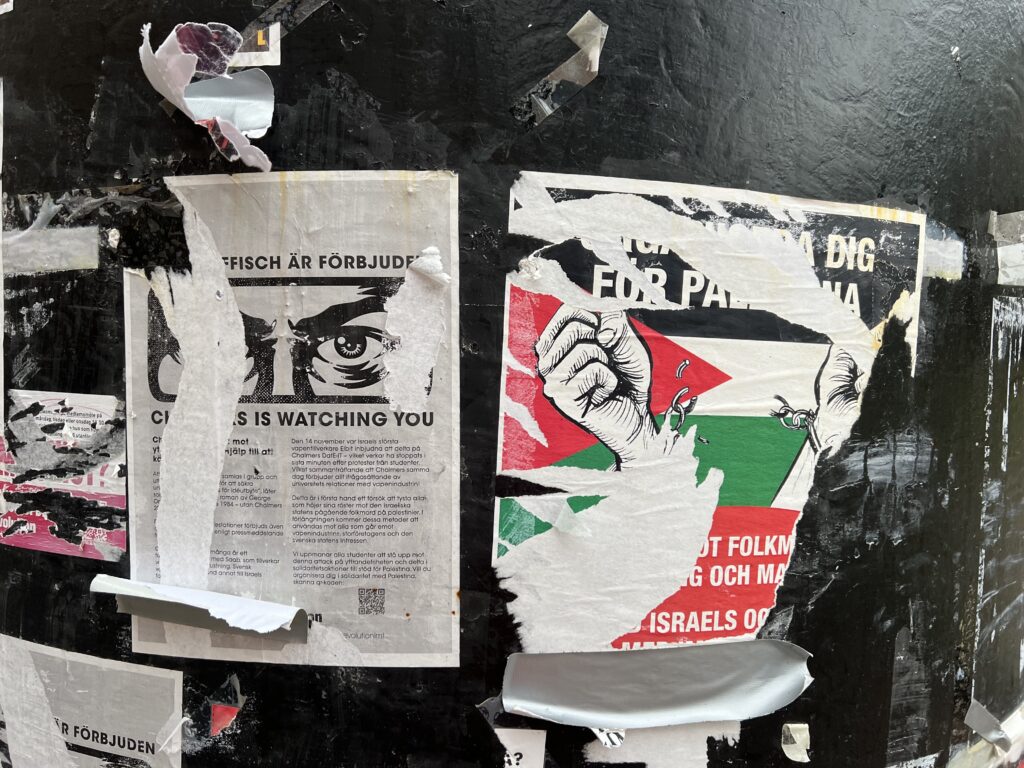
Throughout all of this, Chalmers students maintained a visible presence on campus, hanging flyers for Chalmers Social Justice events and circulating petitions in favor of cutting Chalmers’ ties to Israeli companies. By mid-May 2024 they had set up an encampment with tents and Palestinian flags on a central campus lawn near the architecture department, where most of the authors of this piece teach and where several student organizers were enrolled. By this point, the Chalmers administration had allowed students access to toilets and electricity, but a current of intimidation and silencing of pro-Palestinian voices continued to run under the surface.
The university’s abuse of power
In addition to our horror about the ongoing atrocities in Gaza and across the Israeli occupied territories, we are deeply troubled by the aftermath of the university’s ban on political expression. Students’ requests to meet with the university president were repeatedly ignored. Long after the retraction, some students continued to be surveilled by campus security and subjected to disciplinary action for peaceful protest. Despite obtaining permission to be an officially recognized student group, Chalmers Social Justice faced increasing bureaucratic hurdles to normal student group activities, such as booking rooms for their events, as Chalmers made new rules under the guise of security that seemingly only applied to them.
Chalmers has created a culture of uncertainty, silencing, and suppression of political opinion. For many members of faculty, the university’s response to student activists has left us feeling like our hands were tied in either supporting the students or expressing our own solidarity. Moreover, as teachers of architecture and urban planning, we recognized the danger in Chalmers’ appeal to the “privateness” of campus spaces as a justification for the university to continue policing what forms of speech were allowed by its students and staff after the ban was retracted.
We are deeply concerned by the university’s deployment of the term “political” as a stance which faculty should not take. We have been told that we can be “political” in our private lives, but not as representatives of the university. This imposition of a false dichotomy is a direct threat to academic freedom. The university has made itself the arbiter of what is political by deciding which voices, bodies, and topics are considered “political” or “activist” (i.e. constituting inappropriate behavior) and targeting Palestinian students and pro-Palestinian supporters. Their behavior stands in stark contrast to the way the university openly displays the pride flag, for example.
We believe that, rather than silencing, universities have an obligation to encourage and support activism both by students and faculty. As scholars of planning and architecture, we teach our students to understand their fields of study as necessarily political in nature. How then should we be expected to remain ‘apolitical’ on campus?