By Brenda Lau
The following piece is part of Progressive City’s “Contesting the University as Planner, Occupier, and Developer” series, which asks authors to examine the role of academic institutions in (re)shaping cities and how planning practitioners, activists, educators, students, or other actors can contest their harmful impacts both from within and outside these institutions. More information about this series can be found here.
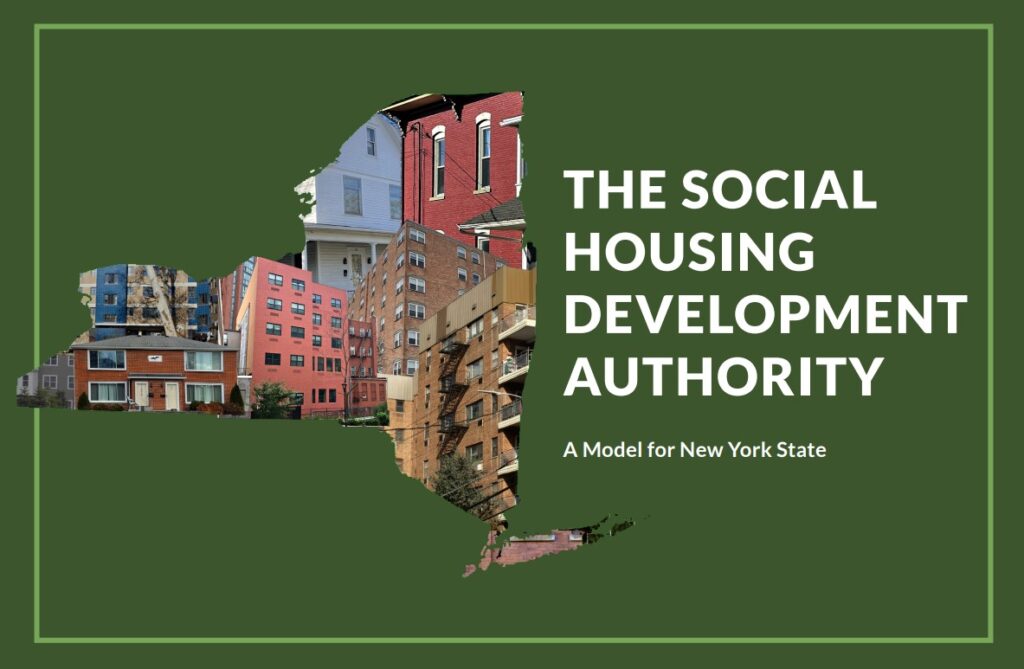
At Hunter College (City University of New York), the studio is typically the capstone workshop that urban planning students partake in to complete their graduate studies. As one of the first instances where planners must tackle a real-life planning scenario with a professional client, this exercise engages students in the planning process, teaching them essential participation skills such as collaboration, negotiation, and decision-making. In Fall 2023, non-profit organization Community Service Society (CSS) engaged Hunter planning graduate students for a semester-long studio. Since 1843, CSS has served New Yorkers of all backgrounds, championing equitable causes such as anti-poverty initiatives, issuing research, and stewarding advocacy on housing justice, healthcare policy reform, and workforce development. In lieu of drafting a comprehensive planning framework for a neighborhood rezoning, recommendations to revitalize a commercial corridor, or a transit feasibility study—typical topics for the studio—our group was tasked with supporting CSS’s ongoing housing policy recommendations; specifically, setting up the planning framework and legislative backing for a New York State Social Housing Development Authority (SHDA), anchored in the legal and land use mechanisms historically enabled by planners, financiers, and city and state governance. This article serves as a retrospective on the SHDA studio and how it introduced a new perspective on planning as a pedagogical exercise, in both learning how to plan and define the role of the present day planner. Over the course of a semester, our studio was liberally granted the freedom to devise a curriculum, strategize on phased modules, compile supplementary readings, and invite planning practitioners as guest speakers. Determining the legal framework and housing goals of the SHDA, navigating the political and economic challenges confronting the success of the Authority, and situating the role of the planner as activist were also key considerations of studio outcomes. Ultimately, the studio yielded unexpected yet fruitful new directions for how planning can achieve social goals beyond institutions, potentially reparative in scope, and why coordinating these goals among diverse stakeholders, planners, and community members should matter.
Hunter College’s Department of Urban Planning was founded in 1968 by lawyer and planning activist Paul Davidoff, who is credited with coining “advocacy-based planning.” While other urban planning programs are traditionally affiliated with the architecture or urban design disciplines, Hunter’s program is affiliated with the Urban Policy department, which provides elective opportunities that introduce social justice, community development, and equity considerations into planners’ coursework. Many Hunter College planning graduates transition into the public service and non-profit sectors.
A contemporary of both famed urbanist Jane Jacobs and divisive urban administrator Robert Moses, Davidoff was a planner who believed in the social and ethical stakes underlying planning. Perhaps both borrowing from Jacobs’ perspective on people-scaled planning and challenging Moses’ top-down urban renewal initiatives, Davidoff proposed advocacy-based planning as a new disciplinary approach, one that democratized community participation in the planning process and positioned the planner to act as a political arbiter. A champion of civil rights issues such as desegregation, Davidoff believed that planners, like elected officials, carried social responsibilities for the communities in which they worked. Writing for architectural journal Perspecta in 1967, Davidoff stressed that, “Advocate planning implies the commitment of professional planners and designers to representing the interests of their client organizations. This commitment implies a willingness to take sides in political battles, rather than attempting to synthesize all interests into a public interest which is presumably served by a public plan. In many cases, this commitment is supplied by the convictions of the planners themselves.”
In 1968, Davidoff authored a planning report called “A Housing Program for New York State,” a state-wide survey of housing needs and recommendations for state agencies. In it, he proposed increasing public subsidies for affordable housing financing, greater incentives for public-private developments, and notably, mixed-income and racially integrated housing developments. Davidoff believed that egalitarian housing needed to cater to the “missing middle,” workforce families who made too much to qualify for welfare or public housing, but also did not make enough to afford traditional homeownership opportunities. He also stressed the importance of the state as an intervening agency that could act on behalf of these communities in need. While it was encouraging to see that some of our case studies arrived at the same goals, the fact that the so-called housing “crisis” still exists nearly 60 years later, is a sober reminder that continued efforts to mobilize a collective housing agenda are still critical to both planners and non-planners alike.
In the 1970s, the Nixon administration imposed a federal moratorium on public housing funding, which prevented many public housing authorities from accessing vital financing for new construction and delayed crucial capital maintenance repairs on decades-old housing stock. Subsequent changes to housing policy shifted the onus away from government spending onto private sources. The creation of Low Income Housing Tax Credits (LIHTC) in 1986 was widely embraced by developers and investors who were eager to receive tax breaks in return for equity investments in new construction projects. Across the United States, LIHTC is currently the most readily available financing subsidy for affordable rental housing developments. In short, the widespread financialization of housing production has created a planning environment where governments, municipalities, and city housing authorities and agencies are pressured to commit to a real-estate development agenda by focusing on underwriting loans and subsidies, negotiating capital stacks with developers, and ensuring that projects must “pencil out” before considering the social necessity and political need for the housing in the first place. The difficulty of securing financing for real-estate projects, even when constructing 100% affordable housing, remains a clear bureaucratic obstacle for equity-minded planners.
By Fall 2023, at the start of the studio, New York Governor Kathy Hochul’s ambitious Housing Compact, which would have mandated the construction of 800,000 affordable housing units across the state and growth targets in wealthy yet underdeveloped suburbs, was shuttered in the legislature. Tenant organizing campaigns did not see successes in the passing of the Good-Cause Eviction law (which later went into effect on April 20, 2024). Working-class, rent-burdened households continued to proliferate across the state, exacerbated by cost of living expenses still affected by the pandemic. Taking inventory of the existing conditions of the political climate convinced our studio that the need for a politically-savvy yet financially solvent vehicle such as the SHDA was more necessary than ever.
The studio was structured as a semester-long course that met twice a week. Our cohort decided to split the curriculum into three modules: grounding context through researching precedent-setting examples, defining current-day SHDA case studies, and structuring the legal and planning components of the Authority. What emerged was a new public benefit corporation that could leverage the development lessons from the past, harness the availability of current financing tools, and enact policy goals chartered by the state. The resulting model would be able to build and develop ambitious mixed-income housing projects, issue innovative financing solutions and interventions beyond the existing market, and be legally chartered to meet a variety of social housing measures such as democratic control, permanent affordability, and universalist demand. In the final case studies, the SHDA would be able to issue bonds to finance a mixed-income development in lieu of LIHTC, empower tenants’ democratic control by supporting a limited-equity co-op conversion, and create middle-income homeownership opportunities for a growing workforce economy.
Below, I interviewed several of my studio peers about their experience. Their professional backgrounds encompass real-estate development, affordable housing financing and underwriting, tenant organizing, and working for non-profit developers and public sector agencies.
What factors or themes drew you to this studio? Were they aligned with your planning interests?
I was really interested in social housing as a concept… because it seemed like the existing, sort of piecemeal affordable housing infrastructure that we had, was posing a lot of issues, and we were getting rid of some pretty essential resources that the City had, like disposing of public land to private or non-profit affordable housing developers, and in other cases, not leveraging land ownership to get back… maximum affordability.
I was already working in housing. I wanted to get a different perspective… I had one perspective from the non-profit developer side of things. I was interested in different points of view related to the production of housing.
I thought it’d be a good learning experience, both [in] technical skills and collaborating with other people, and kind of understanding how to reflect certain desires or objectives and pare them down… what the numbers might say, kind of like what is feasible and what’s likely to happen. How can we get them to outline as closely as possible, balancing the balancing kind of idealistic goals with pragmatic approaches.
What were you hoping to learn?
I was thinking about going back to the original public housing in New York, how it’s for, you know, lower income people and working people to working families. [Developing] workforce housing.
I wanted to learn about the politics of the interest groups that are lobbying for a larger public sector role in housing development in New York State. I can’t say I was interested in the mechanics and history of public authorities before starting the studio, but that was the most interesting reading and research component of the studio for me.
I had just read Modern Housing by Catherine Bauer which changed my mind a lot, because I think I had primarily been like a ‘bring back Section 9,’ traditional American public housing, build as much public housing for the lowest income New Yorkers… and then learning about a model that produced mixed-income housing that could be of a higher quality, because more money was going into [the maintenance of] the units. That helped shift my personal perspective [on social housing].
I came into the studio as a bit more of a supply skeptic than I am now. I was someone who had a lot more of a policy understanding without having a lot of the technical underwriting understanding. Learning about how expensive it is to actually produce housing with union labor specifically, is necessary for understanding what type of housing that we realistically can and should build.
If we want to create projects that are actually high quality for all living there, that are deeply and permanently affordable for all people living there at a wide range of incomes… then I think having that kind of background to explain and understand that kind of financing, was something that I really lacked, and it made me less able to articulate why a program like this [SHDA] would be so important. So I was really hoping to get out of the studio, by learning from folks who had more expertise in that.
What did you find challenging or unexpected about problem solving with your peers?
Everyone was coming at it from different perspectives [at first]. Someone wanted the SHDA to only build Mandatory Inclusionary Housing projects. I think getting to a place where we felt like we had a really solid and universal, universalist approach, [and] income mix, that was something that I thought to be challenging.
In my role, I was basing [underwriting] on the way things currently work. I think that’s still somewhat the case. We just made things up, like “it should be like this,” and let’s see how it goes. I don’t think we were horribly unrealistic. We definitely had low interest rates and we were a little soft on how much things could cost.
Another challenge. I remember, there was a lot of discourse about doing preservation [housing], because while they are more expensive, I think that there is a lot of political demand for preservation projects. Also, none of the scenarios were underwritten with prevailing wage, which I thought seemed like a disconnect between the underwriters and the rest of the class.
My broader background, which was a little bit more political organizing rather than planning, was [getting] the union coalition… to get this bill passed, and I was pretty certain that it was going to be necessary to get the building trades on board, and therefore we would have to use prevailing wage. I think we had people that were really concerned about that high cost that would create and what that would do to our ability to provide deeply affordable housing to people with extremely low or no income.
Why do you think studios are important components of the planning curriculum?
You apply what you did or learn in a lot of ways.
This studio feels much more consequential than most studios, because [at the time] there was an active campaign to actualize the SHDA.
It’s important to, ideally, apply what you’re learning to a more or less real world scenario. It’s good to work with somebody who has a goal in mind and who will be returning comments on what you’re producing, somewhat consistently. If anything, to be exposed to working with different interest groups, because that’s pretty much what planning is the entire time.
Being a good project manager and being able to work and communicate well with a group is essential to most professional careers, especially in policy and planning. Everyone in graduate school knows how to write a memo, give a presentation, and stick to deadlines. The most important part of the studio was managing this as a group.
Should planners be activists?
I think that going to community groups for every single issue just makes things take far too long and complicates things to an unnecessary degree, and probably leads to opposition groups if certain [housing] needs aren’t getting met.
I think that interest groups are not always majoritarian. Learning when to point out when those groups are fighting against the interest of the larger community is an important skill. For example, there are Councilmembers who see themselves, in a planning context, as representative of their communities and they want to not have any affordable housing projects [in their district]. That’s not in the best interest of the community at large, and planners should be able to work against that.
I don’t know if this qualifies as activism, but I think there’s a lot of opportunities for planners to resist institutional inertia within their workplaces, within municipal government, governance and planning agencies. To push [for] an alternative perspective in those contexts. One of those perspectives being that, in many ways, the quote, unquote democratic planning process actually facilitates a lot of reactionary and regressive outcomes. For example, social housing is a foreign concept to a lot of planning staff, just because it’s just not what the City has done for fifty years.
Taking the momentum past the studio, organizing opportunities with collectives such as DSA’s House the Future are currently pushing New York City Mayor mayor-elect Zohran Mamdani to adopt social housing as one of his housing agenda policies. Additional preservation bills in the NYC Council such as Community Opportunity to Purchase Act (COPA) and Tenant Opportunity to Purchase Act (TOPA) would enable tenant unions and community land trusts the “first right to purchase” when a landlord sells a building, allowing community members to achieve wealth pathways to asset-building. Policies such as these, which encapsulate the democratic functioning of social housing, would complement the Authority, further maximizing its partnership with local nonprofits and tenant groups.
Reflecting on the studio with my peers and discussing the mechanics, politics, and even shortcomings of planning was a revealing exercise. What became apparent is that despite the sentiment that governments should be accountable to the public by responding to critical infrastructural needs, it cannot do so without political momentum. Although the creation of the Authority would be an ostensible social good, its ends are vastly dependent on the contingencies of “external” planners such as labor unions, elected officials, and community boards. Threading this needle of civic engagement is a reminder that planning is oftentimes a non-physical exercise. Outside of the work of dissecting pro formas, zoning applications, and public hearings, planners must synthesize, forge, and translate relationships between civic groups and power brokers. The arm of government is distilled through the planner as intermediary. Evidently, the planner’s most critical work still remains outside of, and beyond, the institution.
Planning institutions and schools, as they exist now, need to craft curriculums that are as experimental and inventive as our Studio was, but must also invest in teaching technical expertise skills, including financial exercises such as underwriting, the real estate development cycle, and negotiating community benefit scenarios. A key tension point lies in embracing these new iterations of the planning field while also evaluating their social equity impacts, and whether this step towards a more development-oriented planning leaves adequate room for the advocate planner to critique and fine-tune the planning process. However, one of the main takeaways from the studio is that interdisciplinary and creatively-driven approaches to planning are still necessary, even if the discipline itself becomes increasingly reliant on technocratic or empirical approaches to development. As Davidoff mentioned, conviction is critical to the advocate planner. With this belief, conviction in our planning remains fundamental to shaping equitable futures ahead.
The published SHDA studio report can be found here. The report by Community Service Society is here.
Brenda Lau is a mission-driven urban planner and economic development practitioner. Her research investigates how cities and governments are implementing place-based investments and leveraging financing mechanisms to shape resilient economies and communities. She received her Master in Urban Planning degree from Hunter College. Her independent study, a mapping project on New Markets Tax Credits investment trends in New York State, was presented at the 2024 International Conference on Urban Affairs.