
By Tom Angotti
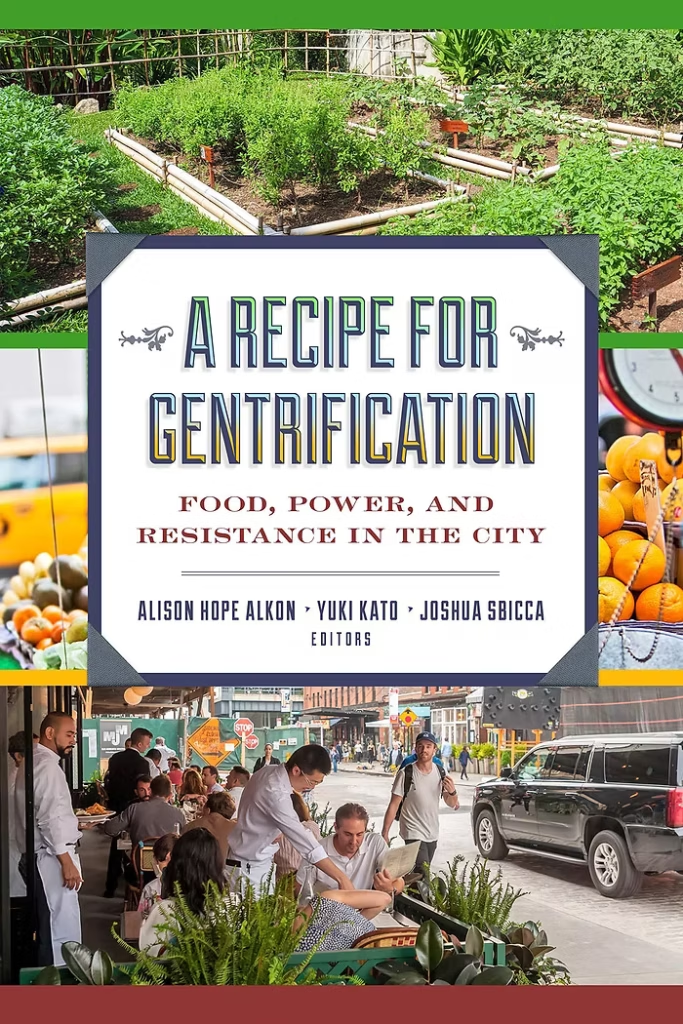
A Recipe for Gentrification: Food, Power, and Resistance in the City
Edited by Alison Hope Alkon, Yuki Kato and Joshua Sbicca
NYU Press
384 Pages
Concern about accessibility to healthy food has often shaped local urban planning discussions and would seem to be consistent with the profession’s longstanding embrace of the theory (if not the practice) of planning for healthy living environments. However, planning practice in North America has more often reinforced the separation of communities from food production, allowed the proliferation of junk food in communities with high rates of obesity, diabetes and other food-related illnesses, and accepted the structural divides of race and class that undergird these inequalities. Community gardens and urban agriculture may be promoted by planners and community groups but they are too often seen as palliatives in local governments subject to the overwhelming power of the real estate market, reliance on property taxes, and deference to corporate food monopolies. Professional planners historically have treated this power imbalance as a given by helping to fulfill real estate’s quest for the “highest and best use” (i.e., the most profitable use per square foot).
Recipe for Gentrification is an excellent collection of articles that focuses on the role of food in gentrification and displacement while it opens up prospects for just alternatives. The contributors bridge the gap between research and activism and underline the role of community resistance in advocating for change. As stated by the editors, “The central claim of this volume is that food is an important lens through which to understand the process of gentrification.” They illustrate how changes in the production, distribution and consumption of food, driven by corporate monopolies, have been part of the systemic dispossession of people of color, immigrants and Native people. The wide array of case studies also probes multiple complexities that face diverse movements against gentrification and for food justice.
Recipe for Gentrification is divided into four parts. The first part, “Dining Downtown” looks at food retailing and gentrification in San Diego, Durham (North Carolina) and Oklahoma City. It focuses on the ways that food both reflects and promotes urban development. The second part, “Ripe for Growth,” looks at alternative food systems: urban agriculture in Denver; foodways in New Orleans before and after Hurricane Katrina; an orchard in a changing neighborhood in Portland (Oregon); and how community gardens became fodder for the urban growth machine in Seattle. Part Three looks at the alliances, conflicts and contradictions within communities and urban food movements. Case studies of San Francisco, Vancouver and Oakland examine strategies and tactics that focus on combating gentrification while sustaining food justice. The last part of the volume, “Growing Resistance: Community-based Strategies,” looks at struggles for food justice and against gentrification in New York City, Chicago’s Paseo Boricua, Cleveland’s Black Urban Growers, and attempts to implant food sovereignty in South Los Angeles.
Taken together, the contributions to this volume offer a rich buffet of diverse examples from cities across North America. There is much food for thought here for planners who are engaged or want to be engaged with questions of agroecology, food justice and gentrification.
What Progressive Planners Can Do
Recipe for Gentrification underlines for me how important it is for urban planners to stop talking about “land use” and “the highest and best use” when these terms typically reflect whatever is most profitable to landowners in the local real estate market. Such a narrow view of land is responsible for creating cities marked by racial and class segregation and the displacement of people of color. It also reinforces the separation of food production from the vast majority of consumers. When it comes to solutions to bridge this divide, producing local food in cities is usually left out of the competition, except when it comes to trendy, highly-priced boutique products like herbs and exotic greens. In addition, some planners are creating illusions that inequalities in access to healthy food will disappear once supermarkets selling produce are given zoning incentives to move into urban “food deserts” that are now served by fast food outlets and cheap junk food. This is the case in New York City, for example, where upscale supermarkets typically appear on gentrifying neighborhoods, with or without zoning incentives, and signal the arrival of higher rents and home prices that push out renters and homeowners. They also put pressure on the sizable network of community-based gardeners and land stewards who see open space as an integral part of their resilience.
Local plans and zoning need to reimagine the city not as just a “Garden City” but as a place where food can be produced, consumed and distributed in an equitable and safe way, with priority to those most vulnerable to hunger and food-related illnesses. “Open space” must promote the resilience of flora and fauna and be more than pristine playgrounds for humans. It must aspire to much more than satisfaction of the visual appetite of elites for a “City Beautiful.” In brief, planning should insure a more just and resilient environment, including a just and sustainable food system, one that is geared to human and environmental health.
As pointed out in A Recipe for Gentrification, the urban growth machine is the source of the problem, for it presumes growth will solve all problems, including the provision of affordable housing, improvement of public services, and reduction of the local tax burden. Planners can be advocates for just alternatives alongside those who are struggling for food and environmental justice.
Tom Angotti is Professor Emeritus of Urban Policy and Planning at Hunter College and The Graduate Center, City University of New York, and an editor of Progressive City.