By Planning for Solidarity: The Case of Brazilian Catadores
The following piece is part of Progressive City’s series The Future of Planning: Insights From Emerging Planners, in which current or recently graduated Planning students reflect on the state of the planning profession and how our activities as planners can be oriented towards justice as opposed to perpetuating ongoing racial, colonial, economic, environmental, and ability-related injustices. More information on this series can be found here.
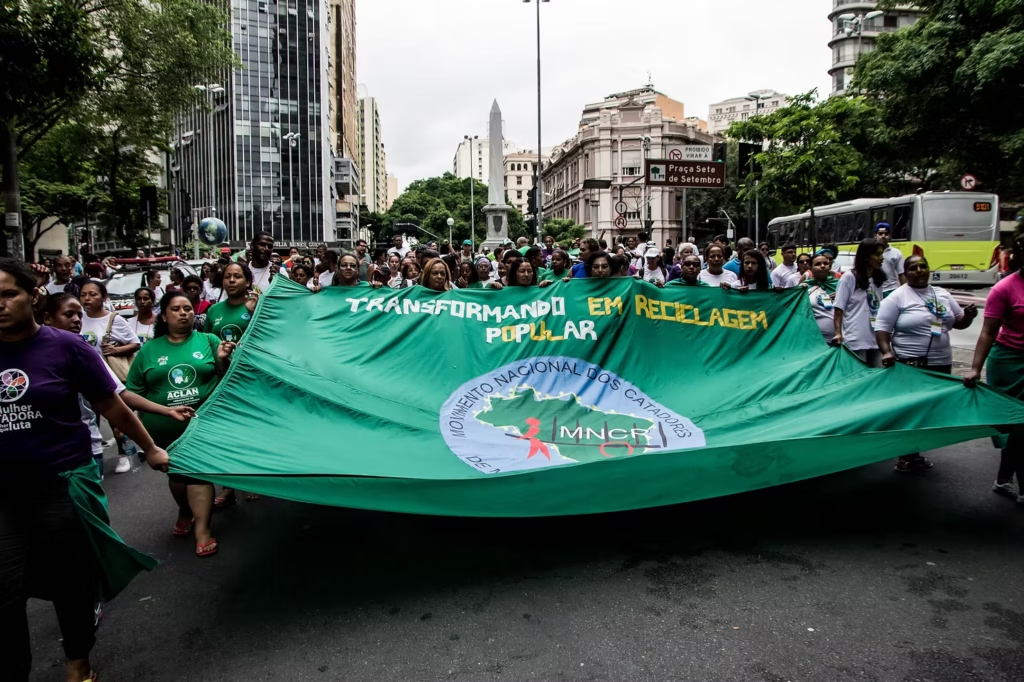
Brazil’s waste pickers, known as catadores, constitute one of the most indispensable and exploited workforces in the country. By collecting, sorting, and re-selling discarded materials, this historically informal workforce provides ecological and sanitary services that improve the quality of urban life, ease the burden on landfills, conserve raw resources, and create employment for almost 1 million people.
Despite their environmental and social contributions, catadores endure social stigma, dangerous working conditions, and criminalization. Municipal governments, the public entities responsible for waste management, often choose to contract private waste collection services, citing these enterprises’ technical capacity. As private companies monetize waste into profits, catadores find themselves shut out of a livelihood.
In response to this economic exclusion, catadores have formed diffuse but networked social movements with workers’ cooperatives as the primary unit of organization. Beginning in the 1980s under sympathetic local governments led by the leftist Workers’ Party (PT), these organizing efforts have culminated in the National Movement of Waste Pickers, the largest movement of waste pickers in the world, which unites cooperatives across the country in joint struggle for class solidarity, self-management, and mutual support.
Catadores gained acclaim from PT leaders and planning departments for their self-organization models, which have become an emblematic example of the solidarity economy. The solidarity economy is characterized as an “alternative economy generating work and income, as response to the demand for social and labor inclusion”. Embodied by worker cooperatives, the solidarity economy model rejects logics of profit in favor of meeting people’s basic needs and overcoming poverty and unemployment.
The solidarity economy became a national project in 2003 under PT president Lula, who appointed Paul Singer, São Paulo’s former secretary of planning, as head of the newly created National Secretary of the Solidarity Economy (SENAES). Singer used his office to bolster catador cooperatives, which he viewed as “an expression of democratic socialism” connected to a project of social transformation in Brazil. SENAES helped form cooperative networks through the Cataforte program, dovetailing with the federal government’s official recognition of the catador profession in 2002 and the creation of an inter-ministerial committee for catador inclusion.
The PT government’s explicit commitment to the solidarity economy is a unique case that informs radical planning futures. Researchers argue that Brazil is one of few countries to design waste management policies that “bring the social aspect of waste management to the center of the discussion” by promoting the advancement of catadores. The fact that initial groundswells of catador coalition-building that catalyzed this agenda occurred during a twenty-one year military dictatorship is all the more meaningful in the face of right-wing resurgence under president Jair Bolsonaro. It should remind planners worldwide that re-imaginations of capitalism are within reach, often spurred by social movements of those most excluded by the market economy. The planning profession is well-positioned to support and advance their goals.
Suzanne Caflisch is a masters student in Urban and Regional Planning at UCLA Luskin School of Public Affairs, and an intern at WIEGO (Women in Informal Employment: Globalizing and Organizing). Her current research examines social movements of catadores in Brazil, and the coalitions that these movements have formed with civil society partners to achieve inclusive and environmentally responsible waste management policies. Suzanne’s broader interests include the informal economy, environmental politics, waste, and Latin America.