
By Tom Angotti From the Progressive City: Radical Alternatives Editorial Committee: Over the course of the year, we will be reprinting some of our most widely read past articles from Progressive Planning Magazine, which are still relevant for the present. These will include commentaries and reflections from the authors of the relevance of the issues for our present … [Read more...] about ADVOCACY AND COMMUNITY PLANNING: NOW MORE THAN EVER
WHOSE RIGHT, TO WHAT CITY?
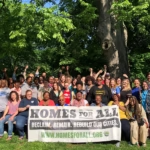
By Kelly Anderson During the 1990s, after decades of disinvestment, white flight and suburbanization, American cities once again became sites of large-scale capital investment. The resulting waves of gentrification¹ and displacement spurred the formation of new social movements, including many that considered themselves part of a US-based coalition The Right to the City … [Read more...] about WHOSE RIGHT, TO WHAT CITY?
REFLECTIONS OF AN ACTIVIST SCHOLAR: HENRY LOUIS TAYLOR, JR.
Introductory remarks by contributing editorial board member Jeffrey Lowe: On Friday, April 6th, Henry Louis Taylor, Jr., received the Urban Affairs Association's (UAA's) 2018 Marilyn J. Gittell Activist Scholar Award. Gittell spent her entire 50-year career with the City University of New York, and focused her scholarship and community activism on concerns about racial, … [Read more...] about REFLECTIONS OF AN ACTIVIST SCHOLAR: HENRY LOUIS TAYLOR, JR.
EMBRACE ABOLITIONIST PLANNING TO FIGHT TRUMPISM
By Thomas Abbot, Roxana Aslan, Riley O'Brien, and Nathan Serafin We write as part of a group of 17 UCLA graduate students in Architecture, Public Policy, and Urban Planning who co-facilitated a course, “Abolitionist Planning in Today’s Political Conjuncture.” In a political moment in which a new state "fully committed to white supremacy, misogyny, and virulent nationalism" … [Read more...] about EMBRACE ABOLITIONIST PLANNING TO FIGHT TRUMPISM
A SENSE OF PLACE IN TORONTO’S INNER SUBURBAN STRIP MALL
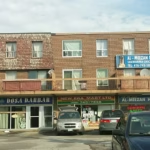
By Sunjay Mathuria As a landing pad for newcomers, the City of Toronto touts its diversity, which is most visible in Toronto’s inner suburbs. In 2016, 51.5 percent of Torontonians identified as a visible minority, with many neighbourhoods in the inner suburbs (Scarborough, North York and Etobicoke) exceeding 70 percent visible minorities. Suburbs are often imagined as … [Read more...] about A SENSE OF PLACE IN TORONTO’S INNER SUBURBAN STRIP MALL