
By Alexander Ferrer
The following piece is part of Progressive City’s series The Future of Planning: Insights From Emerging Planners, in which current or recently graduated Planning students reflect on the state of the planning profession and how our activities as planners can be oriented towards justice as opposed to perpetuating ongoing racial, colonial, economic, environmental, and ability-related injustices. More information on this series can be found here.
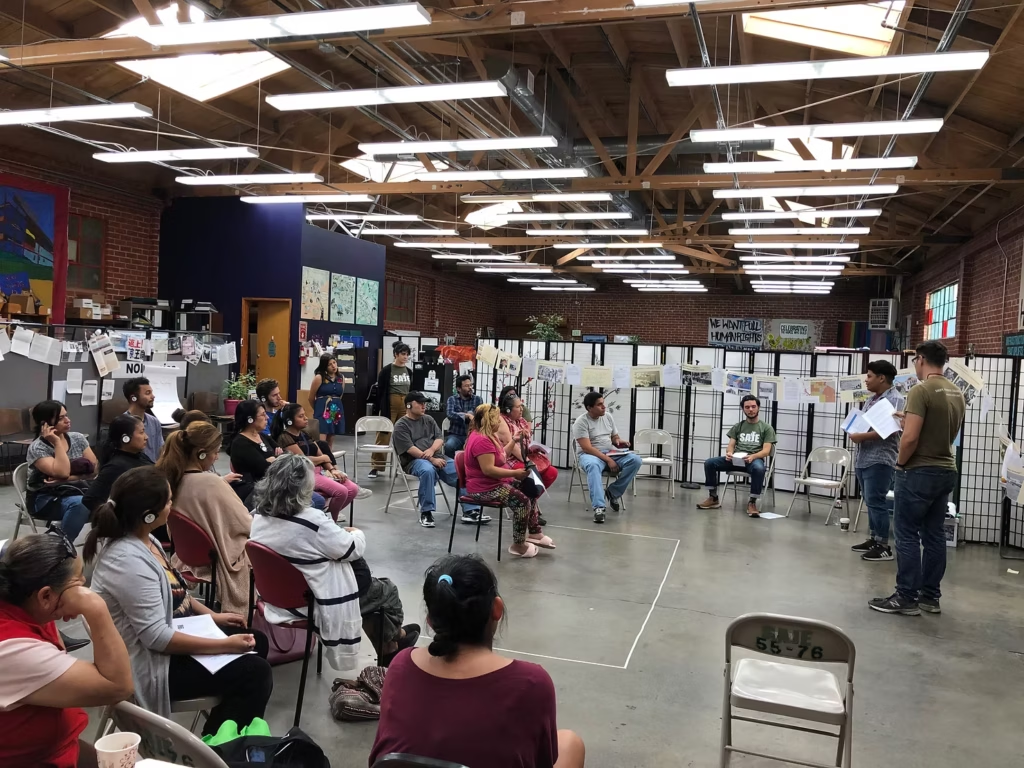
The idea of the stakeholder is fundamental to participatory planning practice rooted in liberal-democratic understandings of citizenship and property.
Moving from the stakeholder to a new conceptualization of urban citizenship is imperative if progressive planners want to realize a renewed practice. While planning theorists like Leoni Sandercock and Mark Purcell have raised issues with stakeholder-based planning for some time, it’s time for justice-minded planners to ditch the term stakeholder and start working towards a new form of urban democracy in practice.
The problem with the stakeholder as the fundamental agent in the participatory planning process is that the idea of the stakeholder itself is not a representative or value-neutral concept. The depoliticization of planning and its construction as a technocratic and deliberative process hides the relations of domination that are contained within the participatory apparatus. Such is the case with the stakeholder, which collapses differentiated subjects with complex relations into merely interested parties.
One example of the exclusionary nature of the stakeholder discourse is the comparative marginalization of renters and people who are houseless versus homeowners, landlords, or business owners in planning contexts dependent on stakeholder participation.
Renters, and more so unhoused persons, are already disadvantaged in exercising any agency in the occupation and reconstruction of urban spaces by virtue of their lack of control over land, which is the fundamental ingredient of space-making projects on the urban scale. Within the formal venues of democratic decision about the production of space, those that are property-less are likewise dispossessed. It’s a common refrain from homeowner groups opposing the construction of new rental housing, from neighborhood associations, business improvement districts, and other place-based constituencies that represent mostly property-owning interests that renters have relatively little or no stake in the community.
Renters and houseless persons in a sense, are thus doubly dispossessed in contemporary participatory planning practice. Once by the very real barriers to participation in any form that exist for low-income persons, and again by the stakeholder discourse, which legitimizes the recursive claims that non-owners are less invested in their neighborhoods than other groups. In allowing for the construction of the stakeholder in such a way, planners legitimize an antidemocratic, elitist, and racialized conception of the urban community, in which property ownership is a necessary precondition of full citizenship.
This tradition is deeply rooted in the structure of this nation’s political history, with both radical and reactionary thinkers insisting on the necessity of property ownership as the basis for autonomy, and autonomy as a precondition of citizenship, as legal thinker Robert Hockett uncovers succinctly in his portion of this talk. Property and participation are also both deeply racialized from the root, and regardless of their position with regards to property ownership, People of Color often stand on unequal footing with Whites in participatory systems.
The marginalization of renters and houseless people, both more likely to be People of Color, in planning and land use decision making is a pressing socio-spatial justice issue, as renters are uniquely affected by the outcome of planning processes. Similar and more violent is the way in which the condition of property-lessness is used as a justification for the direct spatial disenfranchisement and removal of unhoused persons, often carried out at behest of property-owning associations through policing. Renters, likewise, are similarly subject to violent state enforced displacement through eviction. The always racialized nature of property and its relationship to policing presents yet another barrier to the realization of spatial justice.
At present, to ensure the equal participation of disenfranchised groups within the planning system, individual rogue planners and community-based organizations must go to exceptional lengths. While their efforts have produced some incredible victories, we cannot be reliant on such practices to serve as a band-aid to a fundamentally unjust system, and cannot be satisfied with requiring that popular movements subordinate themselves to doing the work of democracy that the state should already be carrying out.
In order to produce a more democratic planning apparatus and to take a step towards the realization of the Right to the City, it is necessary that we first move towards a new, more inclusive and universal understanding of urban citizenship. The demand for a responsive universalism by anti-capitalist and abolitionist scholars, which recognizes the inequality of differently positioned actors in advancing a universalist politics that is “not colorblind… but weighted so that racial equity is pursued by means of universal benefit,” provides an excellent starting point. In order to realize the equitable participation of persons who are differently positioned in relations of racial and economic domination in the planning process, we must be attentive to this difference and put in place formal structures that recognize and address it through prioritization. We cannot leave this to be the work of organizers alone.
Alexander Ferrer is a movement based planner and researcher focused on how increasingly financialized housing impacts tenants. He is currently studying for a master’s degree in urban and regional planning at UCLA, where he helps organize PRAXIS, a student organization dedicated to advancing socialist and abolitionist planning in practice.