
By Ali Qureshi
The following piece is part of Progressive City’s series The Future of Planning: Insights From Emerging Planners, in which current or recently graduated Planning students reflect on the state of the planning profession and how our activities as planners can be oriented towards justice as opposed to perpetuating ongoing racial, colonial, economic, environmental, and ability-related injustices. More information on this series can be found here.
Active transportation is now all the rage in Canada and for good reason. Whether walking, cycling, skateboarding or rollerblading, human-powered locomotion is beneficial for the body, mind, and the environment.
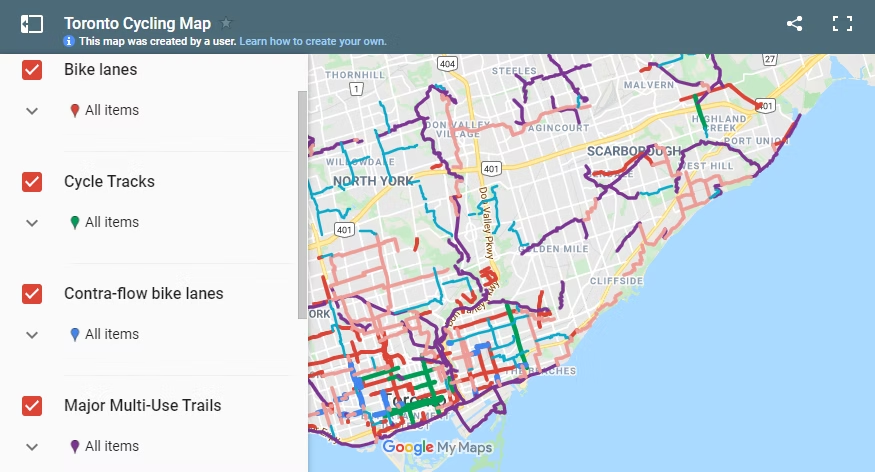
Cities across the province of Ontario have been releasing their cycling master plans. These include the City of Hamilton and the City of Mississauga, with the latter claiming a cycling network of 897 kilometres to be built over the next 27 years. Similarly, the City of Toronto has also been hard at work updating its cycling infrastructure, with an additional 120 kilometers planned as of 2021. While the City of Toronto proudly displays its many different types of cycling infrastructure around the downtown core and along the waterfront from Long Branch to Cliffside, one quick look at the cycling map reveals an oddity. While their cycling Infrastructure is scattered throughout the city, there is a cycling desert located in Scarborough, shown in Figure 1.
A significantly large area, from Victoria Park Avenue in the west to Midland Avenue in the east and Lawrence Avenue in the South to Sheppard Avenue in the north, has no cycling infrastructure at all: not bicycle lanes, trails, or even shared lane markings (see Figure 2). There is a similar story in the Malvern area as well.
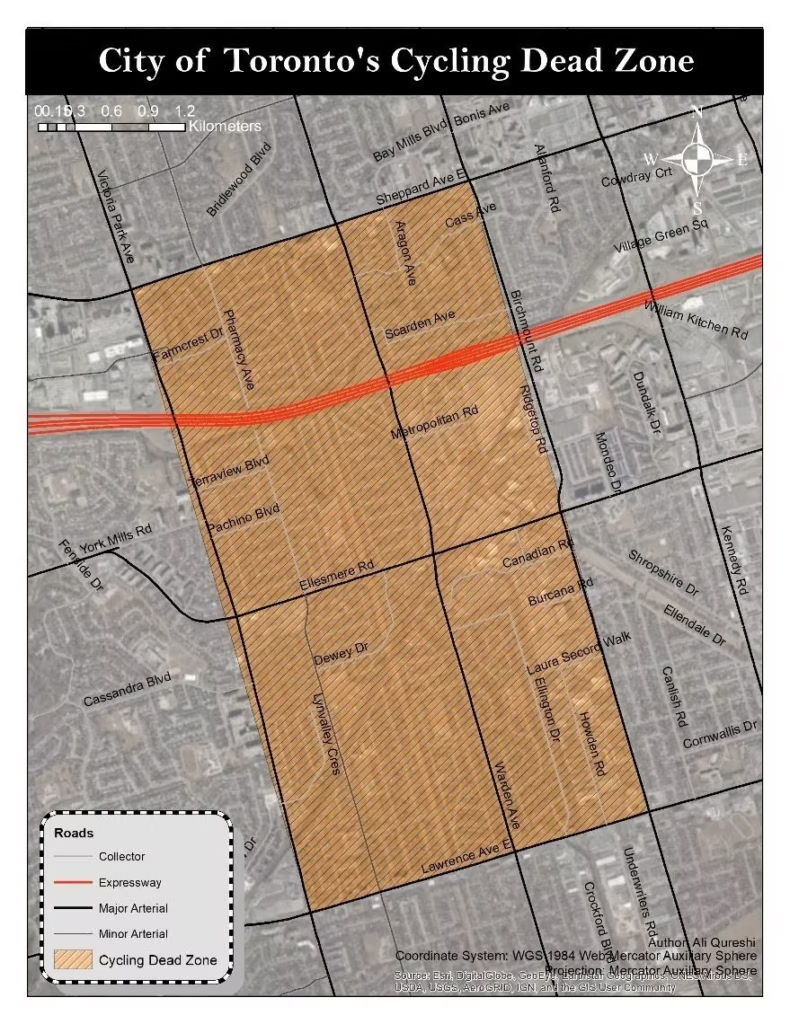
Now that we know where the cycling dead zones (areas with no cycling Infrastructure) exist, we must ask ourselves why? Perhaps a glance at a map of incomes in Toronto might shed some light.
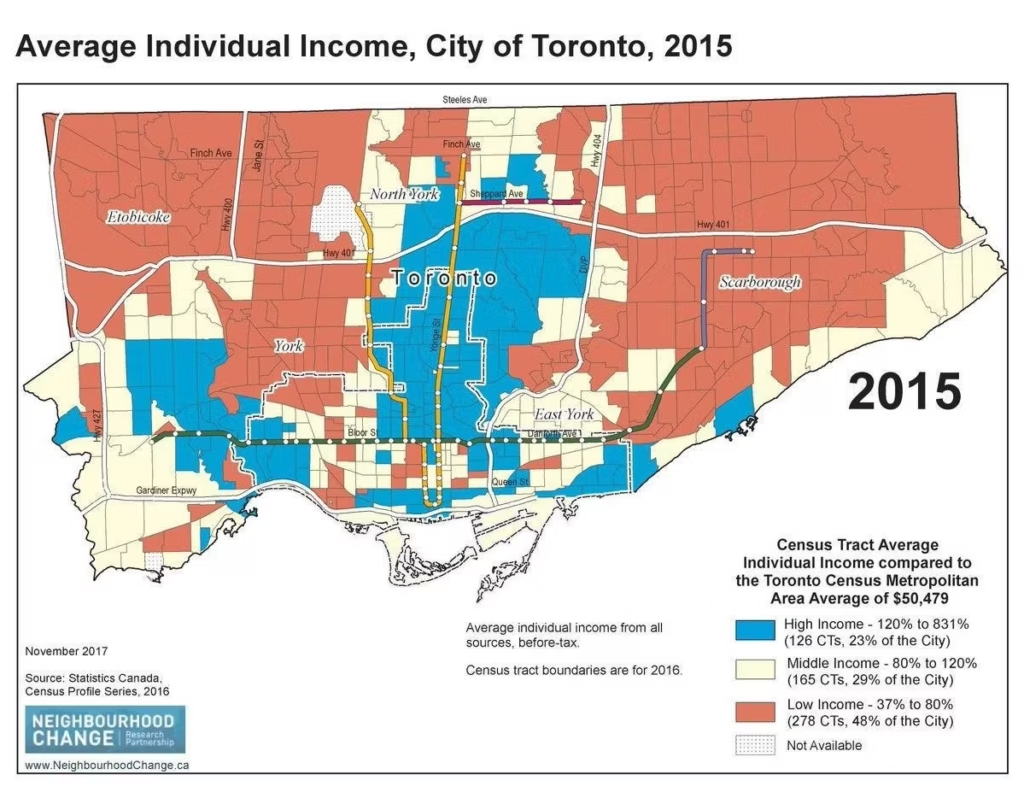
As we can see in Figure 3, the area of the cycling “dead zone” lies in a low-income area of Toronto. More specifically, the area in question is known as Wexford-Maryvale. This neighbourhood has among the lowest median income in Toronto. Why is it that the city has failed to offer the residents of Wexford-Maryvale the numerous benefits that accompany cycling infrastructure?
The City of Toronto in its infinite wisdom has failed to provide cycling infrastructure to a community that needs it. Communities of lower-income face significant challenges when they are not provided with reliable transportation infrastructure, specifically with their health and access to employment. Known as the Transportation Barrier, low-income residents must have access to several different modes of transportation, as their existing transportation options might not be reliable (transit, personal vehicle, etc.). Without adequate transportation options, residents will face barriers to healthcare access, leading to missed appointments, delayed care, or missed medication. In the long term, this can lead to chronic illness and poorer health care outcomes. Thus, the implementation of cycling infrastructure can lead to overall improved health. This is essential for a community such as Wexford-Maryvale which has 2400 unemployed, 9450 low income and 8910 residents living in unaffordable housing.
Also, a low-income community such as Wexford-Maryvale should be given an equitable chance to obtain long-term high paying employment. Studies show that the availability of multi-modal transportation possibilities is associated with increases in median household pay and a decrease in the unemployment rate. Therefore, the failure to provide a separate mode of transportation in the form of cycling infrastructure, in turn, leads to barriers in the ability to obtain higher-paying jobs.
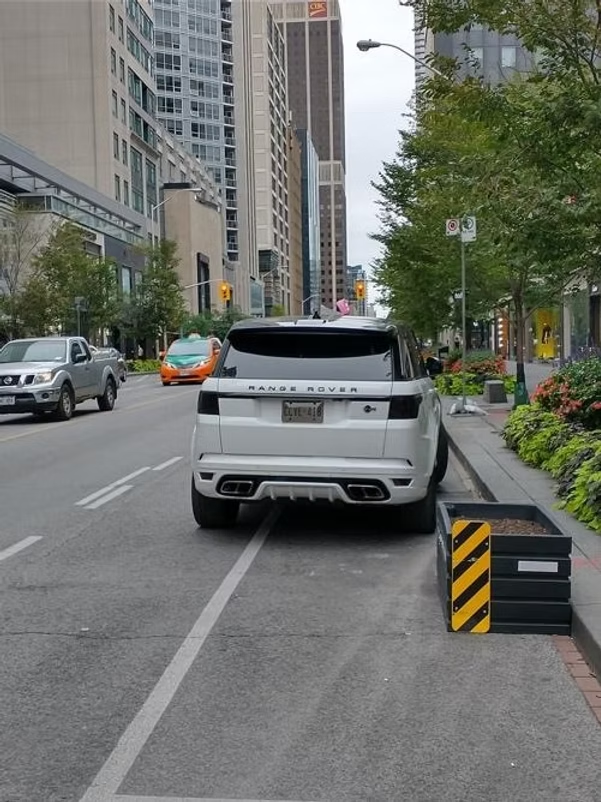
Another barrier towards bicycle lanes in Scarborough and Toronto as a whole, is the issue of safety. A recent accident in Scarborough left a cyclist in the hospital following a collision with a vehicle. Incidents like these are far too common in areas where bicycle lanes are available. The decision-making regarding bicycle lanes in Scarborough reached a bewildering junction during the summer of 2020 when the City of Toronto decided to remove safer/separated bicycle lanes that were placed along Brimley Road just 5 months after installation, at a cost of $160,000. Staff proclaimed the decision was based on “ongoing data collection, monitoring and analysis” as well as “feedback from constituents and other stakeholders”. This move eliminated a safe space for cyclists in the area, as these bicycle lanes include dividers from the vehicular traffic. Toronto is full of unprotected bicycle lanes and in the first half of 2020, there were 63 accidents where cyclists or pedestrians were killed or injured. Figure 4 below showcases one such bicycle lane, where there is no protection from larger vehicles and where large vehicles frequently drive in or park on the dedicated bicycle lane.
As planners, we need to measure and identify the strengths and weaknesses in our communities and understand the requirements of said communities. The planners at the City of Toronto should have identified that the residents of Wexford-Maryvale required bicycle infrastructure, as this is an at-risk community. As a lower-income neighbourhood, Wexford-Maryvale would have benefitted greatly from bicycle lanes, trails, or even shared lane markings as these would have provided increased access to greater employment and better access to healthcare. One could argue that it is at-risk communities such as these that require the greatest amount of planning interventions. It is essential that good planning practices be implemented if we as a city plan to reach an equitable future.
Ali Qureshi is currently a MES (Planning) Candidate at York University. His previous academic achievements include a GIS post-graduate diploma from Niagara College and a BSc (Environmental Science) from the University of Toronto. Outside of academia, Ali has worked in a variety of industries ranging from Transportation and Traffic Planning, Asset Management, School Board Planning and Geospatial Analysis. In his free time Ali loves to travel and observe different geographies and cultures. Ali’s other interests include writing, hiking, camping and other outdoor adventures.