By Kelly Anderson
In 1960, the French ethnographic filmmaker Jean Rouch and sociologist Edgar Morin roamed the streets of Paris, asking citizens “How do you live?” and “Are you happy?” Their experiment, which became the classic cinema vérité documentary Chronique d’un Eté (Chronicle of a Summer), revealed a society deeply anxious about the future, its inhabitants struggling to make sense of post-WWII changes, the Algerian War, and race and class tensions. The documentary camera, it turned out, could do more than provide didactic education or a simple record of events. The filmmaker and their crew could be a catalyst, liberating truths that lurked just beneath the surface of daily life.
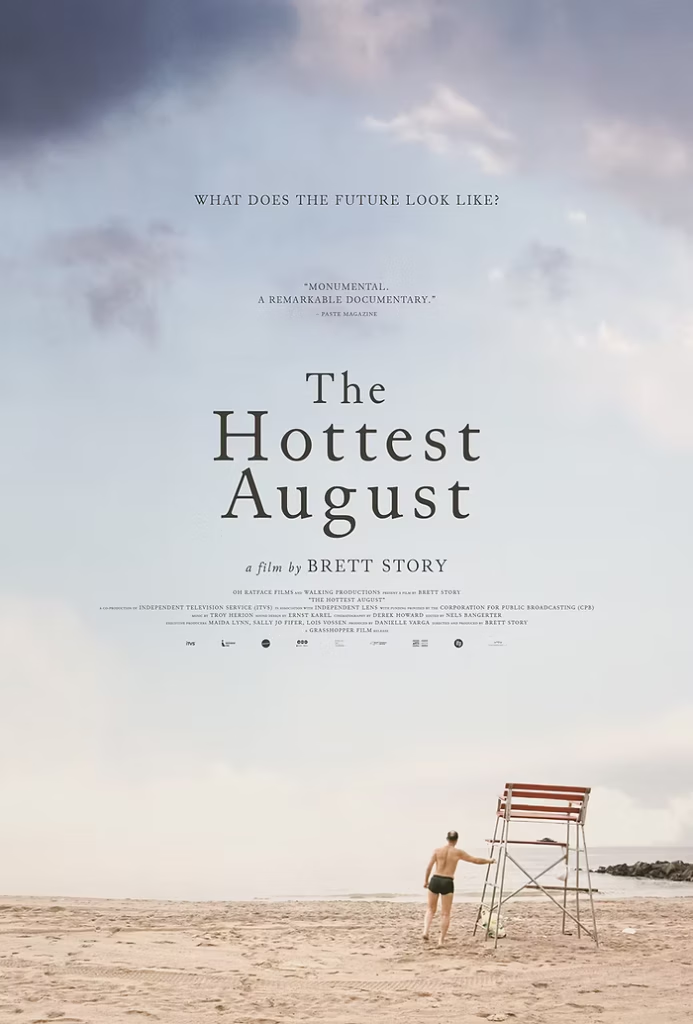
Brett Story’s evocative and piercing documentary The Hottest August, made almost 60 years after Chronique, recalls the spirit and methods of Rouch and Morin while turning the camera on New York City during the month of August, 2017. It is an essay film, told from the point of view of a fictitious visitor from the future, who roams the city’s streets to “ask people questions, as if something useful might be gleaned.” The camera wanders throughout New York’s five boroughs, training a patient and cinematic eye on the city’s inhabitants and the built environment. We hear from a wide range of individuals, including an iron worker, a naturalist, a fitness instructor, a mechanic, an economist, skateboarding teens and stoop sitters. We observe sunbathers, a sand sculpture competition, kids swimming in fountains, protests and people working, eating and doing laundry. Television screens in the backgrounds of many establishments provide a glimpse of the broader national context: racial conflict, extreme weather, heat.
When asked “What are your hopes for the future?” these New Yorkers uniformly express concern. Will they have jobs? Will they be able to retire? Will their children survive violence, financial and housing insecurity, possibly nuclear war? These anxieties, combined with the camera’s persistent gaze and an evocative soundtrack by Ernst Karel, give us the uneasy feeling of being on a precipice, awaiting an apocalypse. The people in the film know something is wrong, but can’t put their fingers on what it is or what they might do to change course.
There are no trusted experts in the film to tell us what to think, or what to do. In place of a traditional story or expository arc, the film delivers a slow, deliberate burn. There are some keys to the film’s underlying logic in the musings of the narrator, who quotes Marx to tell us that “Capital is in practice moved as much and as little by the sight of the coming degradation and final depopulation of the human race as by the probable fall of the earth into the sun.” Ultimately, the film is a deeply poignant and intellectually rigorous portrait of a city ravaged by late capitalism, whose inhabitants are alienated and struggling to understand the forces shaping their lives. It pays particular attention to the specter of climate catastrophe, showing us windows full of air conditioners, as planes and helicopters pass continually overhead. The film crew lingers longest at the edges of the city, where residents are still dealing with the effects of Superstorm Sandy and water pools in the streets. Nature is largely subjugated, preserved in the Museum of Natural History’s dioramas or waiting in restaurant fish tanks to be consumed, but one senses that it may have the final word.
Occasionally we feel human connection, as in the film’s final scene where people dance on the boardwalk to celebrate the last days of summer, but these moments are rare. If redemption exists, it comes in the form of the Afronaut, the creation of an artist who dresses up as a visitor from the future who, like the film’s narrator, comes back to take a look around. The Afronaut wears a climate-controlled suit, and chats with urban residents who may be so consumed with survival in the present that dreaming about the future becomes a challenge. Being allowed to see the future, the artist posits, may push humanity to make better decisions in the present. One hopes he’s right, though many viewers may identify more with a woman he encounters who asks him to “take her away with him.”
Morin and Rouch end their film with the admission, “I think we are in trouble.” They may have been referring not only to their filmic experiment, but to their own time and place. They had captured a city, frozen for a moment, on the precipice of great upheaval. Watching The Hottest August from home during the COVID-19 lockdown, this film may turn out to be alarmingly prescient as well.
Kelly Anderson is the director of My Brooklyn. She is a Professor and Chair of the Department of Film and Media Studies at Hunter College (CUNY).