Reviewed by Tom Angotti
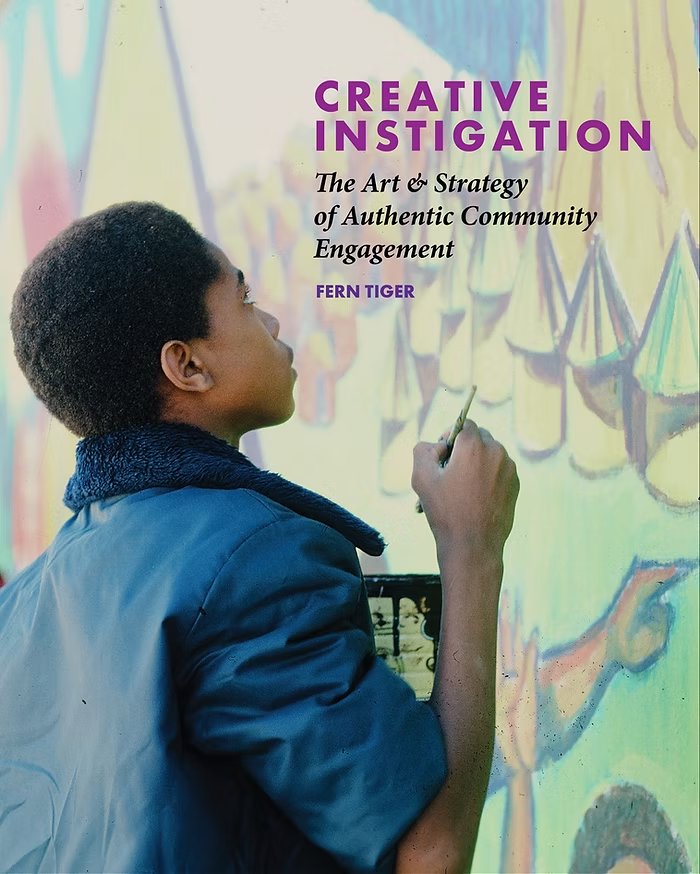
By Fern Tiger
New Village Press
328 pages
Progressive City readers receive a 20% discount off the $44.95 cover price when ordering Creative Instigation online from INDIEPUBS using the discount code PEACE20
Urban planners and community advocates who reject rote formulas for engaging communities will find this book by Fern Tiger an inspiring alternative. It is filled with stories about the communities she has worked with in creative ways over long periods of time to develop community plans. It is an admirable alternative to the planning profession’s habit of using charrettes and charades to produce and print plans that wind up on the proverbial bookshelf or, even worse, lend validity to the ambitions of developers and government bureaucrats.
Fern Tiger is a trained artist who has worked for years with communities to develop strategies and plans for their futures. She doesn’t start with the traditional planner’s focus on developing physical space but instead starts from real experiences and everyday issues as expressed by people as a prelude to more intensive and detailed planning. She shows how communities can be encouraged to use their collective and creative imaginations both to understand problems and to bring about change in their communities.
She and her staff support an array of tactics at multiple scales ranging from house meetings to community-wide assemblies. It is all grounded in a fundamental commitment to empower communities to engage in deep discussions, resolve issues and develop strategies for the future. Absent are the typical instant formulas filled with charrettes, workshops, games and infantile exercises that too many trained facilitators have employed. Instead of engaging genuine participation and building communities, planners often wind up disarming grassroots democracy by using simplistic exercises and then writing big reports with lots of bullet points. Instead Tiger and her team promote deep immersion in community discussions. I know from my own experience, these can help to build solidarity around key issues and future strategies without hiding difficult and controversial differences. After many meetings over long periods of time communities can build solidarity around shared visions for the future while respectfully acknowledging inevitable differences.
Creative Instigation teaches us that long-range community planning ought to be about stimulating many in-depth community discussions at multiple scales, discussions that help communities arrive at mutual understandings about the past and present and plans for the future. Fern Tiger shows us how this takes time, often many months and years.
City planning was grounded in professions—architecture and engineering—that emerged when private owners, corporations and governments sought relatively short-term changes to the physical environment that were often backed by private landowners and corporations seeking to maximize returns on their investments. When initiated by public entities they invariably are financed by grants, loans, bonds and capital investments yielding regular returns to bondholders and taxpayers. In this milieu, concern with the long histories, critical problems and deep experiences of working people often becomes secondary. In Fern Tiger’s practice, they are primary.
Tiger explains how she uses everything from meetings in people’s homes to large-scale public events to engage people, especially those who too often remain spectators at large meetings or events. These are not just one-off sessions but ongoing discussions that often blend an understanding of issues and concerns at the most micro-level with larger political and economic questions and strategies.
Creativity as a Planning Principle
Fern Tiger was trained as an artist and has taught university classes in her field. She is based in Oakland, California and in separate chapters she relates the work she has done with communities in various parts of the state and in New Mexico, Hawaii, and Arizona. Each of her case studies reveals how she worked intensely within communities over periods spanning months and years—not just days. She brings to her work a commitment to true engagement and empowerment without imposing clinical formulas and routines out of textbooks. Much of her work has been with women-led community groups. It is therefore not surprising that she validates deeper participation and many practices that for too long have been overlooked by the male-dominated urban professions. Tiger and her team methodically take cues from extensive small-group as well as large-group discussions to build momentum towards solutions and deepen community solidarity.
Tiger describes herself as a “creative instigator.” She is not the habitually “neutral” mediator or short-term problem solver; nor is she an inventor of grand master plans, tough compromises and negotiated solutions, though these may turn out to be a part of the final product. In the stories she tells, she and her team actively nurture movement by community participants towards solutions that emerge from within the community-driven process, proposals that are not just inventions of the consultant but reflections of extensive discussion and deliberation. This is a sterling example of what I call slow planning, the necessary substitute for the assembly-line speedups of the community planning process that justify decisions already made by investors, bondholders and their technocratic allies.
Tiger honors the uniqueness of every community and the differences within communities by employing a variety of strategies and tactics ranging from home-based discussions to large public meetings, informal as well as formal gatherings. She seeks out and emphasizes the uniqueness of each community as she helps shape the process with them. Her case studies demonstrate the importance of listening, adapting and revising the process as it matures, and ultimately developing the capacity of individuals and communities to affect their futures. All this takes time!
Tom Angotti is Professor Emeritus at Hunter College and the Graduate Center, City University of New York, Visiting Professor at Parsons/The New School, and an editor at Progressive City.