
By Destiny Brown, Meghan Z. Gough, Duron Chavis, Susan Bodnar-Deren, and Ellis Sawyer
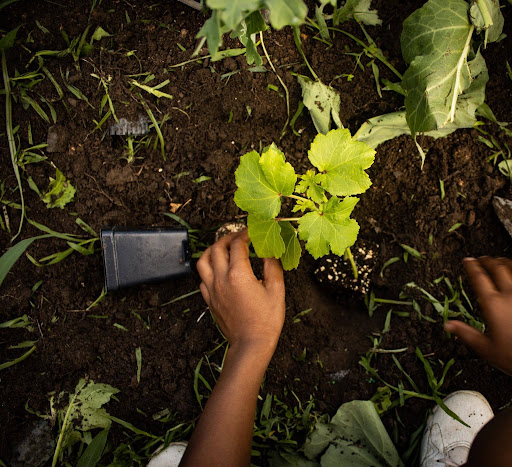
Through quotes, this piece follows Black-led gardens and farms in Central Virginia to ask what is growing there beyond food: how land that remembers becomes a site of joy, care, connection —ultimately Love—and what that means for land justice in a city planned around their erasure.
Land that Remembers
During the COVID-19 pandemic, fruit trees were being planted in a Richmond public housing community. In Mosby Court, people gathered outside, turning soil, building gardens, and planting trees in spaces where turmoil was present. This led to questions: Why are Black people in “the hood” outside planting fruit trees during a global crisis? Why gardening? Why something more than surviving? Why here?
Long before the public housing developments, the land of Mosby had once been part of Howard’s Grove, an orchard landscape that stretched across the area beginning in the 1700s until the Civil War. Later, the site became a hospital and asylum for formerly enslaved Black people.
The peach tree is part of a broader strategy of collective self‑efficacy. In a landscape often framed solely through narratives of struggle with “nothing in the middle,” as one interviewee described it, growing food to feed people and training children offer a different narrative. The peach tree can “bring us full circle” by reconnecting present‑day gardening work to a much older Black history of orchards and fruit trees on that same land. The peach tree and other fruit trees are not just food assets; they are narrative devices that let communities start their story before trauma and redlining.
It wasn’t just about recognizing the symbolic significance of the peach tree; it was about what it meant to imagine land as something that remembers. Something that holds onto earlier versions of itself, even when those versions are no longer visible on the surface due to realities like gentrification and displacement.
“This so-called Food Desert of Petersburg was once an Oasis, and it is now growing back into that.”
What the Land Remembers in Richmond
In Richmond, land has always been reworked by plans, roads, and deals that treated some neighborhoods as permanent and others as expendable. Places like Mosby, Gilpin, and Jackson Ward sit within this longer history—public housing, highways, and “renewal” layered over older Black neighborhoods until whole blocks were renamed, rezoned, or erased. But what disappeared on paper does not always disappear in practice.
Jackson Ward is the most referenced example: a center of Black cultural and economic life split by a highway and carved up by mid-20th-century urban renewal efforts. Underneath those layers sits a much older geography in Virginia and the broader South, where a system of enslavement and plantation economies structured land ownership, labor, and spatial organization. Those histories do not hide in the past; they show up in present-day maps of food access, environmental justice, and evictions.
The people we spoke with told this story through more than policy language—they showed us where a house used to be before it was razed and left as a vacant lot, but is now a community farm. As one grower put it, the problem is not only that Black neighborhoods have been harmed; it is that the outside world insists on reading them only through suffering:
“A part of being able to view African-Americans as whole people is being able to hold suffering and joy simultaneously.”
Black‑led urban agriculture in Central Virginia is not something new. Rather, it looks like a return —a continuation of cultivation, mutual aid, and land stewardship that has persisted before, through, and beyond waves of displacement.
Learning from the Keepers of the Story
This project’s foundation never sat with us as researchers. It rested with the farmers and activists across Central Virginia whose daily work with land made the story possible. We came to think of them as the keepers of the story—not as research subjects, but as people already narrating, tending, and reshaping the landscapes we hoped to understand. The methodology followed the farmers’ rhythm through a collaborative and symbiotic relationship, rather than a fixed, linear design. Interviews unfolded in cycles across gardens, farms, kitchens, and parks; we paused to reflect, we returned as new relationships formed, and gaps came into view. Conversations followed planting and harvesting seasons, shaping the timing and focus of our questions.
Existing and long-term partnerships between two Black farmers in Richmond and VCU faculty on this project made this community-based research possible. Experience working together on smaller projects provided the tested and trusted relationships necessary for collaborative community-university research. As trained members of the research team, undergraduate and graduate students helped in all stages of the research, from interviewing farmers to disseminating findings. Funding from the VCU Humanities Research Center and the Institute for Sustainable Energy and Environment helped make aspects of this research possible. These partnerships demonstrate how the university supports multidisciplinary engaged research documenting farmers’ longstanding work.
The interview process became a series of conversations structured with care. We invited reflection and storytelling, asking people to define their own relationships to land and community. One question we carried from site to site asked about their “radical reimagining” of land justice. Answers explored possibility, healing, and restoration alongside present-day constraints.
Interviews were more than information gathering—they were occasions to listen together, surface memory, and trace connections that might otherwise remain fragmented. Audio or audiovisual interviews lasted 45 minutes to over two hours, allowing conversation to unfold naturally. Listening in this way set the conditions for the themes that emerged and for the StoryMap that would later hold these stories in a shared, living form.
What Grew Beyond Food: Joy, Care, Connection
As we listened, certain themes continued to resurface: joy, care, and connection. These themes did not appear as separate or neatly defined categories, but as overlapping ways of understanding what Black-led urban agriculture spaces in Central Virginia make possible. Across gardens, farms, kitchens, murals, and gathering spaces, participants described forms of healing, relationship-building, memory, and collective care that extended far beyond the growing of food itself.
Joy as Practice
Joy was described as something deeply intentional. Not a denial of struggle, but a way of moving through it. One farmer described joy not as an escape from the weight of this work, but at the very center of it:
“I am very deeply connected to the joy, the joy that food brings, the joy that healing brings using food as medicine and it having healing properties.”
Joy also emerged through the creation of spaces where people could feel grounded and fully themselves. For some, joy surfaced in the quiet relief of finding spaces where you didn’t have to perform or justify your presence to anyone:
“It feels unreal to find your people and just people that you don’t have to explain everything… your nervous system is relaxed…when you feel around family, when you feel safe.”
Care as Infrastructure
Care repeatedly surfaces as a force holding these spaces together. Not simply as emotion but as consistent action, labor, responsibility, and presence. Across conversations, people described Love as an ecological mode of being: a way of tending the self, the soil, and the community as one continuous gesture. In this sense, Love is what care looks like when it stretches across scales from the cellular to the communal, from the raised bed to the neighborhood block.
Care showed up in the everyday work of feeding people, creating gathering spaces, sharing knowledge, mentoring others, and sustaining environments where people could feel supported and connected. As one community farmer reflected on what kept drawing them back to the garden, it became clear the most lasting impact had little to do with what was being grown in the ground:
“And I think that was the biggest impact. It was even less so just about the plants and about growing food and all the ins and outs about that, but it’s also the community that I yearned for, being a part of something and having people hug me and say hi when they see me and listen to me when I’m talking about something that I care about.”
A repeated argument we heard from agrarians was that the crisis is not only one of resources but of value: a wound in the capacity to believe oneself worthy of care in the first place. In that sense, tending land becomes one route back to self-worth, because the work of caring for the soil can also begin to restore a relationship to the self.
Care in these spaces is not decorative or sentimental. It is a quiet, necessary practice: mowing grass, mending beds, checking on elders, staying when the funding goes away. In this way, Love is not what you feel. It is what you build. It is not the sentiment that precedes the work; it is the work itself. When asked about what moved them to start, one keeper of the story answered in a way that captured how care in these spaces rarely waits for permission or resources:
“Farming is not the best use of my skills. But farming is what allows me to come into a community and demonstrate what the power of transformation is.”
Care also appeared in the background work sustaining these spaces, beyond the garden or farm. Farmers continuously identify and apply for federal, state, local, and nonprofit grants. Some grants supported organizational capacity-building; others covered production, upkeep, maintenance, and equipment.
Sustaining the work also meant fundraising, inviting ongoing or one-time donations. Yet sustaining these spaces depended on more than funding. Farmers drew on relationships with other growers, neighbors, and community organizations, making mutual aid part of tending land and community. Through these relationships, people contributed time and labor, and helped one another respond to needs that available funding could not meet. These exchanges made care practical and collective. While mutual aid did not remove the need for reliable funding, it helped farmers sustain the work with limited or uncertain financial resources.
Researching opportunities, preparing applications, and maintaining funder relationships continued alongside nurturing reciprocal support. Both required time and trust amid shifting political administrations, policy priorities, and uncertain funding. While local, state, and federal priorities may change, these farmers’ responsibility to their land and communities remains.
Care, in this sense, is Love made visible through maintenance, consistency, trust-building, and the willingness to continue showing up for the community even within conditions of uncertainty and limited resources. That care had a way of returning to people in moments they needed it most, often from the most unexpected directions:
“I broke. I just broke. And these boys — there was three boys in there… Without question, walked up to me, just hugged me… that was community.”
Connection as Ancestral and Relational
Connection emerged as relational, spiritual, and historical. Interviewees often described their work within urban agriculture as a part of a longer continuum of ancestral knowledge, family history, spiritual connection, cultural practice, and relationship to land. For some, the connection to this land and the work felt less like a deliberate choice and more like something that has always been waiting to be recognized:
“I just been going with spirit and just having faith that I’m in the right place. But it come to find out that as I’m telling you about my family lineage, I have a whole lot of farmers in my family.”
For many, growing food was a continuation or return to relationships that have always existed beneath the surface. One urban farmer pushed back against the idea that Sankofa was only a concept to be studied, insisting that it was something you did every single day:
“The techniques that we use to build for fertile soil…we’re pulling from those lessons from the past and bringing them into our present. So for me, Sankofa is a verb, right? This is an action.”
Connection also appeared through collective support, collaboration, and community-building. In this sense, connection is not only personal or symbolic; it is part of the social infrastructure that allows land justice work to endure across time, space, and generations. One keeper of the story framed this history of collective care as a form of power that Black communities had been practicing and building long before anyone called it land justice:
“Farming in a black community has been about community strength when historically, access to capital and resources were limited, yet the community made things work.”
What emerged across these conversations was a dense and evolving network. These spaces were growing food, but also they were growing forms of belonging, affirmation, healing, and reimagining that could not be separated from the land itself. These themes did not stay on the ground alone; they began to shape how stories about land were told, shared, and claimed, including through a living digital archive.
A Living Archive of Land Justice
The Reimagining Land Justice StoryMap emerged as a natural extension of the relationships, stories, and themes that surfaced throughout the work itself. As conversations around joy, care, and connection deepened, it became clear that these stories deserved a form that could hold together spatial, historical, and cultural relationships in one place.
The project traces how memory continues to live in landscapes shaped by displacement, redevelopment, and land dispossession, while making visible the ongoing dedication and labor of Black farmers and organizers who continue to cultivate radical futures within those same spaces. The StoryMap belongs to the community and to the people who continue to shape the work in real time. Its purpose is not to finalize a singular narrative of land justice in Richmond, but to remain open to growth, revision, questioning, and continuation as new spaces, new stories, and new relationships emerge. In that way, the StoryMap reflects an underlying theme of the project itself: land justice is not a new phenomenon; it’s not a finished outcome, but an active and collective process with a chance to tell a new story with a new ending.
Returning to the Peach Tree
This project returns to us the peach tree in Mosby, a symbol of memory and a reminder that the land continues holding traces of earlier relationships beneath the surface. What emerged throughout this work was not only gardening and farming, but the persistence of care, connection, joy, memory, and collective imagination.
Maybe that is part of what the land remembers: not only what was taken, but what people kept planting anyway. The StoryMap traces those memories in pixels, and the gardens hold them in their roots. A love letter written in soil is not a metaphor here. It is the infrastructure itself—the beds, the trees, the paths, the gatherings—built by people who keep showing up, putting their hands in the earth, and refusing to leave until something grows.
The authors represent an interdisciplinary collaboration across academia, urban agriculture, community advocacy, and the arts. The authors include Destiny Brown, MURP, a research collaborator at Virginia Commonwealth University (VCU); Meghan Z. Gough, PhD, an associate professor in the Urban and Regional Studies and Planning Program (VCU); Duron Chavis, an urban farmer, community activist, educator, and founder of Happily Natural Day; Susan Bodnar-Deren, PhD, an associate professor in the Department of Sociology (VCU); and Ellis Sawyer, an independent scholar and writer-in-residence at the Visual Arts Center of Richmond.