By Radhya Kareem
The following piece is part of Progressive City’s “Keeping the ‘Public’ in Public Space” series, which asks authors to address the way public spaces are governed, restricted and/or policed, in addition to the role of planning in both enabling and contesting the enclosure of public space. Of special concern are policies, designs and practices that limit the use of public spaces, formally or informally, based on the race, gender, sexuality, disability and national origin of people. More information about this series can be found here.
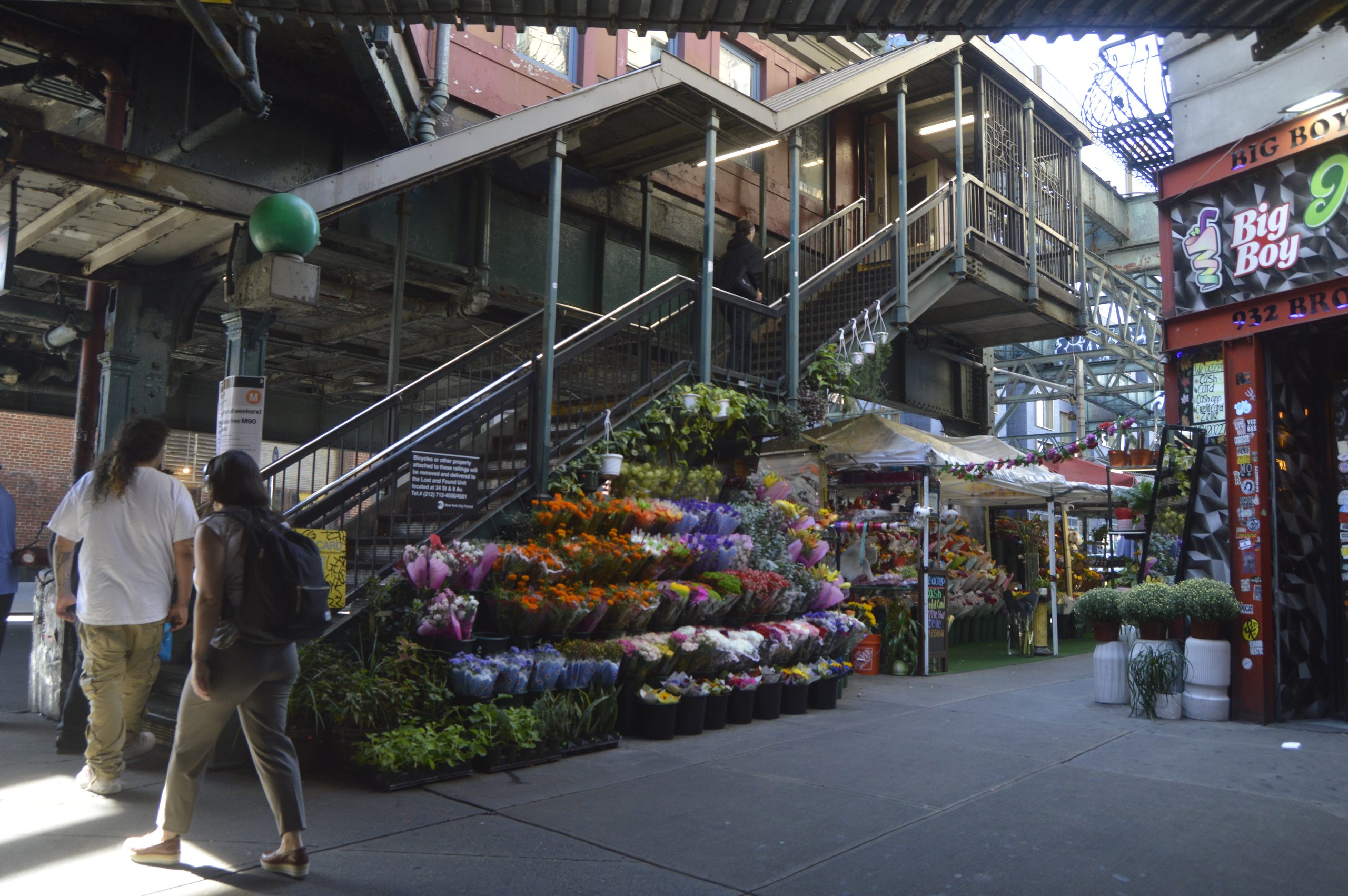
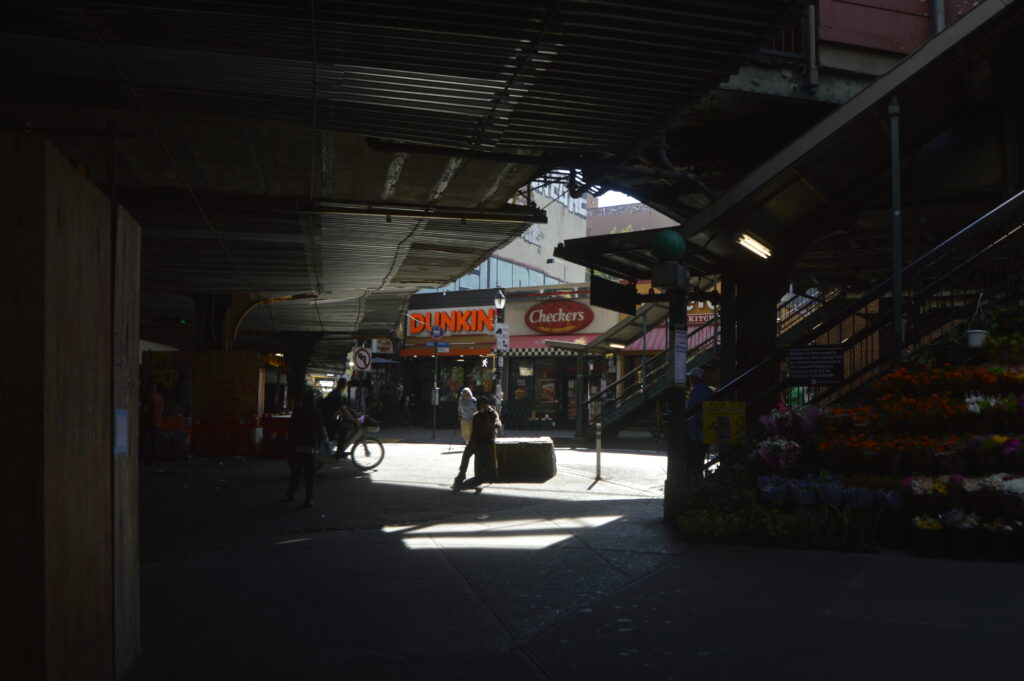
This is how you keep time when you live within three minutes of the Myrtle Broadway JMZ train stop or “live under a bridge”. I had just moved to Bushwick in the summer of 2024 – this warranted a deluge of reels sent my way by friends, cousins and self-proclaimed fortune tellers. The content ranged from documenting a strange trifecta of fast food items you could purchase from the Dunkin’, Popeyes and Checkers under the Stop, christened by TikTokers as the ‘Holy Triad’. Another one was about the potential lead poisoning that everyone was subjected to under the overhead infrastructure repairs. After all, we were going through one of the longest MTA projects of the year, still ongoing.
The last one, which is a fan favorite, documented pre Mayor-dom Mamdani bumping into NYC council member Chi Osse. The reel opens with both of them ascending the twin entrances of the station, colliding into one another at the turnstile, and subsequently sitting down in the train.
Osse opens with: ‘This city is the world’s greatest experiment in human cooperation’
and Mamdani responds with “and there are those who want to tear it down and sell it out.”
I can’t help but wonder: “Is the chaos of the Myrtle Broadway stop part of this larger experiment in human cooperation?”
The most popular reel sent to me was one that narrated the stop as:
“the greatest thing this diseased marble of a planet has ever coughed up, the most divine defiled roach kissed miracle ever squirted out of the universe’s cosmic miscarriage – the Myrtle Broadway stop isn’t a subway station: it’s the Bermuda Triangle of Brooklyn….”
The station hosting the J, M, and Z lines was part of the former BMT (Brooklyn Manhattan Transit corporation) and was originally built and operated by this private company before the City unified the subway systems in 1940. The Myrtle Broadway station was opened in April 1888 and used to house a double elevated train, the ‘Myrtle El’ (short for elevated). Remnants of the old platform, abandoned in 1969, can still be seen today.
According to Thomas Campanella (writer of the oft-quoted Brooklyn: The Once and Future City), the elevated train begets a certain kind of ecological life, a certain synthesis between people and infrastructure. Living close to this infrastructure was less of a choice and more of a circumstantial decision. People were forced to live close to hazardous environmental conditions—i.e., industry—because it was where they worked. Immigrant communities were especially vulnerable to this. The demolition campaigns of the 1930s and 1940s, along with urban planning’s emphasis on the distinction between residential, commercial and industrial zoning, brought about the removal of elevated infrastructure in most of Manhattan. But in some of the outer boroughs, including parts of Brooklyn, the ‘el’s’ still operate.
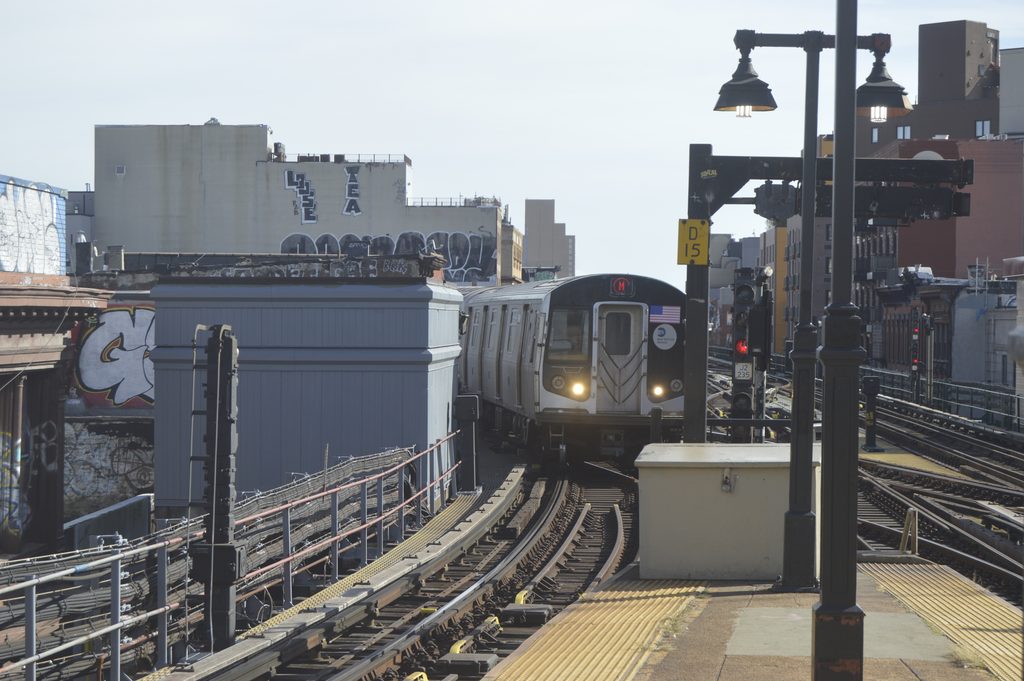
One of the reasons behind the rationale of the campaigns was obvious – maintenance issues were prevalent. The Myrtle Broadway station was unique because it had two levels of tracks. Today, the skeletal remains of the upper second level of the old Myrtle ‘El’ still looms from above when service was shuttered in 1969.The currently active J M and Z tracks on the first level have been operating as early as 1888. In recent repair history, there were two major maintenance processes. In 2017, it took the form of the inclusion of 310 foot long approaches for Junction Ave to assist with smoother transitions for trains between stations. From 2024 to 2025, the second process commenced for steel repairs and the removal of lead paint at six stations. The process of chipping the lead away revealed that the amount of lead present was twelve times the federal hazard limit. Local businesses were greatly affected because the noise and falling debris made potential customers hesitant to enter the area. It feels difficult to imagine the gargantuan task of carrying out repairs of this level while still maintaining varying degrees of subway operationality. The visual effect of the tarps (put up sporadically to catch the chipping paint) for residents and locals translates as a temporary – if not haphazard – repair method. It left many wondering if a different construction infrastructure would have been employed as a result of public pressure were this taking place in one of the city’s more affluent neighborhoods.
Nevertheless, the persistence of the elevated rail here has created unique spatial conditions that produce a cyborg of infrastructure and people, highlighting the ‘public’ in public space. You receive a mixed bag: shade in the summer, darkness in the winter, the screeching trains above mask some of the activities taking place underneath, resulting in the formation of micro territories and in-between grey zones.
What kind of urban life worlds became possible because of the Myrtle Broadway El? Verna Hart’s rainbow colored stained glass windows, which adorn the entrance of either sides of the platform, are part of a series that runs the distance of the JMZ elevated line, aptly called ‘Jammin Under the El’. Musicians in jewelled hues perform a symphony marked by rhythm and punctuated by discord. But what actually happens under the Myrtle Broadway platform? I feel like the English language does not have enough words to describe it—discord alone is not enough. There are a couple of words in Urdu, ‘Ronaq, gehma gehmy’ (hustle bustle? cacophony?), that I see at this intersection. In the absence of functioning traffic signals—you dance (not walk) across the street, to the beats of early 2000s pop music blaring from the corner store and flashing lights from a baseball cap vendor.
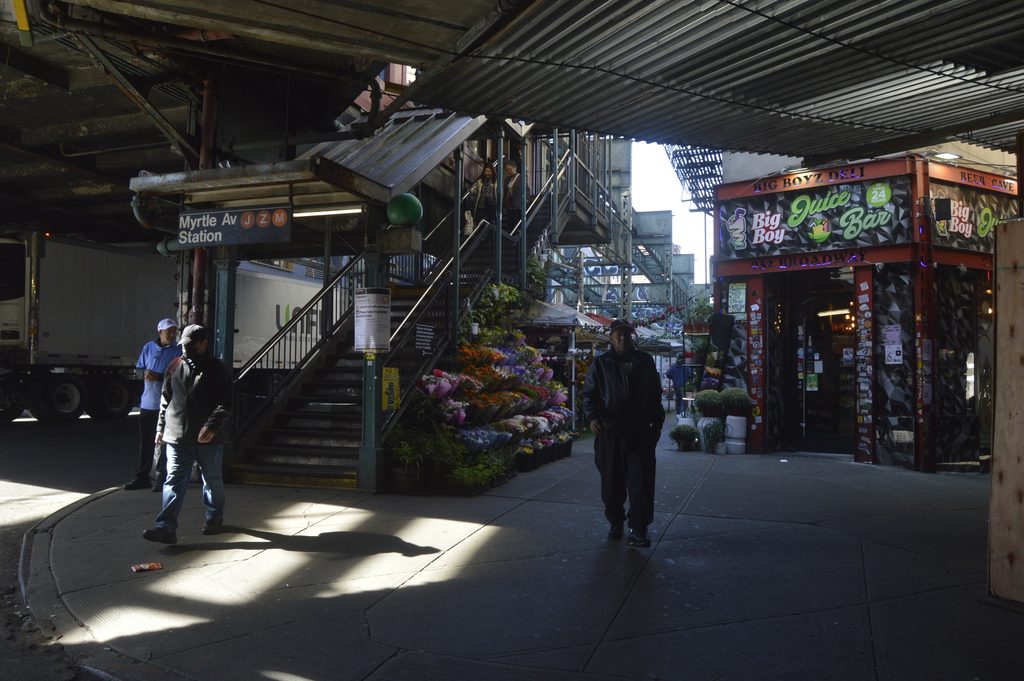
The beast of the Myrtle Broadway subway stop is disruptive and messy. It devours you and you become part of its organic microcosmic (read ‘lead-ridden’) biome. Something that catches you off-guard on both ends of the stop are the flower vendors, almost acting as brackets within the space along Broadway, which divides Bushwick from neighboring Bed-Stuy. You see a twin pair of metal stairs going up to the platform at both ends of the crosswalk. They are painted a deep viridian green (can we call this MTA green?) and are used as overhead hooks to hang plants and flowers or to suspend plastic tarps as a second roof. The stairway acts as a multi-storied bench decorated with plants or crafts depending on the time of year. On this end, the fast food stores, bodegas and delis nearby don’t need to invest in colorful streamers or inflated balloons to act as additional sidewalk advertisements.The flower vendors act as a hook. If you’ve already committed to picking up a bouquet on your way home, maybe you will be unable to resist the olfactory allure of purchasing something deep fried and drenched in hot sauce.
I once tried to have a conversation with one of the flower vendors, attempting to learn more about her experience and whether she had some sort of understanding or agreement with one of the bodega owners. She had signaled to her phone and offered to answer my questions using Google Translate. My many attempts to learn Spanish remain incomplete and thwarted. The beginning of our conversation was quickly interrupted by someone who appeared to be MTA staff. I wasn’t sure if they were part of the ongoing repairs above. They initially seemed to be making a purchase only to whip out their phone and tell the vendor that they wanted to buy the same plant from a cheaper place elsewhere. Defeated, the street vendor was no longer in high spirits or the mood for a conversation and pointed above to the overhead train stairs. I don’t know if she mistook the absence of a purchase for surveillance, but it could be multiple things at the same time. The walls of the bodega nearby are covered in stickers representing the conflicting forces of commercial and civic dialogue on the border of Bed-Stuy and Bushwick. Peeking through invitations to raves and underground clubs the neighborhood is infamous for were calls for protests layered over one another. Some in place, some peeling. The stickers were pasted in the same pastiche as the encounter we had with one another.
The questions I had meant to ask the vendor were left unanswered, leaving me to draw my own conclusions. Asking any questions at all made me feel like Investigator Borlu from China Mievelle’s novel the City and the City. Divided into three parts, the first two parts of the novel present two fictional cities, Besźel and Ul Qoma, which exist on the same geographical plane but whose citizens are trained to unsee one another. Bright orange sticky note scraps define my copy at the center where I join investigator Borlu in finally seeing the city of Ul-Qoma, where his investigation has taken him. A number of phrases from the novel, which initially meant nothing to me, start to materialize: Seeing? Unseeing? Crosshatch zones? Patchwork? By following Detective Borlu of the extreme crime squad while he unravels the murder of a woman, Mahalia Geary, I felt as if I too was simultaneously walking through the two different fictional cities. To perceive both simultaneously constitutes a catastrophic act. The final part of the book, Breach, examines such an act; it is both the name of such a ‘crossing’ (seeing the other) and the name of the ‘border police’ that enforces the cities’ perceptual divide. The third city, Orciny, supposedly hidden between them, is mythologized—to what end is revealed only at the very end of the novel.
Here at Myrtle Broadway, it felt like I had stepped into one of the crosshatched zones between the fictional cities, as if attempting to give words to what was happening was an act of breach. Was the Myrtle Broadway Junction perhaps the third city Orciny? Existing at the crosshatch of the subway that riders had to travel on, that pedestrians and cars had to travel under, negotiating with one another in the absence of operational traffic lights? Was there an unseen, unspoken alliance between the street vendors and the trifecta of fast food restaurants where both agreed to co-exist with one another, or simply un-see each other?
Why do you live under a bridge anyways?
Nearby Myrtle Broadway, my former roommates and I had also fallen into somewhat of a chaotic grey zone, trying to ‘self-help’ our way into a solution—not too different from the repairs around the Myrtle Broadway stop. We were (resisting) if not ‘revolting’ – against – not a landlord, but a failing real estate investing app that wanted to ‘revolutionize’ investing while letting the building fall into slow disrepair. ‘Revolutionizing’ to them meant cutting out any form of building maintenance and roundabout responses to major complaints like carbon monoxide leaks, mold, roof leaks and a tree growing into the foundation. After a multitude of 311 complaints, obsessing over the court case finder database and calls to our local city council member, what were we to do? We had a meeting with our neighbors for the first time in February 2025, where we found out someone had come to ‘shake-down’ our first floor neighbors, ending the conversation with: ‘Why did we want to live under a bridge anyways?’
As an international student from Pakistan, I didn’t fully take stock of what I was getting into. But at first, naively, I was not offended by the suggestion of living under the ‘bridge’. I was only intrigued. What did ‘living under the bridge’ imply? Were we not just terrified tenants but maybe in fact empowered trolls (at least to the real estate company?), protected by NYC tenant courts, equipped with a ton of promised rights. This was almost intoxicating to imagine. Witnessing the flower vendors under the elevated train tracks, the MTA cyborg and the symbiosis that took place, it was hard not to think of AbdouMaliq Simone’s assertion that it is truly people who are infrastructure. Could my neighbors come together? Form some alliances ourselves? Simone asks us to rethink what we envision when invoking the word ‘Infrastructure’. What usually comes to mind are “reticulated systems of highways, pipes, wires or cables” or in this case—the JMZ lines that clatter above on the elevated train. These built and engineered systems are viewed as making the city productive. Instead, he spoke of a different infrastructure that is linked to people’s day to day activities in the city. He urges us to witness how objects, spaces, persons and practices combine and converge with one another to become an infrastructure. And so, in all of the relationships that exist to make a cacophonous zone like Myrtle Broadway possible, maybe what we’re looking at is a string of unlikely collaborations?
But why was the grey space underneath the elevated train on my mind? What was so rattling about the presence of flower vendors in front of the trifecta of fast food chains? What did the presence of a slice of temporary informal economy seeking refuge underneath say about the ‘under-renovation’ transport infrastructure above? The corrugated metal sheeting above turns the sidewalks into true interstitial spaces where public and private become blurry: flower vendors, informal commerce, passengers, ‘New Yorkers’, immigrants, American transplants, sojourners, tourists, all occupy the public transport system of the subway. Perhaps we end up with a space that is meant to be truly public. Accompanied by a sidewalk that is more intimate (not safe by any account, but covered, with increased chances of friction), it represents a network of routes in and out of the area that can only be traversed with a shared understanding between you and your fellow sojourners.
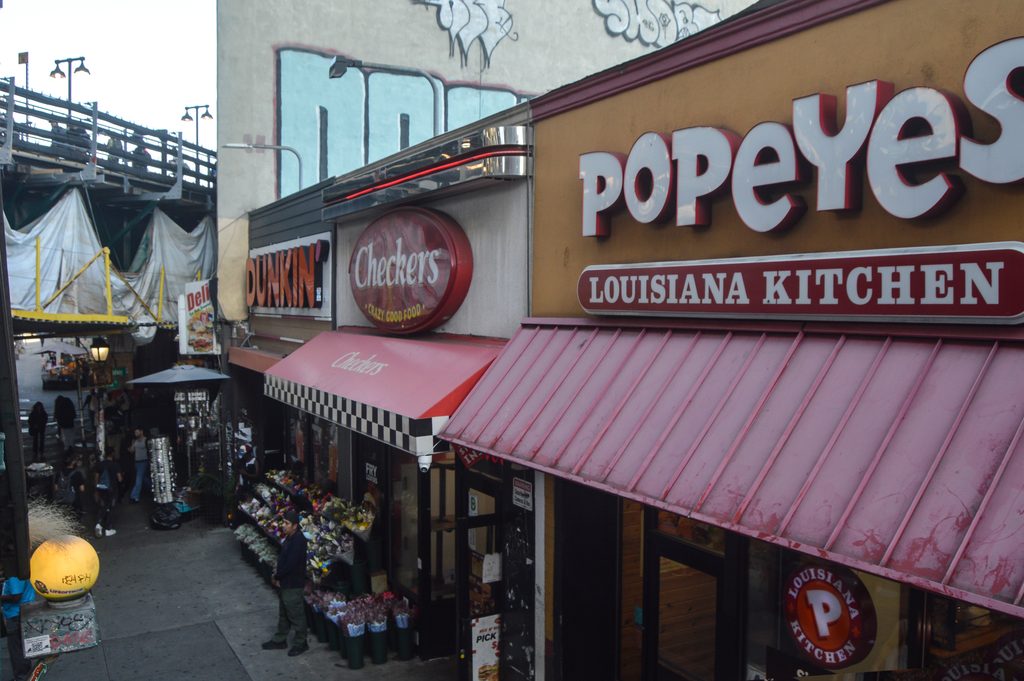
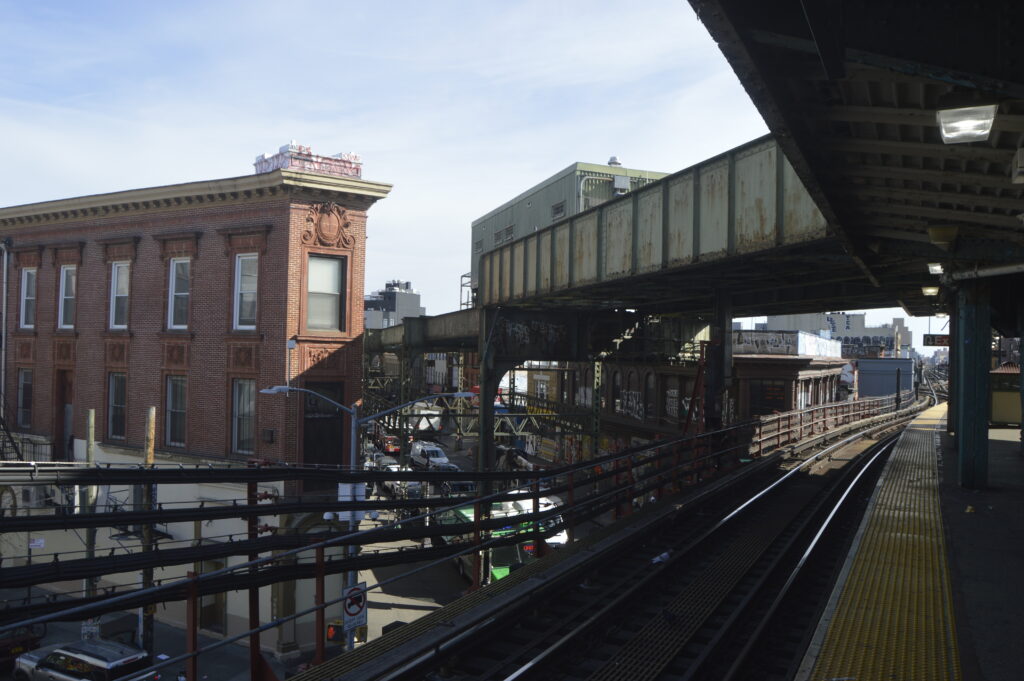
So, why this neighborhood? By the standards of many debates on belonging in New York (see Harmeet Kaur’s piece in CNN), my relationship to the city can be termed as ‘precarious’. But like many others, I see reflections of my own city, Karachi, through the cracks and repairs. The tell-tale relationship between hyper real estate development, growing urban instability and how city dwellers renegotiate embodiment in public space is not a story unique to NYC. Maybe to see alternative ways of imagining and inhabiting public spaces, we need to seek these reflections and correlations?
Finding a point of convergence among movements in a rapidly gentrifying Bushwick can be difficult. Tenant unions struggle against landlords and the real estate mafia, who dismiss maintenance concerns on the grounds of aging buildings. In recent days, longtime residents struggle to rally enough support and recognition to save a cherished community space subject to arson; the neighborhood recently lost the ‘leaning-steeple’ and the entirety of the Bushwick church. The maintenance of the church was an ongoing community-led endeavor to preserve a landmark structure. The towering structures of a church steeple or the seemingly resilient steel frame of an elevated rail can only be maintained and repaired as long as it is held up by people as infrastructure. We can only truly keep and preserve places and spaces that are held together by networks and at times unlikely collaborations of the public. I wondered what sort of alliances need to be made in order to stay somewhere? For now, the wider debates in the area around affordable housing and historic preservation are siloed against one another: something that connects them all is ‘demolition by neglect’, through which we lose the things that we fail to maintain and care for. I now leave you with a hypothetical scenario: I wonder what the Bushwick Historic Preservation Association (HPA) and the members of the tenant union feel when they encounter the flower vendors. Perhaps they too might recognize a reflection of themselves. What might the HPA say of the flower vendors? They might think, ‘okay – this is not an old building but maybe what we are witnessing is something beautiful. And this is something we must protect.’ What might the Bushwick tenant union see of themselves in the flower vendors? It is even simpler. They are here, they have been here and they have a right to be here. The flower vendors hold both of those truths.
Radhya Kareem’s passion lies in understanding the connection between the conservation of built environments and natural ecologies. She holds an M.S. in Historic Preservation from Pratt Institute, where she conducted research into how preserving the past can help communities envision solutions for the future. She focused this work on port cities like Karachi, her city of origin, and her current home, New York City. Radhya also holds a Bachelor of Architecture from the Indus Valley School of Art and Architecture, which continues to shape her academic and professional journey. A recipient of the Aga Khan scholarship program, she is deeply interested in informal and tactical urbanism and participatory planning with the goal of developing new theories of a subaltern approaches to preservation. Her work merges built and intangible heritage, exploring architectures of necessity and jugaad as potential ways to re-negotiate identity and re-evaluate policy within urban contexts. As a Ph.D. student at The New School, Radhya employs a multi-layered cartographic approach to understanding the cities where she has lived, identifying intersections and points of convergence across diverse experiences. Her aim is to celebrate diversity and promote pluralism in the built and lived environments. Outside of the studio, she can be found capturing the beauty of urban nature through photography and drawing. A key pursuit for her is to find the best biryani in New York City.