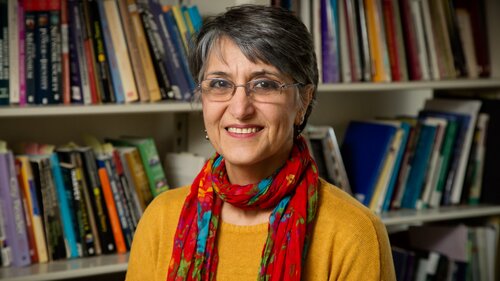
The following is a transcription of Faranak Miraftab’s speech delivered upon receiving the 2025 Association of Collegiate Schools of Planning (ACSP) Distinguished Educator Award at the ACSP Annual Conference held in Minneapolis from October 23rd to 25th.
Good morning. Thank you so much for your generous introduction.
I received the email about this unexpected honor a week into the American-Israeli bombardment of my birth city, Tehran-a time of horror and anxiety for the safety of family, friends and innocent residents of a densely populated city of 18 million.
It is in this context that this award compels me to consider again the other upheavals in my life and career, and remember with deepest gratitude those who have lifted me up and seen me through stages of my journey. I sincerely thank all the family, friends and colleagues whose love and support sustained and inspired me and on whose work I have had the privilege to build. Time limits me to recognizing only some of them here.
My gratitude
-to the ACSP selection committee,
-to my nominators Marc Doussard and Hiba Bou Akar and to the colleagues who wrote letters in support,
-to my wonderful urban planning colleagues at UIUC with their indispensable support,
-to my students, past and present, who motivate my work,
-to grassroots communities and leaders who trusted me with their stories, and who keep me honest and committed to their cause,
-and to my partner in life and crime, Ken Salo, with whom I argue constantly about ideas and the “so what” of our work.
Most importantly I recognize the responsibility I feel for the platform this award offers me. So I wish to share key moments of my journey in the hope it might be helpful in finding a way forward.
It may (or may not) come as a surprise that my relationship with ASCP has been a rocky one. As a PhD student, I felt out of place at the annual meetings and an intruder among Berkeley’s planning students: my dissertation research on gender and low-income housing was planning-related, but my degree was in architecture.
This feeling out of place at ACSP continued even after I took a position in an established planning department at the University of Illinois. This time it was a more substantive alienation: it was the Eurocentrism of planning as a profession rooted in the colonial project of Western domination; it was the nationalist aspirations and methodologies used in planning education; it was the male-centered domination of the planning field.
I remember in one smaller group at ACSP, I said, “as soon as I get tenure, I will never come to ACSP!” But luckily, this did not happen. I kept returning because I found my community within ACSP: I found the Faculty Women’s Interest Group and the Global Planning Educators Interest Group, thanks to Bish Sanyal. Back then, we did not have a Planners of Color Interest Group. I saw that these groups were part of conversations that deeply mattered to me – to bring critical transnational and feminist perspectives into planning education. Together, we then had “fire to burn” at the annual meetings.
Although we have come a long way, some of you might still have that feeling. I share this for those who might feel alienated and out of place. Alienation can also be a productive force. Find your community within this larger ACSP family and “bum your fire” with them: it will warm not only you, but the larger planning community.
My academic career has been, to a certain degree, unusual. My life as a student activist in Iran, a refugee in Norway, and a migrant in the US has, to a great degree, shaped my research among the impoverished communities of Mexico and Chile, racialized township residents of South Africa, and the immigrant workers of the Midwest US. Local communities I worked with perceived my identity differently. Although seen as a rambunctious, wild, and fearless young woman in Iran, I was sometimes pitied as “a poor refugee,” in Chile; or an “oppressed” woman who lived under Islamic rule, in Mexico; and sometimes, celebrated as a “sister” from a Muslim society, in Cape Flats. I have worked through complex dynamics of field research that my academic training had not prepared me for.
Across these settings and through a life of exile, I have grappled with questions of strategy and perseverance: How, in the face of extreme uncertainty and repeated abuse and displacement, do marginalized communities keep fighting? How do they produce hope? In this journey, I have found my answers in the stories of women grassroots organizers I met in marginalized neighborhoods. In how they organize, make community, and resist their dehumanization by politicians and planners. A feminist lens, which my life experience had sensitized me to, uncovered the vital underworld of the “urban poor” and the less-seen daily practices of care by women organizing unassumingly at the center of impoverished and racialized communities. I call this “termite work,” often invisible to those in power but potent in dismantling the structures that oppress and marginalize them. While the city planner, the municipality, the mayor, and all those involved in our dominant forms of urban development (what I call “bully urbanism”) treat these poor communities as “surplus” population, and while these families did not have a state that respected their rights, I saw how they took their needs into their own hands. I learned from their practices of insurgency and resistance beyond the formal arenas of politics and spaces they invented to realize their rights.
I share my journey with you in the hope that it might provide a useful insight for possibilities in our way ahead. This is a different year for ACSP, and we are in a different world since last year. We are seeing the broad attack on academic institutions, we are seeing McCarthyism and censorship of thought and action on our campuses, and sometimes with compliance by university administrators. Hence, in the remaining part of my remarks, I wish to reflect on our responsibility as educators, as planning educators in the time of genocidal violence and rising fascism.
Antonio Gramsci in his prison notes of 1929, before the Second World War, wrote,
“The old world is dying, and the new world struggles to be born: now is the time of monsters.”
We are going through another time of monsters, a time of urgency for us as educators to engage with the birth of something new, the birthing of a new world of planning.
As we grapple with a dying empire, we need to be prepared to bid farewell to the planning profession as we know it. How should planning educators and practitioners, who by and large define their role in relation to the liberal democratic state, redefine their role when the state is not the democratic entity it claims to be? The dying empire has unraveled the veneer of liberal democracy in ways that we did not imagine possible, and Palestine has been a flash point where we see people standing on a clearly just side while their states ignore their will, or even worse, beat them up and criminalize them if they do not align with the genocidal violence.
Arundhati Roy put it well in her recent remarks:
“Under the rubble of Gaza that exists today, are not only dead Palestinians, dead children, dead journalists, destroyed hospitals, destroyed universities, destroyed history, but also the carcass of Western liberal democracy.”
This is the moment where the fallacy of a liberal democratic state in the US and Western Europe is exposed, where the dark reality of the empire is coming home to us, so we need to turn to a transnational perspective in planning education. I find useful insights by looking outside the US or within the US in subordinate communities that have not trusted the formal political machine to serve them. Perhaps they have a thing or two for our new planning education.
I don’t believe in master plans, but along my personal and professional journey I have learned the importance of organizing and being part of a collective, “to burn our fire together” and by doing so keeping hope alive in face of injustice. In these times of monsters, there are many ways that we can do the work of resistance and work toward a new world, a new planning. While some of us might engage in the invisible “termite work” in the underworld of resistance, others might engage using the formal channels available to us such as those at PAB, ACSP, or APA. For example, I wonder if we at ACSP should broaden our association’s 2020 anti-racism statement issued in response to the police lynching of George Floyd in this very city of Minneapolis, to include all forms of racism such as contemporary global apartheids and anti-immigrant racisms? We need to share/ brainstorm, inspire and strategize our efforts and one such opportunity would be at the meeting held by Planners Network in Canada in May on Planning in the Face of Fascism. These conversations and sharing of experiences are crucial to the conception of the new world we so badly need. Every bit, little or big, tilts the scales toward humanity.
I wish to end here by dedicating my award to the younger generation of planning educators and planning students who find my work inspiring and have heartened me with their enthusiasm. I share this award with you all!
Faranak Miraftab is a Professor of Urban and Regional Planning at the University of Illinois, Urbana-Champaign, USA. As an urban scholar of globalization, Miraftab’s scholarship sits at the intersection of planning, geography, feminist studies, and postcolonial studies. Her interdisciplinary research is empirically based in cities of Latin America, southern Africa, the Middle East, and North America. Her research and teaching concerns global inequalities, in particular the global and local processes involved in the formation of cities and citizens’ struggles to access dignified urban livelihoods. She investigates social and institutional aspects of urban development and planning that address basic human needs, including housing and urban infrastructure and services that support it— particularly how groups disadvantaged by class, gender, race, or ethnicity mobilize to obtain resources such as shelter, basic infrastructure, and services and how institutional arrangements facilitate and frustrate provision of and access to vital urban resources. Her most recent book, Global Heartland, which received the Paul Davidoff award in 2017, reveals global displacement and emplacement by migrant laborers and the army of families and institutions in their communities of origin that make for revitalization of the US Rust Belt.